CHAPTER VI
WHEREIN WE BECOME A TRIO AND JOURNEY
TO ITALY
AS the autumn deepened we found our Red Cross work ending. This
work had taken Henry and me from our quiet country newspaper
offices in Kansas and had suddenly plunged us into the turmoil of
the big war. For days and days we had been riding in motor cars
along the line in France from Rouen to Bacarat and often
ambulances had hauled us--always more or less frightened--up near
the trenches of the front line. We had tramped through miles of
hospitals and had snuggled eagerly into the little dugouts and
caves that made the first aid posts. We had learned many new and
curious things--most of which were rather useless in publishing
the Wichita Beacon or the Emporia Gazette; as, for instance, how
to wear a gas mask, how to fire a trench mortar, how to look
through a trench periscope, and how to duck when a shell comes
226
We Become a Trio and Journey to Italy--227
in. Also we had stood god-father to a serial love affair that
began on the boat coming over and was for ever being "continued
in our next." And it was all--riding along the line, huddling
in abris, sneaking scared to death along trenches, and ducking
from the shells--all vastly diverting. We had grown fat on it;
not that we needed just that expression of felicity, having four
hundred pounds between us. But it was almost finished and we were
sadly turning our faces westward to our normal and reasonably
honest lives at home, when Medill McCormick came to Paris and
tempted us to go to Italy. It was a great temptation; "beyond the
Alps lies Italy," as a copy book sentence has lure in it, and as
a possible journey to a new phase of the war, it caught us;
and we started.
So we three stood on the platform, at the station at Modane, in
Savoy, a few hundred yards from the Italian border, one fair
autumn day, and our heavy clothes--two Red Cross uniforms and a
pea-green hunting suit, made us sweat copiously and unbecomingly.
The two Red Cross uniforms belong to Henry and me; the pea-green
hunting outfit belonged to Medill McCormick, congressman at large
from Illinois, U. S. A. He was going into Italy to study the
situation. As
228--Martial Adventures of Henry and Me
a congressman he felt that he should be really informed about the
war as it was the most vital subject upon which he should have to
vote. So there we stood, two Kansas editors, and an Illinois
congressman, while the uniforms of the continent brushed by us,
in uniforms ourselves, after a fashion, but looking conspicuously
civilian, and incorrigibly middle western. Medill in his
pea-green hunting outfit looked more soldierly than we. For
although
we wore Sam Browne belts, to indicate that we were commissioned
officers--commissioned as Red Cross Colonels--and although we
wore Parisian uniforms of correct cut, we knew in our hearts that
they humped in the back and flopped in the front, and sagged at
the shoulders. A fat man can't wear the modern American army
uniform without looking like a sack of meal. Henry fell to
calling the tunics our Mother Hubbards. We looked long and
enviously at the slim-waisted boys in khaki; but we never could
get their god-like effects. For alas, the American uniform is
high-waisted, and a fat man never was designed for a Kate
Greenaway! So we paced the platform at Modane trying to look
unconcerned while the soldiers of France, Italy, Russia, Belgium,
England and Rumania walked by us, clearly wondering what form of
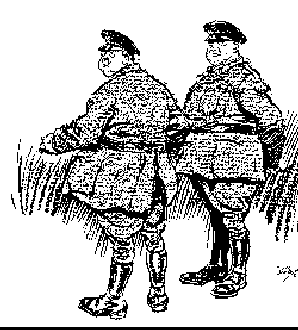
A fat man can't wear the modern American Army
uniform without looking like a sack of meal
(blank page follows)
We Become a Trio and Journey to Italy--231
military freak we were. For the American Red Cross uniform was
not so familiar in those latitudes as it was to be a month later,
when Major Murphy came swinging through Modane with forty-eight
carloads of Red Cross supplies, a young army of Red Cross nurses
and workers, and half a million dollars in ready cash to spend
upon the stricken cities of Northern Italy choked with refugees
fleeing before the German invasion! Today, the American flag
floats from a hundred flag-poles in Italian cities, from Venice
to Naples. Under that flag the American Red Cross has soup
kitchens, food stations, aid bureaus for civilian relief all
along the line of the invader in Italy, and the Red Cross uniform
which made the soldiers' eyes bug out there at the border in the
early autumn, now is familiar and welcome in Italy But we three
unsoldierly looking civilians took that uniform into a strange
country.
Our first evening in Italy was spent in Genoa. And coming direct
from Paris, where men out of uniform were few, the thing that
opened our mouths in wonder was the number of men we saw. There
were worlds and worlds of men in Genoa: men in civilian clothes.
The streets were black with men. Straw hats, two piece suits, gay
neckties--things which were as remote from France
232--Martial Adventures of Henry and Me
as from Mars, figures that recalled the ancient days of one's
youth, before the war; days in New York, for instance, where men
in straw hats and white crash were common. These things we saw
with amazement in Genoa! And then our eyes caught the flashy
bands on their arms--bands that indicated that these men are in
the industrial reserves, not drafted because they are doing
industrial war work. But for all of these industrial reservists
there was an overplus of men in Genoa. It is a seaport and there
were "the market girls and fishermen, the shepherds and the
sailors, too," a crowd gathered from the world's ends, and we sat
under the deep arches before a gay cafe, listened to New York
musical hits from the summer's roof gardens, and watched the
show. In that day--only three weeks before the German
invasion--the war was a long way from Genoa. At the next table to
us an
American sea-faring man was telling an English naval officer
about the adventures of three sailing ships which had bested two
submarines three days before in the Mediterranean; some Moroccan
sailors were flirting across two tables with some pretty
Piedmontese girls, and inside the cafe, the harp, the flute and
the violin were doing what they could to make all our hearts beat
young! A pic-
We Become a Trio and Journey to Italy--233
ture show across the street sprayed its gay crowd over the
sidewalks and a vaudeville house down stairs gathered up rivulets
of humanity from the spray. Somewhere near by was a dance, for we
heard the rhythmic swish and lisp of young feet and the gay cry
of the music. Here and there came a soldier; sometimes we saw a
woman in mourning; but uniforms and mourners were uncommon. The
war was a tale that is told.
But the next day in Rome the war moved into our vision again. But
even if Rome was more visibly martial than Genoa, still it was
not Paris. One could see gay colours upon women in Rome; one
might see straw hats upon the men, and in the stores and shops
the war did not fill every window as it filled the shop windows
of Paris. Rome was taking the war seriously, of course, but
the war was not the tragedy to Rome before the invasion that it
was to France.
Yet there was to me a change in Rome--from the Rome one knew who
had been there eight years before--a change stranger and deeper
than the change one felt in coming from Rome to Paris. This new
Rome was a cleaner Rome, a more prosperous Rome, a happier Rome.
Something had been happening to the people. They wore better
clothes, they seemed to live in cleaner
234--Martial Adventures of Henry and Me
tenements; they certainly had a different squint at life from the
Romans of the first decade of this century. One heard two answers
to the question that arose in one's heart. One group
said: "It is prosperity. Italy never has seen such prosperity as
she has seen during the past ten years. There has been work for
everyone, and work at good wages. So you see the working people
well-clad, well-housed, clean and contented." Another answered
the question thus: "The Socialists have done it. We have had
plenty of work in other years; but we have worked for small
wages, and have lived in squalor. We still work as we always have
worked, but we get better pay, and we get our better pay in many
ways; first in relatively higher wages, next in safeguards thrown
around labour, and restrictions on the predatory activities of
capital. The Socialists in government have forced many reforms in
housing, in labour conditions, in the distribution of the profits
of labour and capital, and we are living in hope of better things
rather than in fear of worse!" One may take his choice of
answers; probably the truth lies between the two.
Prosperity has done something; socialism in government has done
something, and each has promoted the other!
We Become a Trio and Journey to Italy--235
But the war has done one thing to Rome indisputably. It has
paralysed the tourist business. Rome was the greatest tourist
city in the world. But now her boarding houses and her ruins are
deserted. Occasionally in the shops one sees that mother and
daughter, wistful, eager, half-starved for every good thing in
life, expatriated, living shabbily in the upper regions of some
respectable pension, detached from the world about them, uprooted
from the world at home, travel-jaded, ruin-sated, picture-wise
and unbelievably stupid concerning life's real interests--the
mother and daughter who in the old days lived so numerously amid
the splendours of Europe, flitting from Rome to Florence, from
Florence to Lucerne, from Lucerne to Berlin, and thence to Paris
and London, following the seasons like the birds. But today war
prices have sent that precious pair home, and let us hope to
honest work. It is a comfort to see Rome without their bloodless
faces! That much the war has done for democracy at any rate!
And the passing of this "relic of old dacincy," the shabby
genteel of the earth from Rome--even if the passing is a
temporary social phenomenon, has a curious symbolic timeliness,
coming when the working class is rising. It leaves
236--Martial Adventures of Henry and Me
Rome almost as middle class as Kansas City and Los Angeles! For
in Rome one feels that the upper class, the ruling class of other
centuries, is weaker than it is elsewhere in the world. They tell
you flippantly that the king is training his son to run for
president. The high caste Romans have an Austrian pride, that
"goeth before destruction." For politically their power is sadly
on the wane. They are miserably moth-eaten compared to our own
arrogant princes of Wall Street or even compared to the dazed
dukes and earls of England, who are looking out at the wreck of
matter and the crash of worlds about them. One feels vaguely that
these Italian nobles are passing through a rather mean stage of
decay. For a time during the latter part of the last century and
during the first decade of this century, the Italian noblemen
tried to edge into business. They lent their names to promotion
schemes, and the schemes, upon the whole, turned out badly,
and the people learned to distrust all financial schemes under
noble patronage; so the nobility is going to work. A few strong
families remain--the present royal house of Savoy is among the
strong ones.
Our business led us to a call on the Duke of Genoa, uncle to the
King, who in the King's ab-
We Become a Trio and Journey to Italy--237
sence at the front with his soldiers, was a sort of acting king
on the job in Rome. The automobile took us into the first court
of the Royal Palace. Now the Royal Palace--save for a few
executive offices--has been turned into an army hospital and we
saw
doctors and nurses dodging in and out of the innumerable
corridors, and smelled iodoform everywhere. A major domo, in
scarlet, who seemed in the modern disinfected smell of the place
like the last guard of mediaevalism, greeted us as we alighted
from our car; a great, powerful soldier he was, with white and
gold on his scarlet broadcloth. He showed us into a passage where
the minister waited who was to take us to the Duke. The minister
led us down a long stately gallery, out of the twentieth century
into the fifteenth where at the end of the gallery a most
remarkably caparisoned servant stood at attention. He wore a
scarlet coat of unimaginable vividness, a cut-away coat of
glaring scarlet broadcloth. But we could have passed that easily
enough. The thing that held us was his blue plush knee breeches.
It didn't seem fitting that a man in this age of work and wisdom
should wear shimmering blue plush knee breeches for everyday. He
was a big fellow and puffy. And the scarlet coat and blue
breeches certainly gave
238--Martial Adventures of Henry and Me
the place an olden golden air. But alas! The twentieth century
burst in. For he bowed us to an elevator--a modern Chicago
elevator inspected by an accident company, guaranteeing the
passengers against injuries! From the elevator we were emptied
into a nineteenth century corridor, guarded by a twentieth
century soldier and then we were turned by him into a waiting
room. It was floored with marquetry, ceiled with brown and gold
decoration--but modern enough--and walled in old tapestry. The
room expressed the ornate impotent gorgeousness of a useless
leisure class. Four or five tables, cases and stands, backed
standoffishly against the tapestry on the walls, and the legs and
bases of this furniture were great--unbelievably great, rococo
gilded legs--legs that writhed and twisted themselves in a
sheering agony of impossible forms, before they resigned
themselves to dropping to the floor in distress.
Henry nudged me as our Kansas eyes bugged out at the Byzantine
splendour and whispered: "Bill, what this place needs is a boss
buster movement. How the Kansas legislature would wallop this
splendour in the appropriation bill! How the Sixth District
outfit would strip the blue plush off our upholstered friend by
the elevator and
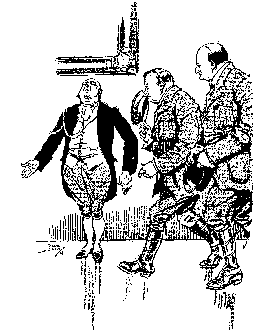
He wore a scarlet coat of unimaginable vividness, a
cutaway coat of glaring scarlet broadcloth
(blank page follows)
We Become a Trio and Journey to Italy--241
send him shinning home in a barrel. Topeka," sighed Henry, deeply
impressed, "never will equal this!"
In this room we met a soldierly young prince, in a dark blue
dress uniform, with a light blue sash across his shoulder. He
shook hands with us. And he wore gloves and didn't say, "Excuse
my glove," as we do in Kansas! But he was polite enough for the
Grand Duke himself; indeed we thought he was the Grand Duke until
we saw Medill and the minister stalking through another door, saw
the minister formally bowing and then we found that we had been
moved into another room--a rather plainly furnished office room,
such as one might find in New York or Chicago when one called on
the head of a bank or of an industrial corporation. We had left
the "days of old when knights were bold," and had come bang! into
the latest moment of the twentieth century. We were shaking hands
rather cordially with a kindly-eyed, bald-headed little man in a
grey VanDyke beard, who wore a black frock coat, rather a low-cut
white vest, a black four-in-hand rather wider than the Fifth
Avenue mode, striped dark grey trousers, and no jewelry except a
light double-breasted gold watch-chain. He was the Duke of Genoa,
who to all intents
242--Martial Adventures of Henry and Me
and purposes is the civilian ruler of Italy while the King is
with the army. We found four chairs grouped around a sofa, and we
sat while the duke, with a diffidence that amounted to shyness,
talked with us about most unimportant things. The interview was
purely ceremonial. It had no relation to the passports we were
asking from his government to visit the Italian front, though
this request had made the visit necessary. Several times there
were pauses in the conversation--dead stops in the talk, which
court etiquette required the Duke to repair. We didn't worry
about them, for always he began to repair these gaps in the talk
rather bashfully but kindly, and always the subject was
impersonal and of indifferent interest. He made no sign that the
interview was over, but we knew, as well as though a gong had
struck, when to go. So we went, and it seemed to me that the Duke
put more real enthusiasm into his good-bye than into his welcome.
It was half-past five. He had been at work since eight. And
perhaps it was fancy, but there seemed to be rising into his
bland Italian eye a determination to knock off and take a half
holiday.
We noticed that his desk was clean, as clean as General
Pershing's or Major Murphy's in
We Become a Trio and Journey to Italy--243
Paris, or President Wilson's in Washington. Then it came to us
that the king's job, after all, is a desk job. The king who used
to go around ruling with a sceptre has given place to a gentleman
in a business suit who probably rings for his stenographer
and dictates in part as follows: "Yours of even date received and
contents noted; in reply will say!" We carried away an impression
that the lot of royalty, like the policeman's lot, "is not a
happy one." Talking it all over, we decided that in the modern
world there is really any amount more fun running a newspaper
than being a king, and for the size of the town, much more chance
of getting things done.
It did not fall to me because of an illness, but a few days later
it fell to Henry and Medill to see a real king at Udine. He was
living in a cottage a few miles out of town in a quiet little
grove that protected him from airplanes. Now Henry's nearest
brush to royalty was two years ago when in the New York suffrage
campaign his oratory had brought him the homage of some of the
rich and the great. Kings really weren't so much of a treat to
Medill, who had taken his fill of them in childhood when his
father was minister to England. But nevertheless they lorded it
over me when they saw me because the
244--Martial Adventures of Henry and Me
king wasn't on my calling list. But they couldn't keep from me
the sad fact that they had started out to make the royal call
without gloves--hoping probably to catch the king with their
bare hands--and had been turned back by the Italian colonel who
had them in charge. Henry once sang in the cantata of "Queen
Esther," and Medill insists that all the way up to the royal
cottage Henry kept carolling under his breath the song: "Then go
thou merrily, then go thou merrily, unto the king!" and also:
"Haman, Haman, long live Haman, he is the favoured one in all the
king's dominions!" just to show that finical colonel who took
them back to Udine for gloves that Wichita was no stranger to the
inside politics of the court. However, gloves seemed to be the
only ceremonial frill required, and they went to the king's
business office as informally as they would go to the private
room of a soap-maker in Cincinnati. They found the king a
soft-spoken little man. Henry said he looked very much like the
mayor of Kansas City, and was equally unassuming and considerate.
He asked his guests what had become of the Progressive party, and
they pointed to themselves as the "captain and crew of the Nancy
brig." Then they talked on for a time about many things--such as
We Become a Trio and Journey to Italy--245
would interest the Walrus and the Carpenter. Then the accounts of
the visit changed. This is Henry's: "Well, finally after Medill
began cracking his knuckles and the king began crossing and
recrossing his legs, I saw it was time to go. I knew how the king
felt. Every busy man has to meet a lot of bores. I sit hours
with bores who flow into the Wichita Beacon office, and I began
to appreciate just how the king felt. So I cleared my throat and
said: 'Well Medill, don't you think we'd better excuse ourselves
to his majesty and go?' The king put up his hand mildly and said:
'O please!' and the colonel in charge of the party gulped at
my sympathy for the king; but I was not to be balked, and we all
rose and after shaking hands around, the colonel led us out. And
I didn't know that I had committed social manslaughter until the
colonel exclaimed when we were in the corridor: 'Oh you
republicans--you republicans, how you do like to show royalty its
place!'"
Medill has another version. He declares that Henry stood the
king's obvious ennui as long as he could, then he rose and cried:
"O King! live for ever, but Medill and I must pull our freight!"
This version probably is apochryphal! The Italian colonel
declares that Henry
246--Martial Adventures of Henry and Me
expostulated: "Well, how in the dickens was I to know that a king
always gives the high sign for company to leave!"
This Italian king is a vital institution. He could be elected
president. For he is a mixer, in spite of his diffident ways.
When the army in Northern Italy was hammering away at the
Austrians, the king was with the soldiers. One gets the
impression that he is with the people pretty generally in their
struggle with the privileged classes. For he has lived peaceably
with a socialist cabinet for some time. He is wise enough to
realize that if the aristocracy is crumbling, the institution of
royalty will crumble with aristocracy if royalty makes an ally of
the nobility. So the king and the Socialists get along
splendidly. Now the Socialists in Italy are of several kinds.
There are the city Socialists, who are chiefly interested in
industrial conditions--wages, old age pensions, employment
insurance, and the like; a group much like the Progressive
party in the United States of 1912. We saw the works and ways of
these Socialists in every Italian town that we visited. Either
they or the times have done wonders. And at any rate this
is the first time in Italian history when industrial prosperity
has so generally reached the workers
We Become a Trio and Journey to Italy--247
that they are lifted almost bodily into the middle classes. Then
there are the Socialists who emphasize the land question, and
they have had smaller success than their industrial brethren.
We went one fine day to Frascatti by automobile. Our road took us
out south of Rome over the New Appian way, through fertile acres
lying in a wide beautiful plain. We passed through half a dozen
little agricultural villages, mean but picturesque. None of the
splendid prosperity of the cities has penetrated here. The people
in these towns are peasants--and look it. They are the peasant
people who live in the canvasses of the artists of the
Renaissance. Half a thousand years has not changed them. Along
the dusty roads we passed huge wine-carts. Two bell-bearing mules
tandem gave warning to other passing carts of a cart's approach.
The driver of the cart was curled up in his shaded seat asleep.
The mules took their way. Carts passed and repassed each other on
the road. Autos whizzed by. Still the drivers slept. They were
ragged, frowsy, stupid looking. They all wore colour, one a
crimson belt, another a blue shirt, a third a red handkerchief
about his head. They would make better pictures than citizens, we
thought. In Rome and Genoa the people would make better
248--Martial Adventures of Henry and Me
citizens than pictures. All day going to Frascatti and coming
home we passed these beggarly looking peasant farmers. At
Frascatti, which stands proudly upon a great hill overlooking the
Roman plain, we saw the rich acres stretching away for miles
toward Rome and beyond it. Villages flashed in the sun, white and
iridescent, and the squares of vineyards and the tall Lombardy
poplars made a landscape that rested the eye and soothed the
soul. We stood looking at it for a long time. With us were some
high officials of the Italian government.
"A wonderful landscape," said Henry to our hosts.
"In all the world there is no match for it," said Medill.
"It has lain this way for three thousand years, bearing crops
year after year!" explained our host.
"Signor," said a friend of our host, "they tell me that this land
yields seven per cent net."
"Yes," replied our host. "I was talking to a man in the
agricultural department about it the other day; it really nets
seven per cent."
"What's this land worth an acre?" This question came from me,
who has the Kansas man's seven devil lust to put a price on land.
We Become a Trio and Journey to Italy--249
"Well--I don't--" Our host looked at his Italian friends. They
gazed, puzzled and bewildered, and consulted one another. The
discussion developed a curious situation. No one knew the price
of that land. With us, out in the Middle West, a boy learns the
probable price of the land in his neighborhood, as soon as he
learns the points of the compass. Finally our host explained:
"The truth of the matter is that this land never has been sold in
the memory of living men. Probably most of it has remained in
its present ownership for from three hundred to five hundred
years. No one sells land in Italy."
And that revealed much; there was the whole program of the
agrarian Socialist. The man on the wine-cart asleep, the peasant
villages, the rags and the poverty, the hovels that we saw on the
rich land and the crumbling aristocracy of Rome, living meanly,
striving vainly, bewildered, and bedevilled, trying to make
profits out of a dormant tenantry, grinding seven per cent out of
the land and yet losing money by it--all these things were the
meat of the answer, which recounted the long unbroken line of
feudal ownership of the land. Wooden ploughs and oxen, women
yoked with beasts of burden, vines and vines planted and
replanted through the centuries; no
250--Martial Adventures of Henry and Me
capital to develop the land; insufficient profits to wake up the
tenants, master and servant going gradually down in a world where
labour and capital, sharing profits equitably, are rising; it was
a disheartening problem.
Then in due course we left Rome and went to the Italian army on
the front, and there we saw another side of the shield. From
Udine in Northern Italy we journeyed into the mountains
where the Italian army at that time was holding the mountain tops
against the Austrians. Wherever we ascended we saw white ribbons
of roads twining up the green soft mountain sides that face
Italy. These roads have been made since the war. Nearly four
thousand miles of them furnish approaches to the Alpine heights.
They are hard-surfaced, low-graded, wide highways gouged into the
mountain side. Two automobiles may pass at full speed anywhere on
these roads. And all night they were alive with wagon trains
bearing supplies to the front. Women help the men mend the roads.
We saw few Austrian prisoners at work on the Italian roads;
possibly because we were too near the front line trenches to see
prisoners who are kept thirty kilos back of the line, and
possibly because they have better work for the Austrians--work
that
We Become a Trio and Journey to Italy--251
old men and women cannot do. Whenever we threaded our way up a
mountain side and came to a top, we found its flanks tunnelled
with deep wicker-walled, broad-floored, well-drained trenches,
and its top honeycombed with runways for ammunition and with
great rooms for soldiers and holes for gun barrels. Mountain
top after mountain top has been made into a Gibraltar by the
Italians. That Gibraltar was 300 miles long, before they lost it
to the Germans. But they had few guns in their fortress. They
showed us emplacement after emplacement without a stick of
artillery in it. They had told the French and the English of
their plight, and a few artillery companies had been sent in;
but only a fraction of the need. There was no central council of
the allies then. Every nation was running its own little war, and
Italy was left to fall, and now the four thousand miles of
Italian roads, and the 300 miles of Gibraltar are German military
strongholds that will have to be conquered with our blood and
iron. Probably no battle line in the world today is more
interesting than the Italian front was in the autumn of 1917. The
south face of the Alps often is green and beautiful but generally
the northern faces of those mountains are bleak and rugged and
steep.
252--Martial Adventures of Henry and Me
The battle line ran a zig-zag course through the mountains, now
meeting in gulches, now scurrying away up to mesas, again
climbing to the top of the barren heights. We stood one sunny day
on a quiet sector of the Pasubio. We were with the Liguria
brigade, the 157-158th infantry. Through a peep-hole in the
trench we looked across a gulch to another mountainside and saw
there the Austrian trenches, not 200 yards away. Before them lay
the ugly scar of brown rusted barbed wire, and just below the
wire, sprawled out on the white limestone of the steep
mountainside, lay fifty dead Italian soldiers who had vainly
charged into the machine guns up that formidable slope. They had
lain there for weeks. It was the grisliest sight we had seen
during our adventures.
Medill and Henry went to another lookout, leaving me with the
Italian soldiers in the trench. Their luncheon came up, a fine
rich soup, with bread cubes in it, some potatoes and vegetables.
It looked palatable and was good. There was enough, but not
plenty. As we sat in the trench waiting for Henry and Medill, one
of the heroes beside me, after thinking it all out carefully,
burst forth with this:
"I livea in Pittsburgh."
We Become a Trio and Journey to Italy--253
It was plain to his comrades that he had put his meaning through
to me. They clearly were impressed by his prowess. This cheered
him up. He went on to further linguistic feats.
"Is, I live-a there five year."
That also got over and his comrades realized that he was a
polyglot. Then in a joyous spirit of over-confidence, he waved
the oriflamme of speech in our faces.
"Is, my papa he live-a in Brooklyn. He keepa da butcha shop and
is make da roast bif. Is, my papa's broader he live-a in Brooklyn
too. He keepa da saloon and is make da jag!" Then we shook hands
as fellow Americans.
In another hour we had wormed our way through the tunnels to the
other side of the peak, and had scrambled down the mountainside
to the general headquarters. Never since Hannibal's day were more
interesting brigade headquarters established. They were niched
into the mountain side about 4,000 feet above a gorge below. The
sleeping quarters and offices were half tunnelled into the
hillside. The diningroom was mounted on a platform overlooking
the gorge below. Across the gorge a quarter of a mile away an
aerial tram ran. That morning two airplanes--an Italian plane and
an Austrian--
254--Martial Adventures of Henry and Me
met out by the tram wire in a battle. It could be seen as easily
from the diningroom platform as if it had been half down the
block; yet the airmen were 4,000 feet in the air. We had luncheon
at the brigade headquarters, and it was made a gala occasion.
Some one had brought in an Austrian cow which was brigade
property and we had real cream. Otherwise it was a war dinner. We
had hors d'ouvres--thin sliced dried ham, sausages, and
sardines--a delectable paste with parmesian cheese on it, roast
beef and
brown potatoes, salad and broiled chicken, and then the chef
d'ouvres, the cream upon a charlotte russe! After that came
cheese and coffee. Chianti and a cider champagne were served. The
mess was proud of itself, as it should have been. But it seems
sad to think how soon that Austrian cow went home. For within
three weeks from the time we sat there, the general had
surrendered in the gulch below the air-tram wire and the Germans
had come with their big guns to fill the vacant emplacements!
We spent one night on our journey along the Italian front at
Vicenza, and there, although the place was jammed full of
soldiers, we left the war behind to stroll by moonlight over the
beautiful mediaeval town. There is a fine square
We Become a Trio and Journey to Italy--255
there--not so broad as the square at St. Mark's where the
tourists used to feed the doves, but to me it seemed as
beautiful. For upon the square was the famous arcade which
Palladio erected around the city-hall of the place. It stood
beautiful and gloomy before us in the moonlight, one of the
world's real bits of architecture. As Americans we had a special
interest in the arcade because it was typical of the best of
Palladio's work and our own Thomas Jefferson, studying it, had
reproduced it and Americanized it in some of the buildings of the
University of Virginia, buildings that have had a distinct
influence upon American architecture! A number of Palladio's
other works we saw that night, softened and glorified by the
moonlight. And we saw also an old French house, not twenty-five
feet wide, but a gem of French architecture erected before the
discovery of America. Finally we went back and stood by the
statue of Palladio and listened to the low rumble of the guns on
the front and wondered what the Germans would do with such a
lovely thing as this Vicenza if by any chance they ever took it.
That day we had looked down from a mountain-top upon an Austrian
town lying peacefully in the valley below us directly under the
Italian guns. The guns of the Austrians
256--Martial Adventures of Henry and Me
and the Italians were smashing away at each other from the
mountain-tops over and across the town.
"You could pulverize that town easily enough," Henry said to the
Italian who was taking the Americans through the trenches.
"Oh, yes," he answered. "But it's a beautiful little town! Why
ruin it?" His theory was that if the Italians took it they would
want it whole and would want the loyalty and respect of the
people of the town: if they did not take it, why smash a
beautiful little town just to be smashing?
The German theory, of course, is exactly opposite to this. They
would smash the town, if they were to take it, to put fear into
the hearts of the inhabitants and command obedience; and if they
knew they could not take it they would smash it to cripple the
enemy that much! We of the Allies desire respect and loyalty that
come from reason. The Germans demand unreasoning obedience and
denied that, they destroy. One philosophy is Christian; the other
Babylonian. But the devilish strength of the German philosophy
came to us more forcibly in Italy than it came elsewhere because
of certain contrasts. They were contrasts in what might be called
We Become a Trio and Journey to Italy--257
public wisdom. The Germans take better care of their poor than
some of the Allies. The Germans know that poverty is a curse to a
nation, and during the past generation they have done much to
alleviate it. And in alleviating poverty they have kept their
poor docile; and they go into battle feeling that they have
something to fight for. In the allied countries too often we
have let the devil take the hindermost. As we rode one afternoon
from Vicenza to Milan we wondered, looking at the farms and the
farmers along the road, why those farmers should be asked to die
for a country that kept them in so low an estate. And yet they
were better off than the farmers of Southern Italy. But in
socializing industry the Italian farmer has been forgotten, and
when the press came upon the Italian front, thousands of ignorant
peasant soldiers lay down their arms, deluded by a German spy
ruse so simple that it should have fooled no intelligent soldier.
But they were not intelligent. Their intelligence had been eaten
up by their landlords for generations, and in a crisis the German
civilization overcame its enemy! You cannot shake the sleeping
peasant on the wine-cart from a thousand years' sleep and make
him get up and go out and whip a soldier who is even half awake!
258--Martial Adventures of Henry and Me
As we rode from Vicenza to Milan we had a curious experience.
There entered our compartment at twilight one of the carabinieri!
We had been looking with admiration at the carabinieri for days.
They were well-set-up soldiers, apparently of a picked grade of
men, who wore wide cocked hats, like those worn by the British
troops in the American revolution. The cocked hats of the Italian
carabinieri are as wide as their handsome shoulders and they make
striking figures. This one who entered our compartment was
drunk--grandly, gorgeously and sociably drunk. He wanted to talk
to us.
He tried Italian and we shook our heads. Then Medill tackled him
in French and he shook his head. Then Henry squared off and gave
him the native Kansas English--with appropriate gestures. But the
Italian sighed amiably and it was clear he was balked. Then he
looked up and down the outer corridor of the car, came in, shut
the door and smiled as broadly as his cocked hat.
"Sprecken sie Deutsch?" he asked, and Medill answered,
"Seemlich!" When it was apparent that two of us understood
German he opened up. He had to talk slowly, but he was willing
to make any sacrifice to get conversation going. He rambled along
in a maudlin way, and finally
We Become a Trio and Journey to Italy--259
picked up an illustrated paper containing an account of the Turin
riots, which angered him, and then and there being, that Italian
soldier told us in German the story of what he called der grosser
rebellion! To talk German in an allied country today is as much
as one's life is worth. For a soldier to talk German is a crime;
for a soldier to tell three foreigners about a riot in his
country, which he, as a soldier behind machine guns had to
suppress, killing hundreds, was mighty near to treason. And we
gasped. We thought he might be testing us out as potential spies.
So we shut up. But he ambled on, and slowly, as the liquor
overcame him, he ran down and went sound asleep with the
offending paper in his arms. Perhaps he was one of those Germans
wearing the Italian uniform who in the German drive three weeks
later gave commands to the ignorant peasant regiments to lay down
their arms and surrender! At least it was reported in Europe that
thousands of them abandoned their works under the command of
German spies!
When we arrived at Milan we found there waiting for us a note
from the Gilded Youth, whom we had met coming over on the boat
from America. And it brought back our everlasting love affair. It
is curious how that love affair
260--Martial Adventures of Henry and Me
kept projecting itself into the consciousness of two middle-aged
men who reasonably may be supposed to have passed out of the zone
of true romance. But the memory of the hazel eyes of the Gilded
Youth as he gazed at the pretty face of the young nurse there in
the moonlight at Landrecourt, with such exaltation and joy, kept
bobbing back into our minds as we saw other lovers in other
lands, married and single, crossing our paths. And there was the
Young Doctor, diffident and reticent, who had his heart set on
the girl, and the contest furnished us with a deathless theme for
speculation. And here at Milan came this letter--just a note
forwarded from Paris--telling us that the Gilded Youth could
"stand and wait" no longer; he was going to hit back. He had quit
the Ambulance service for aviation. And he was in a training camp
near Paris. We wondered how many times during his training he
would slip across the sky to Landrecourt to visit his true love.
The one-horse buggy had been the only lover's chariot known to
Henry and me, and we remembered how a red-wheeled cart used to
lay out the neighbours in the heroic days of the nineties. So in
our meditative moments we considered what a paralysing spectacle
it would be for the neigh-
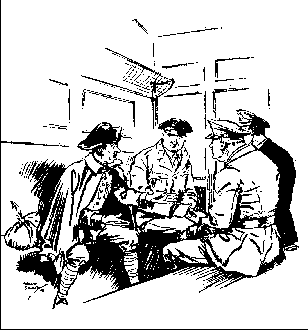
We thought he might be testing us out as potential
spies
(blank page follows)
We Become a Trio and Journey to Italy--263
bours to see a young man come swooping down upon his lady love's
bower in an airplane and Henry, who was betting on the Gilded
Youth as against the Doctor, began taking even money again!
Milan we found today is an industrial town, entirely modern,
dominated not by the cathedral as of old, but by the spirit of
the new Italy. They took us to a luncheon given by the American
chamber of commerce. We heard nothing of their antiquities, and
little of their ruins. We had to fight to get time to see the
cathedral, whose windows are boarded up or filled with white
glass; but the Milanese were anxious to have us see their great
factories; their automobile works, their Caproni airship plant
and the up-to-the-minute organization of industrial efficiency
everywhere. Here in Milan we saw thousands of men out of uniform,
but wearing the ribbon arm-band of the industrial reservists. We
fancied these Milanese were bigger, huskier men than the men in
the south of Italy, and that they looked better-kept and
better-bred. They certainly are a fierce and indomitable people.
The Austrians don't raid the Milanese in airships. They said that
once the Austrians came and the next day the Milanese loaded up a
fleet of big
264--Martial Adventures of Henry and Me
Capronis with 30,000 pounds of high explosives, sailed over
Austria and blew some town to atoms. So Milan has never been
bothered since as other border towns of Italy have been bothered
by air-raiders. The days we spent in Milan were like days in a
modern American industrial city--say Toledo, or St. Paul or
Detroit or Kansas City.
Turin is similarly modern and industrial. though not so beautiful
as Milan. In Turin we saw the scene of the riot--the "grosser
rebellion," which our carabinieri friend told us about. Signor
Nitti, now a member of the Italian cabinet, who entertained us in
Rome, told the Italian parliament--according to the American
newspapers--that the millers caused the riot. The bread ration
did not come to Turin one morning, and the working people struck.
Nitti says the millers were hoarding flour and caused the delay.
The strike grew general over the city. Workers wandering about
the town were threatened with the police if they congregated.
They congregated, and some troops from a nearby training camp
were called. The troops were new; they were also friends of the
strikers. They refused to fire. Then the strikers built
barricades in the streets and in a day or so the regular troops
came down
from the mountains with machine guns, fired on the barricades and
when hundreds were hit the rebellion was quelled. And Signor
Nitti says it was all because some profit hog stopped the
ordinary flow of flour from the farmer to the consumer of bread!
There is, of course, the other side. They told us in Turin that
boys in their teens were found dead back of the barricades with
thousand lire notes in their pockets, and that German agents came
during the first hours of the strike and spread money lavishly
to make the riot a rebellion. Probably this its true. The
profiteer made the strike possible. It was an opportunity for
rebellion, and Germany took the opportunity. Always she is on
hand with spies to buy what she cannot honestly win.
Reluctantly we turned our faces from Italy to France. Yet the
journey had been well worth while. We came home with a definite
and hopeful impression about Italy. The Turin riot, bad as it
was, was not an anti-war riot. It was directed at the bad
administration of the food controller. Italy then was not an
invaded country, as France was, and had no such enthusiasm for
the war, as a nation has when its soil is invaded. Italy has that
enthusiasm now for the war. We saw that her man-power was hardly
tapped. She
266--Martial Adventures of Henry and Me
has millions to pour into the trenches. She needs and will need
until the end of the war, iron and coal. She will have to borrow
her guns and her fuel. But she has almost enough food. We found
sugar scarce; butter scarce, and bread sharply allowanced in
hotels and restaurants. We found two meatless days a week besides
Friday and found the people, as a rule, observing them. We found
the industries of the nation turned solely toward the war. Italy
realizes what defeat means. The pro-Austrian party which was
strong at the beginning of the war has vanished, and since the
invasion, even the Pope has lost his interest in peace!
But all these things are temporary; with the war's passing they
will pass. The real thing we found was an awakening people,
coming into the new century eager and wise and sure that it held
somewhere in its coming years the dawn of a new day. That really
is the hope of the war--an industrial hope, not a political hope,
not a geographical hope, but a hope for better things for the
common man. It is a hope that Christianity may take Christendom,
and that the fellowship among the nations of the world so
devoutly hoped for, may be possible because of a fellowship among
men inside of nations.
|


