CHAPTER V
IN WHICH WE DISCERN THINGS "BY THE
DAWN'S EARLY LIGHT"
AT the close of one fair autumn day our car developed tire
trouble, in a village "Somewhere in France," not far from the
headquarters of the American Army. There are four excellent
reasons for deleting the name of the town. First, the censor
might not like to have it printed; second, because the name of
the place has escaped my memory; third, because there is a
munition factory there and it should not be mentioned, and
fourth, because even if the name of the place returned to me, its
spelling would get lost in transit. In passing it should be said
in this connection that it seemed to Henry and me that the
one thing France really needed was a pronounceable language and
phonetic spelling. The village where we stopped really was not a
village in the Kansas sense; it was twice as big as Emporia and
nearly half as big as Wichita, which is
175
176--Martial Adventures of Henry and Me
70,000. But the thing that made the place seem like a village to
us was the town crier. As we sat in the car he came down the
street beating a snare drum and crying the official news of the
sugar ration; he was telling the people where they could get
sugar, how much they should pay for it and how much they should
use for each member of a family a month.
"Why," asked Henry of an English speaking bystander," don't you
put that in your daily newspaper; why keep up the old custom?"
"We have no daily newspaper," answered the inhabitant.
"All right, then, is there any reason why the news won't wait for
the weekly?" asked Henry.
"And we have no weekly and no monthly and no annual. We have no
newspaper in this town."
That stumped us both. In America every town of five thousand has
its daily newspaper, and frequently two dailies, and in the West
every town of five hundred people has its weekly newspaper. With
us the newspaper crystallizes public sentiment, promotes local
pride, and tries to be the social and intellectual centre of the
community. A community of twenty-five thousand without a
newspaper--and we found that this community
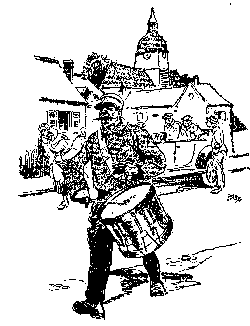
As we sat in the car he came down the street beating
a snare drum and crying official news of the
sugar ration
(blank page follows)
"By the Dawn's Early Light"--179
never had supported a newspaper--was unthinkable to us in terms
of any civilization that we knew. How do they know about the
births, deaths, and marriages, we asked; and they told us that
the churches recorded those things. How do they know about the
scandal? And we remembered that scandal was older than the press;
it was the father of the press, as the devil is the father of
lies. How do they know how to vote? And they told us that
newspapers hindered rather than helped that function. How did
they record local history? And in our hearts, we knew who had
recorded so much local history, that most of it is not worth
recording and that tradition takes care of what is left. But how
did they manage to create a town spirit, to vote the bonds for
the city waterworks, to establish the public library, to enforce
the laws, to organize the Chamber of Commerce, to get up
subscriptions for this, that or the other public benevolence ?
And men shook their heads and said: Water has run down hill
many years; perhaps it will keep on running, even without a
newspaper.
It was a sad blow to Henry and me, who thought our calling was a
torch-bearer of civilization. Indeed, one may digress and say
that we found the whole estate of the press in France
180--Martial Adventures of Henry and Me
rather disenchanting. For advertising is not regarded as entirely
"ethical" in France. The big stores sometimes do not advertise at
all; because people look with the same suspicion on advertising
drygoods and clothing merchants as we in America look upon
advertising lawyers and doctors. So newspapers too often have to
sell their editorial opinions, and the press has small influence
in France, compared with the influence of the press in what we
call the Anglo-Saxon countries.
But in that French village of twenty-five thousand people without
a newspaper we found a civilization that compared favourably with
the civilization in any American town. While the tire was going
on it developed that a cog had slipped in the transgression of
the car--or something of the sort, so we were laid up for an
hour, and we piled out of our seats and took in the town. We
found four good bookstores there--rather larger than our
bookstores at home. We found two or three big co-operative stores
largely patronized by industrial workers and farmers, and they
were better stores by half than any co-operative stores we had
seen in America. For with us the co-operative store is generally
a sad failure. Our farmers talk big about co-operation, but they
"By The Dawn's Early Light"--181
sneak around and patronize the stores that offer the best
bargains, and our industrial workers haven't begun to realize how
co-operative buying will help them. We found no big stores, in
the American sense, but we found many bright, well-kept shops. In
electrical supplies we found the show windows up to the American
average, which is high indeed; but in plumbing there was a sag.
We discovered that the town had comparatively few sewers. The
big, white-tiled bathroom with its carload of modern fixtures
which adorns the show window of at least one plumber's shop in
every American town--we missed. The bathtub is not a household
need in France. Yet some way we surmised that if our towns could
have better bookstores and fewer bathtubs we might have felt
easier in our minds for the palladiums of our liberties. And it
can't be laid to the picture shows--this slump in the American
book reading average; for the French towns are just as full of
picture shows as American towns. That superiority in bookstores
which lies with the French over the Americans, should give us
pause. It more than overbalances our superiority in country
newspapers. And then as we walked about the town that evening in
the sunset pondering upon these things we came to the town park.
182--Martial Adventures of Henry and Me
It was not a large park; but it lay close down to the main
street--" right in the heart of the city," we would say at home.
Everyone in town who moved about, to the stores from the
residential streets, had to pass through that park. In it were
certain long rows of gray-barked trees--trees with trunks that
shimmered like the trunks of sycamores, but that rose sheer from
the ground forty feet before branching, and then spread widely
and calmly into mighty sprays of foliage. One could not walk
under those trees day after day and year after year through life
and not feel their spell upon his heart. "From the old grey
trunks that mingled their mighty boughs high in the heaven," tothose whose lives lay underneath, in busy and perhaps more or
less sordid routine, must inevitably come "the thought of
boundless power and inaccessible majesty!" And that is a good
thought to keep in the heart. That grove in the midst of that
little French town was worth more to it than sewers, more than a
daily newspaper, more than a trolley line or a convention hall.
For it called incessantly to men a mute inexorable summons to the
things outside ourselves that make for righteousness in this
earth. We in America, we in the everlasting Wichitas and
Emporias, are prone to feel that we can make
"By the Dawns Early Light"--183
for righteousness what or when we will by calling an election, by
holding a public meeting, by getting a president, a secretary and
a committee on ways and means, by voting the bonds! But they who
walk daily through groves like this, must in very spite of
themselves give some thought to the hand that "reared these
venerable columns and that thatched the verdant roof!" Now in
every French town, we did not find a grove like this. But in
every French town we did find something to take its place, a
historic spot marked with a beautiful stone or bronze; a gently
flowing river, whose beauty was sacredly guarded; a group of old,
old buildings that recalled the past, a cathedral that had grown
almost like the woods themselves, out of the visions of men into
the dreams of men. And these dumb teachers of men have put into
the soul of France a fine and exquisite spirit. It rose at the
Marne and made a miracle.
And ever since the Marne that spirit has ruled France.
Essentially it is altruistic. Men are not living for themselves.
They are living for something outside themselves; beyond
themselves, even beyond the objects of their personal affection.
Men are living and dying today not for any immediate hope of gain
for their friends or
184--Martial Adventures of Henry and Me
families, but for that organized political unit which is a
spiritual thing called France. We Americans who go to France are
agreed that we have never in our lives seen anything like the
French in this season of their anguish. They are treading the
winepress as no other modern nation has trodden it, pressing
their hearts' blood into the bitter wine of war. They grumble, of
course, as they do their hard stint. The French proverbially are
a nation of grumblers. Napoleon took them grumbling for fifteen
years to glory. He took them grumbling to Moscow, and brought
them grumbling back. They grumbled under the Second Empire and
into the Republic. In 1916 they all but grumbled themselves into
revolution. One heard revolt whispered in a thousand places. But
they did not revolt. They will not revolt. Grumbling is a mere
outer mannerism. In their hearts they are brave.
Over and over again as we went about France
were we impressed with the courage and the
tenacity of the French. By very contrast with
their eternal grumbling did these traits seem to
loom large and definite and certain. We met Dorothy Canfield in
Paris, one of the best of the younger American novelists. She
told us a most illuminating story. She has been two years in
"By the Dawn's Early Light"--185
France working with the blind, and later superintending the
commissary department of a training camp for men in the American
Field Ambulance service. She is a shrewd and wise observer, with
a real sense of humour, and Heaven knows a sense of humour is
necessary if one gets the truth out of the veneer of tragedy that
surfaces the situation.1 It seems that she was riding
into Paris from her training camp recently, and being tired went
to sleep in her compartment, in which were two civilians, too old
for military service. She was awakened by a wrangle and then--but
let her tell it:
"Then I saw a couple of poilus sticking their heads in our window
shaking a beret and asking for contributions to help them enjoy
their week's leave of absence in Paris. My two elderly Frenchmen
had given a little, under protest, saying (what was perfectly
true) that it would go for drink and wouldn't do the poilus any
good. And one of the soldiers was declaiming about the fat
bourgeois who stayed at home and let himself be defended and then
wouldn't give a helping hand to the poor soldier on rest leave!
To get rid of them, I put a franc in the beret. This
------------------------
1 This story appeared in Everybody's Magazine
in Dorothy Canfield's own words.
186--Martial Adventures of Henry and Me
was received with acclamations, and they inquired to whom should
they drink a toast with the money. I said, 'Oh, give a good Vive
l'Amerique. That'll suit me best!' They both shouted, 'Oh, is
Madame an American?' And to the dismay of the two bourgeois, put
first one long leg and then another through the window and came
in noisily to sit down (they were standing on the running-board
all this time with the train going forty miles an hour . . . a
thing which was simply unheard-of in France before the war . . .
one of the 'privileges' which the poilu take!). Well, they shook
hands with me two or three times over and assured me they had
never seen an American before . . . and indeed the two bourgeois
looked at me curiously. Then one of them began to talk
boisterously, expressing himself with great fluency and
occasionally with a liberty of phrase which wasn't conventional
at all, another poilu privilege! They sat down, evidently for a
long visit. They were typical specimens: one was noisy, fluent,
slangy, coarse, quite eloquent at times, a real Parisian of the
lower classes, the kind which leaves its shirt open at the neck
over a hairy chest and calls itself proudly 'the proletariat' The
other was a fresh-faced, vigorous country man from Bourgogne,

They were standing on the running board all this time
with the train going forty miles an hour
(blank page follows)
"By the Dawn's Early Light"--189
the type that corresponds to the middle western American, a kind
of Emporian! He hadn't much to say, but when he did speak, spoke
to the purpose. They both, through all their roughness and
coarseness and evident excitement over starting on their
'permission,' had that French instinctive social tact and amenity
(of a sort) which keeps decent women from being afraid of them or
from hesitating to talk with them; and they were both very
sincere, and desperately trying to express something of the
strange confusion that is in everybody's mind ever since the war
. . . what are we all doing anyhow!
"Here are some of the things the fluent Paris 'cockney' said . .
. for the type corresponds in Paris to the lower-class cockney of
London. "'See here, you know, we've had enough of it . . . we
can't stand it any more! I'm just back from the Chemin des
Dames . . . you know what that's been for the last month' . . .
then he gave me a terrible description of that battle . . . 'how
do you expect men to go back to that . . . do you know
what happens to you when you live for twenty-thirty days like
that? you go mad! Yes, that's what happens to you . . .
that's what's the trouble with me now . . . I know I sound wild.
I am wild . . . I can't
190--Martial Adventures of Henry and Me
stand any more . . . it's more than flesh and blood can endure to
go back into that! Why don't the Americans get in it if
they are going to? Oh, yes, I know they can't any sooner . . .
but why didn't they get in, before! Oh, yes, I know why.
I
know . . . but when you are mad you can't stop to reason. We look
at it this way. . . . When We're not mad, from having been too
many days under fire . . . we say, as we talk it over.... There
are the English ... they've done splendidly . . . they've taken
two years, it is true, to get their army really in shape . . .
but they didn't have anything to begin with . . . they're fine .
. . all that we could expect. But all the same, during the two
years, Frenchmen were dying like flies . . . just watering the
whole North with blood . . . yes, I've seen a brook run red just
like the silly poems that nobody believed. And the Americans . .
. yes . . . suppose this man and I should get to quarrelling. Of
course you can't jump right in and decide which is to blame, if
you don't know much about the beginning. You have to
stand
off and watch, and see which fights fair, and all the rest . . .
but while you are deciding, all France is dying. It is
time the weight of the defence is taken off France . . . there
won't be any French-
"By the Dawn's Early Light"--191
men left alive in France . . . and here she is with all these
foreigners over-running her! Do you suppose they are going to
leave after the war? Not much. All these Algerians and Senegals
and Anamites--not to speak of the Belgians and English and
Americans . . . there won't be any Frenchmen left alive, and
France will be populated by foreigners . . . that's what
we have to look forward to for all the reward of our blood. They
keep promising help, but they don't bring it. We have to
go back and go back! I tell you, Ma'ame, three years is too
long a time! No man can stand three years of war! It makes
you into somebody else . . . you've died so many times you're
like a walking corpse . . . isn't that just how you feel?' he
appealed to his companion, who said impassively,
"'No, damn you, that isn't a bit how I feel. I just say to
myself, "It's war," and "That's the way war
is,"
and I don't try to make anything out of it the way you do. That's
silly! You just have to stick it out. Understanding it hasn't
anything to do with it.'
"The first one went off on another tack . . . still wilder and
more incoherent. 'It's the capitalists . . . that's what it is .
. . they saw that the people . . . the proletariat . . . that's
me,'
192--Martial Adventures of Henry and Me
with a thump of his fist on his chest, 'had begun to see too
clearly how things were going and so they stirred up this
hornet's nest to blind everybody . . . for in war even more than
in peace (and that's saying a good deal) . . . it's the
proletariat that bears the burdens. Who do you think is in the
trenches now . . . is the bourgeois class? No! It's the
labouring class. One by one, the bourgeois have slipped out of
it. Got themselves the fat jobs at the rear, work in hospitals .
. . anything but to stay out in the frontline trenches with us
poor rats of working-people! Isn't that so?'
"He appealed to his companion, who answered again very calmly (it
was extraordinary how they didn't seem to mind differing
diametrically from each other. I suppose they had the long habit
of arguing together). 'No, it's not so! In my company there are
as many bourgeois as labouring men.'
"The first man never paid the least attention to these brief
denials of everything he was saying. 'It's the proletariat that
always pays . . . isn't it so, Ma'ame! Peace or war, old times or
new, it's always the poor who pay all the debts! And they're
doing it to such a tune now in France that there won't be any
left, when the war is over . . .
"By the Dawn's Early Light"--193
oh, it's got to stop. There's no use talking about it . . . and
it will, too, one of these days . . . who cares
how
it stops! Life . . . any sort of life . . . is better than
anything else.'
"At this the other soldier said, 'Don't pay any attention to him,
Madame, he always goes on so but he'll stick it out just the
same. We all will. That's the nature of the Frenchman, Madame. He
must have his grievance. He must grumble and grumble but when
it's necessary, he goes forward just the same. . . . Only he has
to talk such a lot before!'
"'Oh, yes, we'll hold them, fast enough!' agreed the
first
one. 'We'll never let them get past us!' (This type of declaring
poilu is much given to contradicting himself flatly!) 'But never,
never, never an offensive again, from the French . . .
you
see, Madame-- Never again an offensive from the French!
They've done their share! They've done more than their share.
Never an offensive. We'll hold till the Americans get here, but
not more!'
"We were pulling into the station at Meaux by this time, and as
the train stood there waiting, I heard a sound that brought my
heart up into my mouth . . . the sound of a lot of young men's
voices singing an American College song!
194--Martial Adventures of Henry and Me
Everybody sprang to the windows and there was a group of American
boys, in their nice new uniforms, singing at the tops of their
voices, and putting their heads together like a college
glee-club. Their clear young voices completely filled that great
smoky
station and rang out with the most indescribably confident
inspiriting effect! 'Good God!' cried the dingy, battered soldier
at my elbow, 'how little they know what they are going into!' The
soldier from Bourgogne said nothing, but looked very stern and
sad. The contrast between those two men, one so rebellious,
the other so grimly enduring, both so shabby and war-worn, and
those splendidly fresh boys outside, seemed to me the most
utterly symbolic episode imaginable. There was America--there
was France.
"It changed the current of the talk. After that we talked all
together, the two bourgeois joining in . . . sober talk enough,
of probabilities and hopes and fears.
"As I walked home at one o'clock in the morning through the
silent black streets of Paris, turning over and over what that
poor disinherited slum-dweller had said as we parted, quite as
earnestly and simply as he had poured out all his disgust and
revolt, 'Good-bye, Ma'ame, I never
"By the Dawn's Early Light"--195
met an American before. I hope I'll meet many more. You tell the
Americans the French will see it through . . . if a new
offensive is necessary . . . we'll do it! It's the only chance
anybody has to have a world fit to live in!'"
When she had finished her story, Dorothy Canfield concluded
something like this: "That's what they all come back to, after
their fit of utter horror at their life is over. It does them
good, apparently, to talk it all out to a patient listener. They
always, always end by saying that even what they are living
through is better than a world commanded by the Germans . . .
what a perfectly amazing distrust that nation has accumulated
against itself!"
They are sick of war; war weary and sad. Yet they will fight on.
The will to fight is outside the individual will; yet it is not
the will of the leaders, nor is it the will of the many combined
in a common will. For the many are tired unto death of war. But
for all that they will fight on without flinching. It is the
national will--the will deeper than the will of leaders, stronger
than the molten will of the many in one purpose It is the
tradition of centuries: it is the unexpressed purpose, perhaps
unconscious habit of an old, old people, united far down in the
196--Martial Adventures of Henry and Me
roots of them; not so much by race, for the Franks are of many
breeds; not so much by industrial or geographical ties or even
political unity, though it approaches that; but bound most surely
by the sense of national tradition. A people is fighting. From a
thousand villages with their primeval temples, with their lovely
cathedrals grown out of the hearts of the race buried in the
shadow of their spires, from the shining rivers that flow through
green pastures, from soft hills rich in folk tales of heroes,
come the millions; and from Paris, ever radiant in her venerable
youth, come other millions who make this fighting soul of the
nation. What if it grumbles as it fights; it will still fight on.
Of course it is sick of war; but it will not stop. It is a spirit
that is fighting in France, the spirit of a brave people.
We have in France a few hundred thousand men and will soon have a
million and more who are offering their lives in Service. But the
whole French nation is giving thus. And it is without hate. One
finds instead of hatred in France a feeling of deep disgust for
the German and all his works. The spirit of the French is not
vicious. It is beautiful. When the war ceases that may subside,
may retire to the under con-
"By the Dawn's Early Light"--197
sciousness of the people. But it will not depart. It also will
remain eternally a part of the salvage of this war.
By the time the transgression of our car had been sufficiently
atoned for, dusk was falling. And Henry broke away from the
gothic arches of the trees and made for a tavern. He had learned
that one must take food in France where he can find it, and ten
minutes later we came upon him in front of the inn, talking in a
slow loud voice to what was either the inn-keeper's daughter
or his pretty young wife thus: "I said," Henry paused and nodded
his head and beat the thing in with his hand; "we want some
supper--de jurnay--toot sweet!" She shook her head and shrugged
her shoulders very prettily and said she could not "say pa." And
Henry laughed and went on, still enunciating each word
distinctly. "Ah, don't tell us you can't 'Say pa': say 'wee
wee.'" And again he told her "toot sweet." That was the only part
of the French language that Henry was entirely sure of--that and
"comb be-ah!" But we could not get it through her head. So we
loaded ourselves into the car and headed back for St. Dizier,
where at least they understood Henry's gestures, and we could
get food!
198--Martial Adventures of Henry and Me
Our next journey took us to the greatest training camp in the
allied part of the world. It is not the largest camp, of course.
It accommodates less than twenty thousand soldiers. But it is
what might be called the post graduate college of all training
camps. Here ten thousand men come every week from other training
camps all over the earth, and are given intensive training.
For six days, eighteen and twenty hours a day, these soldiers,
trained by many months' labour on other fields, are given the
Ph.D. in battle lore, and are turned out the seventh day after a
Saturday night lecture on hate, and shot straight up to the
front. In all France there is no more grisly place for the
weak-stomached man than this training camp--not even the front
line trenches will kick up his gorge more sedulously. Yet at
first sight the place looks innocent enough. One sees a great
basin hollowed among the hills! and in the ten thousand acre
plain one sees horsemen galloping, soldiers running, great trucks
and tanks lumbering over the field; men digging, men throwing
hand-grenades, men clambering over trench walls, stumbling over
crater holes, men doing all the innumerable things that are
learned by those who carry on the handicraft of war.
But when one starts with the first class and
"By the Dawn's Early Light"--199
goes along through the day's work with it, the deadly seriousness
of the training gets to him. The first thing the first class does
is to gather around a sergeant major, who in a few simple words
tells his pupils how to use the bayonet. Then they go out and use
the bayonet as he has taught them. Then the pupils gather around
another sergeant major, who tells them how to use the
hand-grenade or the knife or the butt of a gun, and the
simple-hearted lads go out and use the grenade, the knife, or the
butt of the gun. At length they are taken to a part of the ground
where some trenches are sunken in the earth. Before the trenches
are barbed wire entanglements and deep jagged shell craters. The
imitation enemy trenches badly bombed by barrage lie twenty rods
beyond. The men are taken in hand by the amiable sergeant major
and taught to yell and roar, and growl and snarl, to simulate
the most murderous passion, and the simulation of a husky youth
in his twenties of a murderous passion is realistic enough to
make your flesh creep; for the very simulation produces the
passion, as every wise man's son doth know. Then the youths are
lined up in the trench, and numbered "one-two: one-two: one-two";
clear down the trench. Then the order is given to go over
200--Martial Adventures of Henry and Me
the top. Every gun rattles on the trench-top, and the second
lieutenant goes over. In the English papers the list of dead
begins "Second lieutenant, unless otherwise designated." And in
the war zone the second lieutenants are known as "The suicides'
club." Well, the second lieutenants get on top, and, down in the
trench, number one hands his leg to number two; clear down the
line; number two boosts number one to the top, then number one
lends a hand to number two and pulls him out. Meanwhile enemy
fire is hot. The line forms in open order. The blood curdling
yells begin--and mingle in an animal roar that sounds like the
howl of an orang-outang in the circus just before it is fed at
the after-show! It is the voice of hell. Then the line walks--
not runs, but walks under machine gun and shell fire to the enemy
trench; for experience has proven that if the men run into that
fire they will be out of breath and probably go down in the
hand-to-hand, knee-to-knee, eye-to-eye conflict with knife and
bayonet and gun butt that always occurs when they go over the top
to charge the enemy trench. As they near the enemy trench the
bestial howl rises, and as they jump into the shell-shattered
trenches the howl is maniacal. In the trenches are canvas bags
"By the Dawn's Early Light"--201
made to represent wounded enemies. The first wave over the top
leaves these bags for the stretcher bearers. But by the time the
next wave comes over, or the third wave comes, the stretcher
bearers are supposed to have cleared the trenches of wounded
enemies, and after that every soldier is supposed to jab his
bayonet in every bag in the trenches, as he is expected to jab
every dead body, to prevent an enemy from playing possum and then
getting to a presumably disabled enemy machine gun and shooting
our soldiers in the back. Every time a student soldier jabs a
canvas bag he snarls and growls like a jackal, and if he misses a
bag it counts against him in the day's markings. Wave after wave
comes over, and prisoners are sent to the rear, if there are
guards to take them. If not prisoners are killed, and one does
not waste ammunition on them. It may be well to pause here to say
that in the gentle art of murdering the business of taking
prisoners is not elaborately worked out. They learn that by rote,
rather than by note. The Canadians, since two of their men were
crucified by the Prussians, take few Prussian prisoners. Here is
a snapback of the film. It is the Rue di Rivoli in Paris. Two
lanky youngsters in Canadian uniform are talking to Henry and me.
202--Martial Adventures of Henry and Me
"What part of the states do you Canadians come from?" we ask.
They grin and answer, "San Francisco."
WE: "What's this story about you Canadians not taking any
prisoners? "
THEY: "Oh, we take prisoners--all right, I guess!"
WE: "Well, how often?"
THEY: "Oh, sometimes."
WE: "Come on now, boys, as Californians to Kansans, tell us the
truth."
The tall one looked at the short one for permission to tell the
truth, and got it. Then he said:
"Well, it's like this. We go into a trench after them damn brutes
has been playing machine guns on us, knowing as soon as we get in
they'll surrender, but trying to kill as many of us as they can
before they give up. Then they raise up their hands and begin
yelling, 'Kamerade, Kamerade,' and someone says, 'Come on,
fellers, let's take this poor bugger,' and we're about to do it
when along comes a chap and sees this devil, and up goes a gun by
the barrel, and whack it comes down on the Boche's head, and the
feller says, 'No, damn him, he killed my pal,' and we
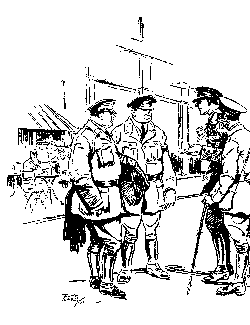
"What part of the States do you Canadians come
from?"
(blank page follows)
"By the Dawn's Early Light"--205
polishes him off! polishes him off and cleans out the trench.'
WE: 'Now, boys, does that always happen? How often do you fellows
polish Fritzie off and clean up the trench?"
THEY (after the short one had nodded to the tall one): "Well,
mister, I'll tell you. It's got so it's mighty damn risky for any
Prussian to surrender to any Canadian!"
When the line out there in the training camp has gone to its
objective, which usually is the third or fourth enemy trench, the
men begin digging in. Then they go back to the sergeant major for
more instructions. The digging in is usually done under a curtain
of fire to protect them. It is a great picture.
In another part of the field we saw the engineers learning to
make tunnels under the enemy; saw the engineers blowing up enemy
trenches--a pleasant and exciting spectacle; saw the engineers
making camouflage, and it may interest the gentle reader to know
that one of the niftiest bits of camouflage we saw was over a
French seventy-five gun. It was set in the field. A railroad
siding ran to it. On a canvas over the gun two rails and the
usual number of ties were
206--Martial Adventures of Henry and Me
painted, and the track ran on beyond. Fifty feet in the air one
could not tell that the gun was there.
The liveliest part of this martial cloister was the section
devoted to the bayonet practice. And as we watched the men trying
to rip the vest buttons off a dummy and expose its gastric
arrangements with a bayonet, while loping along at full speed, we
recalled a Civil War story which may well be revived here. A
Down-easter from Vermont and a Southerner were going around and
around one day at Shiloh, each trying to get the other with the
bayonet, but both were good dodgers. Finally as the Yankee was
getting winded he cried between puffs:
"Watch aout--! Mind what yer dewin'! Ye dern smart aleck! Haint
yew got no sense! You'll stick the pint of thet thing in my
boawels, if you ain't keerful!"
We heard a lot of shivery stories around that training camp. They
told us that the French chasseurs, the famous blue devils, were
more or less careless about the way they forgot to take
prisoners. They are a proud people, from the French Alps, and
exceedingly democratic. A German brigadier, caught under their
barrage, came up to a troop of chasseurs and when they
"By the Dawn's Early Light"--207
demanded his surrender asked curtly, "Where's your superior
officer?" They pointed down the hill, and he started down. At a
safe distance they threw a hand grenade into him and obliteratedhim, remarking, "Well, the world is that much safer for
democracy." It is told of a Canadian who came across a squad of
Germans with their hands up that he asked: "How many are you?"
Eleven, they said. He reached in his pocket; found his hand
grenade, and threw it at them, remarking, "I'm sorry I have but
the one; but divide it between you! " There is also the story of
the Indian Sikhs, who begged to go out on a night raiding
party--crawling on their bellies with their knives as their only
weapons. Finally two of them returned with new pairs of boots.
Showing them proudly to their amazed Captain, they said humbly,
"Yes, sire! But you would be pained to learn how long we had to
hunt for a fit!" There is also the story of the festive Tommy who
tried to play a practical joke on his German prisoner by slipping
a lighted bomb in the German's pocket. The Tommy then started to
run; the German thought he must keep up with his captor and Tommy
realized that the joke was on him, just as the bomb went off and
killed them both.
208--Martial Adventures of Henry and Me
Such stories are innumerable. They are probably untrue. But they
indicate what men at war think is funny; they reflect a certain
impoliteness and lack of courtesy that prevails in war. As it
wears on it grows more or less unneighbourly. And yet the
upheaval of war is just a passing emotional disturbance in the
normal life of men. Even in France, even in the war zone, there
is no glorifying of war; men in war, at least on our side of the
line, hate war more than they hate the Germans. And with the
whole heart of the civilized world--if one frankly may call the
Turk and the Prussian the savages that they are--set upon
maintaining this war to a victory for the allies, civilization
may be said to be in the war as a makeshift. Everywhere one hears
that it is a war against war. Every one is "longing for the dawn
of peace " when it shall come with justice, and in the meantime
France is as deeply devoted to healing the wounds of war as it is
in promoting the war. Six hundred French societies are devoted to
various war works of mercy! Every man and woman in France who is
not a soldier or a nurse is working in one of these societies.
And yet life goes on with all this maladjustment of its cams and
cogs and levers much as in its ordinary routine. There never were
more joyous
"By the Dawn's Early Light"--209
dahlias and phlox and china asters than we saw coming back from
that training camp where men were learning the big death game.
And when we came to Paris the real business of war seemed remote.
Of course, Paris is affected by the war. But Paris is not
war-like. One doesn't associate Paris with "grim-visaged war!"
For if Paris is not gay, still it remains mighty amiable. At
noon the boulevard cafes are filled to the sidewalks, and until
nine o'clock at night they give a fair imitation of their former
happiness. Then they close and the picture shows are crowded, and
the theaters are filled. One sees soldiers and their women folk
at the opera and at the vaudeville shows more than at the other
shows. During the summer and the autumn a strong man put on a
show at the Follies with the soldiers that was the talk of the
town. His game was a tug of war. He announced that he would give
fifty dollars to any soldier who could withstand him. The strong
man sat the soldier down on the floor, foot to foot before him.
Both grasped a pole, and it was the strong man's "act" to throw
the soldier over his head, on to a mattress just back of the
strong man. It is a simple act; one that would soon would tire
Broadway, but when one remembers that soldiers bring their local
pride with them
210--Martial Adventures of Henry and Me
to Paris from the ends of the earth, from New Zealand, from
India, from Canada, from South Africa, from Morocco, from China,
from Australia, and then when one remembers that the men of his
country are gathered in the theater to back every local athlete,
it is easy to see why the strong man holds week after week, month
after month, season after season. Every night some proud nation
gathers in the show house to get that fifty dollars with its
favourite son. And every night some favourite son almost gets it.
And if the strong man didn't fudge a little, pinch the favourite
son's hands on the pole and make him let go, almost every night
the strong man would be worsted. The struggle sets the house
yelling. It is the only real drama in Paris. We noticed that the
shows of Paris which appealed to the eyes and ears were far below
the American standard. In comedy which appeals to something
behind the sense, in the higher grades of acting, the Paris shows
were, on the whole, better than Broadway shows. But in the
choruses, the dancers lack that finish, that top dressing of
mechanical unison required by American taste. Moreover the
lighting and colour were poor. The music at the Follies was
Victor Herbert of 1911! Old American popular songs seemed
"By the Dawn's Early Light"--211
to be in vogue. One heard "O Johnny" and "Over There" at every
vaudeville house this year. Sometimes they were done in French,
sometimes in English. In Genoa, one may say in passing that we
heard one of the songs from "Hitchy-Coo" done in Italian. It was
eery! American artists are popular in Paris. We saw a girl at
three show houses in Paris, under the name of Betty Washington,
doing a gipsy dance, playing the fiddle. She was barefoot, and
Henry, who has a keen eye, noticed that she had her toes rouged!
But she always was good for four encores, and she usually got a
good start at the fifth from Henry and me; we had just that much
national pride! Great throngs of soldiers filled these gay show
houses. The French, the English, and the Australians seemed
satisfied with them. But the Canadians and Americans sniffed.
To them Paris is a poor show town.
One night we fell into a Boulevard show the like of which we had
never seen before. It was a political revue! The whole evening
was devoted to skits directed at the ministry, at the food
administration, at the scandals in the interior department and
the deputies, at the high taxes and the profiteering of the
munition makers. The skits were done in dialogue, song and dance,
212--Martial Adventures of Henry and Me
and the various forms of burlesque. A good crowd--but not a
soldier crowd--sat through it and applauded appreciatively.
Imagine an American audience devoting a whole evening to a
theatrical performance exclusively concerned with Hoover,
Secretary Daniels, Colonel Roosevelt, former Mayor Mitchel, and
LaFollette. In America we get little politics out of the theater.
In France, where they distrust the newspapers, they get much
politics from the theater. The theater is free in France--and
apparently not so closely censored as the newspapers. We learned
that night at the revue of a coming cabinet crisis, before the
newspapers announced it. And in learning of the crisis we had
this curious social experience, which we modestly hoped was quite
as Parisian as the Revue. During the first act of the show it was
Greek to Henry and me. We could understand a vaudeville show, and
by following the synopsis could poke along after the pantomime in
a comedy. But here in this revue, where the refinements of
sarcasm and satire were at play and that without a cue, we were
stumped. Henry was for getting out and going somewhere else. But
we had a dollar a seat in the show and it seemed to me that
patience would bring results. And it did! A good-looking,
middle-aged couple
By the Dawn's Early Light--213
sat down in the seats next to us, and the woman began talking
English. She was sitting next to me, so it was my turn, not
Henry's to speak. We asked her if it would be too much trouble to
interpret the show for two jays from Middle Western America. She
replied cordially enough. and she gave us a splendid running
interpretation of the show. The man with her seemed friendly. We
noticed that he was slyly holding her hand in the dark, and that
once he slipped his arm around her when the lights went clear
down. But that spelled a newly married middle-aged couple, and we
would have bet money that he was a widower and she, late from his
office, was at the head of his household. Between acts he and
Henry went out to smoke, leaving me with the lady. We exchanged
confidences of one sort and another after the manner of strangers
in a strange land. When it occurred to me to ask:
"What does your husband do for a living?"
"My--what?" she exclaimed.
"Your husband, there?"
"Who--that man? Why, I never saw him in my life until I picked
him up in a cafe an hour ago!"
And she got from me a somewhat gaspy "Oh." But we had a good chat
just the same
214--Martial Adventures of Henry and Me
and she told me all about the coming fall of the cabinet. Her
type in America would not be interested in politics. But the
shows of the boulevards discuss politics and the theaters are
free! So her type in France had to know politics. It takes all
kinds of people and also all kinds of peoples to make a world.
And the war really is being fought so that they may work out
their lives and their national traditions freely and after the
call of their own blood. If we are to have only one kind of
people, the kind is easy to find. There is kultur!
Still the love affairs of the French did bother us. Henry did not
mind them so much; but to me they seemed as unreasonable and as
improbable as the ocean and onion soup seemed to Henry. Every man
has his aversion, and the French idea of separating love from
marriage, and establishing it beautifully in another relation, is
my aversion, and it will have to stand. Henry was patient with
me, but we were both genuinely glad when a day or two later we
came back to the sprightly little American love affair that we
had chaperoned on the Espagne crossing the ocean. That
love affair we could understand. It had been following us with a
feline tenacity all over France. When we left the Eager Soul with
the
"By the Dawn's Early Light"--215
Gilded Youth in the hospital at--we'll say Landrecourt, because
that is not the place--we thought our love affair was gone for
ever. The letter she gave us to deliver to the Young Doctor
we had to trust to other hands; for he was not at the American
hospital where he should have been. He had gone to the British
front for a week's experimental work in something with four
syllables and a Latin name at that. But the cat came back one
day, when we were visiting a hospital four hours out of Paris.
The place had that curious French quality of charm about it,
which we Americans do not manage to put into our "places and
palaces." Down a winding village street--a kind of low-walled
stone canyon, narrow and grey, but brightened with uniforms
like the streets of most French villages these days--we wormed
our machine and stopped at an important looking building--an
official looking building. It was not official, we learned--just
a chateau. A driveway ran under it. That got us. For when a road
leads into a house in America, it means a jail, or a courthouse,
or a hotel, or a steel magnate's home or a department store. But
when we scooted under the house we came into a wide white
courtyard, gravel paved. We left the machine and went from the
court-
216--Martial Adventures of Henry and Me
yard into a garden--the loveliest old walled garden imaginable.
At the corners of the garden were fine old trees--tall,
spike-shaped evergreens of some variety, and in the midst of it
was a weeping yew tree and a fountain. Around the walls were
shrubs and splashed about the walks and near the fountain were
gorgeous dabs of colour, phlox and asters, and dahlias and
hollyhocks and flowers of various gay sorts. And back of the
garden, down a shaded path, lay the hospital--a new modern
barracks of a hospital, in a field sheltered from the street by
all that grandeur and all that beauty. The hospital was made of
rough, brown stained boards; it was one story high, built
architecturally like a tannery, and camouflaged as to the roof to
represent "green fields and running brooks." Board floors and
board partitions under the roof were covered as well as they
could be; and stoves furnished the heat. The beds--acres and
acres of iron beds--were assembled in the great wards and
stretched far down the long rooms like white ranks of skeletoned
ghosts. The place was American--new, excruciatingly clean, and
was run like a factory. We were proud of it, and of the
business-like young medical students who as orderlies and
bookkeepers and helpers went
"By the Dawn's Early Light"--217
about in their brand new uniforms--young crown princes of
democracy, twice as handsome and three times as dignified as they
would have been if they had royal blood. Henry called them
the heirs apparent "of all the ages" and enjoyed them greatly.
They certainly gave the place a tone, converting a sprawling ugly
pile of brown boards into a king's palace. When we had finished
our errand at the hospital and were returning through the garden,
we met our young doctor. He was sitting on an old stone bench,
among the asters and dahlias--wounded. It was not a serious wound
from an ordinary man's standpoint; but from the Young Doctor's it
was grave indeed. For it was a bullet wound through his hand. He
thought it would not affect the muscles permanently--but no one
could know. Then he sat there in the mediaeval garden among
the flowers under the yew trees and told us how it happened; took
us out to the first aid post again, and on out to the first line
trenches, and over them into No Man's Land, stumbling over
the dead, helping the stretcher bearers with the wounded. In time
he came to a wounded German--Prussian officer with a shell-wound
in his leg.
He told us what happened, impersonally, as
218--Martial Adventures of Henry and Me
one who is listening to another man's story in his own mouth. "I
gave him something like a first aid to stop the bleeding," the
young Doctor paused, picked a ravelling from his bandage and went
on, still detached from the narrative. "Then I put my arm around
him, to help him back to the ambulance." Again he hesitated and
said quietly, "That was a half mile back and the shells were
still popping--more or less--around us." He looked for
appreciation of the situation. He got it, smiled and went on
without lifting his voice. "Then he did it."
"Not that fellow?" exclaimed Henry.
"Well, how?" from me.
"Oh, I don't know. He just did it," droned the Young Doctor. "We
were talking along; and then he seemed to quit talking. I looked
up. The pistol was at my head; I knocked it away as he fired. It
got my hand! "He stopped, began poking the gravel with his toe,
and smiled again as one who has heard an old story and wants to
be polite. To Henry and me, it was unbelievable. We sat down on
the hoary, moss-covered curb of the ancient fountain regardless
of our spanking new uniforms and cried: "Well, my Heavenly home!"
He nodded, drew a deep breath and said, "That's the how of it."
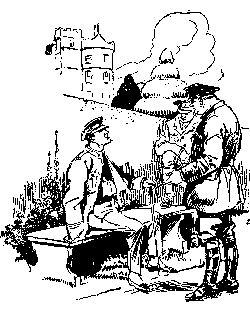
He told us what happened impersonally as one who is
listening to another man's story in his own mouth
(blank page follows)
"By the Dawn's Early Light"--221
"Well, what do you know about--"
Then Henry checked me with, "You weren't expecting it? Did he
make no warning sign?"
"Not a peep--not a chirrup," answered the Doctor, still
diffidently. Then he added, as one reflecting over an incident in
a rather remote past: "It was odd, wasn't it. You would think
that two men who stood where we were together--I, who had put my
hands in his live flesh, and had felt his blood flow through my
fingers, and he who was clinging to my body for support--you
would think we had come together not as foes, but as friends; for
the war was over for him!"
The Young Doctor's eyebrows knitted. His mouth set. He went on:
"This man should have abandoned his military conscience. But
no--," the Doctor shook his head sadly, "he was a Prussian before
he was a man! He carefully figured it out, that it takes four
years to make a doctor, and three months to make a soldier, so to
kill a doctor is as good as killing a dozen men. It's all very
scientific, this German warfare--scientific and fanatical;
Nietzsche and Mahomet, what a perfect alliance it is between the
Kaiser and the Sultan."
Then it came to us again that Germans, on seas,
222--Martial Adventures of Henry and Me
in submarines, in air, in their planes bombing hospitals, and on
land, looting and dynamiting villages--in all their martial
enterprises, think unlike the rest of civilized men. They are a
breed apart--savage, material-minded, diabolic, unrestrained by
fear or love of God, man or devil. We talked of these things for
a time; but something, the quiet beauty of the garden maybe, took
the edge off our hate. And gradually it became apparent to me, at
least, that the Young Doctor was marking time until we should
have the sense to tell him something of the Eager Soul. What did
he care for the war? For the Prussians? For their Babylonian
philosophy? For his wounded hand? What were gardens made for in
this drab earth, if not for sanctuaries of lovers? One does not
go to a garden to hate, to buy, or sell, to fight, to
philosophize, but to adore something or someone, somehow or
somewhere. And the Young Doctor was in his Holy Temple, and we
knew it. So Henry asked: "You received your letter?" And when he
thanked us for our trouble, Henry asked again: "Did she tell vou
that the Gilded Youth was there at her hospital?"
"Only in a pencilled postscript after she had
"By the Dawn's Early Light"--223
decided to send the letter to me by you," answered the Doctor.
That sounded good to me. Evidently she had written to the Young
Doctor before the Gilded Youth had appeared. Also presumably she
had not written to the Gilded Youth. If she had written to him
after the air raid that had killed the head nurse, it would
indicate that she had turned to the Young Doctor, in an emotional
crisis. and that he was still a safe bet, as against the Gilded
Youth. The only question which occurred to me to develop this
fact was this: "Did she tell you that she was made assistant to
the new head nurse that came to supply the place of the one who
was slain by the Germans?" Henry looked at me as if he thought
the question was unfair.
"Yes," laughed the Doctor, "in the very first line."
"What odds are you giving now, Bill?" asked Henry bitterly.
"In the very first line,--" we could all three see the Eager
face, the proud blue eyes, the pretty effective hands brushing
the straying crinkly strands of red hair from her forehead, as
she sat there in the bare little nurses' room, bringing
224--Martial Adventures of Henry and Me
her first promotion in pride to the young Doctor. Perhaps he did
not realize all that it meant. For you see he was very young.
Certainly he did not understand about the odds and repeated the
word in a question. Henry cut in, "Oh, nothing, only that night
after they went walking in the hospital yard, Bill made me give
him three to five. Now I ought to have two to one. It's all over
but the shouting." And Henry laughed at the Young Doctor's
bewilderment; but the young Doctor looked at his bandaged hand
and shook his head. The walk in the hospital yard was disturbing
news to him.
"Ah, don't worry about that," Henry reassured him. "Why, man, you
ought to have heard what she said about you!" And Henry, being a
good-natured sort, told the Doctor what the Eager Soul had said
to the Gilded Youth in the hospital compound, while the buzzing
monsters in the air were singing their nightingale songs of death
in the moonlight.
We left the Young Doctor after he had squeezed out of us all the
news we had of the girl. Long after we had passed through the
garden gate, out into the white, gravel-paved court under the
proud arch and into the crooked, low, grey-walled canyon of the
street, we thought of
"By the Dawn's Early Light"--223
the Young Doctor sitting there reading blue eyes into china
asters, red hair into dahlias, pink cheeks into the phlox, and
hearing ineffable things whispered among the leaves of the
melancholy yew tree. And all that, in a land of waste and
desolation, with war's alarms on every wind.
And we thought that he looked more like a poet than a Doctor even
in his uniform; and less like a soldier than either. Such is the
alchemy of love in youth!
|


