CHAPTER IV
WHEREIN WE FIND THAT "OUR FLAG IS
STILL THERE"
THIS chapter will contain the story of our visit to General
Pershing and the American troops. But before we came to that part
of France which holds our men we passed through divers warlike
and sentimental enterprises which lay across our path, and while
we relate the story of these adventures, the reader must wait a
few moments before we disclose the American flag. But the promise
of its coming may buoy him up while the preliminary episodes clog
the narrative. One afternoon we were chugging along in our Red
Cross ambulance coming down from the first aid posts where we had
been talking to some American Ambulance boys on the French Front,
when we noticed the arrives were landing regularly so we knew
that the Germans were after something in the
neighbourhood--perhaps a big gun, perhaps an ammunition dump. We
were
122
"Our Flag is Still There"--123
speculating upon the nature of the target when we whirled around
a corner and saw it. It was a cross-road. Four roads forked
there; the Germans, of course, had it marked. It was getting its
afternoon pour parler; for they believed that the ammunition
trains would be passing that crossroad at that time. And as we
looked out of the windows of the ambulance our hearts jumped--
at least Henry's and mine jumped--as we saw that between us and
the forks of the road a great French camion had skidded and
stalled, with two wheels over the embankment that raised the road
from the swamp about us, effectually blocking our way. "This,"
said Major Murphy, taking in the situation quickly, "is a mighty
dangerous place." As the word "place" escaped him he was on the
ground. He had slid through a window of the ambulance. The
ambulance drivers--Singer and Hughes--neglecting to unlock the
ambulance doors, ran up the road and began working with the
drivers of the camion to get the great van on the road again. The
other occupants of the ambulance also hurried to the
camion--through the windows of the ambulance; no one was left to
unbutton
the thing for Henry and me. Henry insists that he was there
alone; that he was afraid to follow me through
124--Martial Adventures of Henry and Me
the window for fear of sticking in it. He had not been avoiding
fats, sugars and starches for a year and had no girlish lines in
his figure. And the arrives were certainly bouncing in rather
brashly. The rest of us were out in the open where we could duck
and perhaps avoid the spray of shrapnel. But an ambulance was no
more protection against fifty pounds of German junk than an
umbrella. And there sat Henry in the ambulance wistfully looking
through the window of the vehicle and realizing that his exposure
was less in a dignified sitting posture in the ambulance than it
would be horizontally half in and half out of the thing, held
fast in the vain endeavour to get away. So he waited for the next
"arrive" to come with commendable fortitude. And then it came. It
sounded like the old granddaddy of all shells. We fancied we
could sense its direction; possibly that was imagination. But
anyway we looked toward the German lines and realized Henry's
grave danger. And then it struck--whanged with an awful roar
about seventy-five feet from us, against the bare trunk of a
shell-stripped tree. We knew without looking that the shell had
hit the tree. Then our consciousness recorded the fact that a
French soldier had been standing by that tree. And slowly
"Our Flag Is Still There"--125
and in terror we turned our eyes tree-ward. The tree was a mass
of splinters. It looked like a special sale of toothpicks in a
show window. Then we turned our eyes toward the place where
we had last seen the French soldier. We hardly dared to look. But
instead of seeing a splatter of blood and flesh upon the earth by
the tree stump, we saw the soldier rise from the buckbrush where
he had been ducking, and light a cigarette. The shell had hit not
a dozen feet above him, but had sprayed its fountain from him,
instead of toward him. He had some trouble lighting his cigarette
and was irritated for a second at his inconvenience. But so far
as we could see, the fact that death had reached for him and
missed him by inches had left no impression upon his mind. Three
years in war had wrought some deep change in him. Was it entirely
in his nerves or was it deeper than nerves, a certain calmness of
soul--or was it merely a dramatic expression of a soldierly
attitude? We did not know. But to Henry and me, who had been
rescued from death by that tree that stopped the shell headed
straight for us, it seemed that we should come back after the war
was over and nail a medal of honour and a war cross on the
stump, and put up a statue there with an all-day
126--Martial Adventures of Henry and Me
program! We had no desire to hide our fright! It relieved us to
chatter about the tablet on that tree stump!
The French soldier strolled over to us; helped to straighten out
the camion, and when we learned that he was going down the hill
we gave him a lift. He was a hairy, dirty, forsaken looking poilu
who, washed and shaved and classified, turned out to be an
exchange professor from the Sorbonne, who had spent a year at
Harvard, and it was he who told us of the bombing of the hospital
at Landrecourt; we'll call it Landrecourt to fool the censor, who
thinks there is no hospital there. At the mention of the hospital
the Major turned to us and said: "That s where we sent that
pretty red-headed nurse who came over with you on the boat. And,"
added the Major, "that is the hospital equipped by Mrs. Chesman,
of New York!" whose name is also changed to fool the censor. It
was a better known name!
"Say," exclaimed Henry, "the Aunt of the Gilded Youth!"
"You mean our ambulance boy who came over on the boat with
you--the multimillionaire?" asked the head of the American
Ambulance
service.
"The same," answered Henry, who turned to
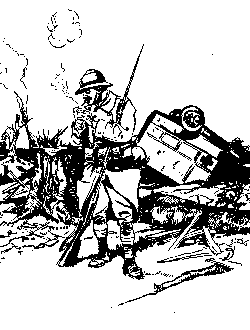
He had some trouble lighting his cigarette and was
irritated for a second at his inconvenience
(blank page follows)
"Our Flag is Still There"--129
me and said in his oratorical voice: "The plot thickens." Then
the Frenchman told us the story of the raid: How the airmen had
come at midnight, dropped their bombs, killing nurses and
doctors, and how the discipline of the hospital did not even
flutter. He said that the head nurse summoned all her nurses,
marched them to the abri at the rear of the hospital, and stood
at the door of the abri, while the girls filed in, and just as
the last nurse was going into the dugout with the head nurse
standing outside, the airmen dropped a bomb upon her and erased
her! None of the nurses inside was hurt. Two doctors were killed
and a number of patients. Landrecourt was on our way and we
hurried to it.
Was there ever a martial adventure without a love story in it?
Little did it seem to Henry and me as we left our humble homes in
Wichita and Emporia to make the world safe for democracy, that we
two thick-set, sedentary, new world replicas of Don Quixote and
Sancho Panza should be the chaperons and custodians of a love
affair. We were not equipped for it. We were travelling light,
and our wives were three or four thousand miles away. No
middle-aged married man gets on well with a love affair who is
out of daily reach of his wife. For when he gets into the barbed
130--Martial Adventures of Henry and Me
wire tangle of a love affair, he needs the wise counsel of a
middle-aged woman. But here we were, two fat old babes in the
woods and here came the Gilded Youth, the Eager Soul and the
Young Doctor--sping! like a German shell--right into our midst,
as it were.
There at Landrecourt we found the Eager Soul, a badly scared
young person--but tremendously plucky! And mad--say, that girl
was doing a strafing job that would have made the kaiser blush!
And the fine part of it was, that its expression was entirely in
repression. There was no laugh in her face, no joy in her heart,
and we scarcely knew the sombre, effective, business-like young
person who greeted us. And then across the court we saw something
else that interested us. For there, walking with his patrician
aunt, we saw the Gilded Youth. Evidently he had heard of the
raid, had run over from Valaincourt on some sort of military
permission.
"Oh, yes," answered the Eager Soul to our enquiring eyes. "Mrs.
Chesman--this is practically her hospital. I mean she and her
group are keeping it equipped and going--a wonderful work. I mean
here is a real thing for a woman to do. And, oh, the need of it!"
"Nice sort?" This from Henry, observing
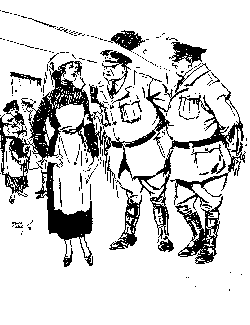
"Oh, yes" answered the Eager Soul to our enquiring
eyes. "Mrs. Chessman--this is practically her
hospital"
(blank page follows)
"Our Flag Is Still There"--133
that there was no move toward us, on the part of the Gilded Youth
and Auntie. Henry may have had his theory for their splendid
isolation. But it received no stimulus when the Eager Soul
answered:
"Oh, yes, I believe so. I haven't met her yet. They all say she
is charming." Henry looked at me. She caught the glance. Then to
cover his tracks he grinned and said: " Charm seems to run in
their family."
"Yes," she returned amiably. " One meets so many nice people on
the boat."
And Henry, still in pursuit of useful social information,
insisted: "Well, are they as nice in the war zone as they are--on
the boat?"
We got our first dimple then, and the Eager Soul tucked in a wisp
of red hair, as she answered:
"Well, really, I've been too busy to know." She turned
absent-mindedly toward the figure of the Gilded Youth, across the
court. But the dimples and the smile faded and she closed the
door firmly and finally on romance, when she said: "On the record
of service shown by my entrance card, they have made me assistant
to the new head nurse who is coming over from Souilly tonight."
134--Martial Adventures of Henry and Me
After we had told her that we were going to American headquarters
soon, she smiled again, to show us that she knew that when we
went probably we would see the Young Doctor. But she let the
smile stand as her only response to Henry's suggestion of a
message. In another moment she turned to her work.
"Well," said Henry, "some pride! 'One meets so many nice people
on the boat!' The idea being that her outfit at home is just as
good as Auntie's group in New York, even if he didn't introduce
her! You know I rather like the social spunk of our Great Middle
West!"
While we were talking the Gilded Youth began moving Auntie slowly
but rather directly around the court to us. It occurred to me
that perhaps he realized that we were the only social godfathers
that the Eager Soul had in Europe, and that if he introduced us
to Auntie it would be an indication that the affair of the boat,
if it was an affair, was to be put upon a social basis! And in
two minutes more he had docked Auntie at our pier. A large,
brusk, well-groomed, good-looking woman of fifty was Auntie. Her
Winthrop and Endicott blood advertised itself in her Bostonese,
but she was sound and strong and the way she instantly got at the
invoice price of
"Our Flag Is Still There"--135
Henry and his real worth, pleased me. She was genuine American.
The thing that troubled me was the fear that Henry would begin
too soon to lambast onion soup. But he didn't and in a few
moments we were having this dialogue:
HENRY: "Oh, yes, indeed; we've grown fond of her. Her father
was--"
AUNTIE: " Oh, yes, I knew her father. Mr. Chesman and he were
interested together in New Mexican mining claims in the eighties;
I believe they made some money. But--"
THE GILDED YOUTH: " Well, Auntie--would you mind telling me
how--?"
AUNTIE: "Why, on her application blank, of course, with her
father's name, age and residence."
THE GILDED ONE: "But you never mentioned it to me?"
AUNTIE: " Nor to her, either. Why should I? This is hardly the
place to organize the Colonial Dames! I believe you said a few
minutes ago that you had met her on the boat."
HENRY: "One meets so many nice people on the boat!"
ME: "You've heard of the woman who said she didn't know the man
socially, she had just met him coming over on the boat!"
136-- Martial Adventures of Henry and Me
The Gilded Youth looked quickly at me, catching me suppressing a
wink at Henry, who grinned at the expiring ghost of it. Then
Auntie led the talk to the raid of the night before; and invited
us to come up for a night's sleep in a civilized bed in the
hospital. We were quartered for the night with the Ambulance
boys, sleeping in a barn loft, so naturally, we accepted her
invitation. Just as we were leaving to get our baggage, out into
the court came the Eager Soul bearing a letter. We did not see
the address, but it was, alas, plainly dimpled in her face, for
the Gilded Youth to see, and after greeting him only pleasantly,
she handed the letter to us, saying: "Would you be good enough to
deliver this for me at Gonrecourt next week, as you are passing?
It is to a friend I met on the boat!"
"Yes," said Henry; "one meets so many nice people on the boat."
"Sometimes," she answered, as she turned to her work.
That night we slept like logs until after midnight; then the moon
rose, and the hospital began to come to life. The stir and murmur
of the place wakened us. And we realized what a moonlight night
means in a hospital near the front line. It means terror. No one
slept after moon-
"Our Flag Is Still There"--137
rise. It was a new experience for Henry and me. So we rose and
met it. And we realized that in scores of hospitals all over the
war zone, on the side of the allies, similar scenes were
enacting. The Germans were literally tearing the nerves out of
hundreds of nurses by their raiding campaign--nurses whom the
raiders did not visit, but who were threatened by every moonlight
night!
It must have been after two in the morning, when we saw the Eager
Soul and the Gilded Youth walking around the court as they used
to pace the deck together. Once or twice they passed our window,
and we heard their voices. They were having some sort of a tall
talk on philosophical matters, which annoyed Henry. The ocean and
onion soup and philosophical theorizing never seemed reasonable,
normal expressions of anything properly in the cosmos to Henry;
he professed to believe that persons who tolerated these things
would sooner or later be caught using the words "group" and
"reaction" and "hypothesis," and he would have none of them. But
for all that she used the word group and once confessed that she
was a subscriber to the New Republic, Henry did like the
Eager Soul; so he waked me up from a doze to say: "Bill,
138--Martial Adventures of Henry and Me
she's putting him through the eye of the needle all right. And
he's sliding through slick as goosegrease. I heard him telling
her a minute ago that the war isn't for boundaries and geography;
but for a restatement of human creeds. Then she said that steam
and electricity have over-capitalized the world; that we are
paying too highly for superintendence and that the price of
superintendence must come down, and wages must come up. Then he
said that he and his class will go in the fires burning out
there--melted like wax. And she told him that they both had a lot
of stolen goods on them--bodies and minds, and hearts cultivated
at the expense of their fellow creatures whose lives had been
narrowed that theirs might be broadened. And you should have
heard her talk about the Young Doctor--a self-made man, who had
earned his way through college and medical school, and made his
own place professionally. She said he was the Herald of the New
Day. "Bill," sighed Henry, "what would you give if you could talk
like that--again?" But from me, drowsily, came this: "Henry--do
you suppose she will get around to that slapping tonight she
promised him on the boat? That would be worth staying up to
see!"
"Our Flag Is Still There"--139
"She'll never slap him. He'll never need it. She's talked him
clear out of the mood!"
"Yes, she has--yes, she has," came from me. And Henry insisted:
"She may have to slap the Doctor; but she has steered this boy
out of the danger zone into the open sea of friendship."
"Oh, yes, she has; oh, yes, she has," came the echo from the
other bed! And Henry subsided.
But the buzzing about the hospital would not let us sleep. At
three o'clock evidently they were serving tea to the nurses, or
lunch of some kind. The moon was shining straight down into the
court; the Gilded Youth and the Eager Soul had gone in, and
another couple, a stenographer and a hospital orderly were using
it as a parlour.
"Queer, queer business, this love-making under the rustle of the
wings of death," said Henry. A French plane flying across had
filled the compound for a moment. But everyone soon recognized
its peculiar buzz. Then for a few seconds from afar came the low
ominous hum of the German planes. But they circled away from
us. Perhaps the French drove them back. However it was the
excitement in the court that caused Henry's remark. For the young
people
140--Martial Adventures of Henry and Me
did not deflect their monotonous course about the compound, when
the sky-gazers had returned indoors. Around and around they went,
talking, talking, talking, with the low insistent murmur of
deeply interested people. Their nerves were taut; emotion was
raw; they were young, and their blood moved riotously. And there
was the moon, the moon that, since man could turn his face
upward, has been the symbol of the thing called love. And now all
over that long line slashed across the face of Europe, the moon
is the herald of death. Men see it rise in terror, for they know
that the season of the moon is the season of slaughter. Yet there
they walked in the hospital yard, two unknown lovers, who were
true to the moon.
Henry's next remark was: "Bill, fancy when you were young doing
your courting out there where a shell is liable to wipe you out
any second. We at least had the advantage of elm trees to protect
us from the shafts of death."
"Do you suppose, Henry," answered his friend, "that they miss the
drip of oars, the shade of the overhanging willows, the
suggestive whisper of waters frisking over the ripples at the
ford? How can they make love in such a place?"
"Our Flay Is Still There"--141
"'Gold,'" replied Henry, quoting from Solomon, who was wise, "'is
where you find it!'"
Then we heard the insistence of the lovers' babble drawing near
us again. As they turned a corner, Henry heaved a sigh at the
perversity of youth in the flaunting neglect of sleep and death,
which ever are vital to middle years. We both looked out to the
white courtyard, heard the snarl of another plane, obviously
French, but still disconcerting, saw the slow even pace of the
lovers, unaffected by the approaching growl of the plane, and it
came to me to quote one wiser even than Solomon: "O death, where
is thy sting!"
We took but a cat-nap that night, and in the morning set down the
score on our love affair. The record indicates that during the
day Henry had lost; during the night he had won. He put it down
in his black book against the time when we should get to Paris,
where money would buy things. For we ate at camps, slept in
hospitals or in barns or in mess rooms of the ambulance men, and
day by day and night after night we saw much misery and were
"acquainted with grief." There are so many kinds of hospitals in
France! The great streams of broken men that flow unceasingly
down from the front are divided
142--Martial Adventures of Henry and Me
as they reach the base hospitals and field hospitals into scores
of smaller currents, each flowing to a separate place, where
specialists treat the various cases. The blind go one way; those
dumb with shell-shock go another; jaw cases separate from men
with scalp wounds, and hip fractures are divided from shoulder
fractures as the sheep from the goats. Travelling about among the
hospitals one picks up curious unrelated and unexplained bits of
information; as, for instance, that the British Tommy is the most
patient man in Europe under pain. He likes to distinguish between
himself and his wound and is likely to reply to the doctor any
fine morning, "Me? Oh, I'm right at the top form, Sir; but my leg
is bothering me a bit, Sir!" The Canadian isn't so game under a
roof as he is under the open sky and in the charge. And the
American grunts more than he should. But here is a queer thing.
The French tubercular soldier is despondent. With Americans,
tuberculosis breeds hope. Perhaps it is the buoyancy of the
young blood of our country; but no American feels he is ever
going to die with tuberculosis. He feels he is hit hard; that it
may take six months or a year to get on his feet: after that--he
goes on dreaming his dream. But the tuber-
"Our Flag Is Still There"--143
cular French soldiers are the saddest looking men
in Europe.
Back in Kansas last spring we had heard a story to the effect
that the Germans were inoculating the French and Belgians behind
the lines of the allies with tubercular bacteria. We asked French
and American and British doctors about that story, and they all
answered that there was nothing to it. The doctors told us that
the Germans have a cheaper and better way to fill France with
tuberculosis than by wasting serum on their enemies. And then,
one day in a tuberculosis hospital we picked up this story, which
explained what the doctors meant.
We met a young man from Lille. It was his birthday; Henry bought
him a bouquet. He told us his story. He said:
"Three years ago when the war broke out I was 19 years old and
was living in Lille with my parents. The Germans came to our
house one day with their guns and took me away. They took me to a
town in Germany; I think it was Essen, where they made me work in
an iron or steel mill. I worked fourteen hours a day, slept on
straw outside the works in a shed, had only the clothes they took
me in and had only bran to eat!"
144--Martial Adventures of Henry and Me
"Only bran?" we asked, doubting it.
"Only bran," the interpreter repeated, and from half a dozen cots
near by, where others who had suffered as he had, heard our
question, came the echo of his confirmation, "Only bran to eat!"
He soon caught cold, and soon the "cold" became tuberculosis, and
after three years of this his sick days exceeded his work days,
and in due course he and five hundred others were assembled, put
on a train and shipped out of Germany through Switzerland to
Evian in France. Three hundred thousand of these poor husks, men,
women, and children, have been dumped into France in the last
seven months. Two trainloads of them arrive at Evian every day.
The men and women, mostly tubercular, do not tarry. They push on
into France, a deadly white stream.
In time the week ended that marked our first trip to the French
front. During that week we lived almost entirely in the war zone,
and under war conditions. The food was good--better than good, it
was excellent, but not plentiful, and the beds were clean and
full of sleep. The only physical discomfort we found was in the
lack of drinking water. We were warned against all local water.
"Our Flag Is Still There"--145
My feelings on the subject of the French coffee and milk were
something like Henry's antipathy to onion soup. But we both loved
water with our meals. We had been vaccinated against typhoid, and
we were rather insistent that we could drink any kind of water,
if it was reasonably clean. But men said "this country is no
place to drink water. It has been a battle-ground and a cemetery
for three years." Still we insisted and then, Mr. Norton, head of
the American ambulance, told us this one: "Out behind a barrage
once near the Champagne; helping the stretcher bearers; nasty
weather, rain, and cold. But there we were. We couldn't get in.
We ducked from shell hole to shell hole. Finally I found a nice
deep one, with water in the bottom--oh, maybe five feet of water
in a fifteen foot hole, and I stayed there; two days and nights.
My canteen went dry, and for a day or two I scooped water out of
the shell hole and drank it. Good enough tasting water so far as
that goes, and fresh too! But at the end of the third day, I
decided it wasn't agreeing with me and quit."
"Why?" we asked. "Did you leave the shell hole?"
"No--oh, no. It was a good shell hole. I
146--Martial Adventures of Henry and Me
stayed. But you know Fritzie came up! " he answered.
So our taste for water with our meals, which is America's
choicest privilege, passed. Henry could drink the coffee, but it
didn't taste good to me. The brackish red wine they served with
the army ration tasted like diluted vinegar and looked like
pokeberry ink. It seemed only good to put in our fountain pens. A
tablespoonful would last me all day. Our week's trip ended at
Monter-en-Der, where there was a hotel and an Ambulance corps
unit that had been over to visit the American troops and had
brought back from the commissary department much loot. Among
other things was water--bottled water, pure unfermented water.
And when we sat at table they brought me a bottle.
Try going seven days on pokeberry ink and boiled coffee yourself
and note the reaction. Your veins will be dry; your stomach will
crackle as it grinds the food. The water in that bottle, a quart
bottle, evaporated. They brought another. It disappeared. They
brought a third. The waiters in the hotel were attracted by the
sight. No Frenchman ever drinks water with his meals, and the
spectacle of this American sousing himself with water while he
ate was a
"Our Flag Is Still There"--147
rare sight. The waiters gathered in the corner to watch me. Henry
saw them, and motioned toward me, and tapped his forehead. They
went and brought other waiters and men from the bar. He was a
rare bird; this American going on a big drunk on water. So they
peered in doors, through windows and stood in the diningroom
corners to watch the fourth bottle go down. And when at the end
of the meal the American rose, and walked through the crowd, they
made way for him. A desperate man at least commands respect,
whatever his delusion may be.
And that night we left the French front, and nosed our car toward
Paris.
There we made preparations to go to the headquarters of the
American Army. In Paris also we got into our new regulation Red
Cross uniforms. Ever since man first pinned a buffalo tail to the
back of his belt, and stuck a rooster feather in his matted hair,
he has been proud of his uniform. Sex vanity expresses itself
most gorgeously in a uniform, and when they put Henry and me into
uniforms, even carefully repressed Red Cross uniforms, open at
the neck and with blue dabs on our coat lapels to distinguish us
from the "first class fighting man," we were so proud that often
five or six consecutive
148-- Martial Adventures of Henry and Me
minutes passed when we weren't afraid of what our wives would say
about the $124 each had spent for the togs. At times our attitude
toward our wives was not unlike that of drunken rabbits hunting
brazenly for the dogs! But when we slipped into citizen clothes,
sobriety and remorse covered us, and we shook sad heads. We wore
the uniforms little about Paris; for our Sam Browne belts kept us
returning salutes until our arms hurt. They couldn't break me of
the habit of saluting with a newspaper or a package or a pencil
in my hand. And my return of the interminable round of salutes
from French, British, and Italian soldiers who throng Paris,
probably insulted--all unbeknownst to me--hundreds of our allies,
and made them sneer at our flag. So it seemed best for us to wear
these uniforms only where soldiers congregated who would know us
for the gawks that we were and forgive us our military
trespasses. Then a real day came when our Red Cross duties took
us to General Pershing's headquarters.
For Americans during the year 1918, "Somewhere in France," will
mean the Joan of Arc country. It is not in the war zone, but lies
among the hills of Central France, a four or five hours' auto
ride from Paris. To reach the American

He was a rare bird; this American going on a big
drunk on water
(blank page follows)
"Our Flag Is Still There"--151
"Somewhere in France" from Paris, one crosses the battle-field of
the Marne, and we passed it the day after the third anniversary,
when all the hundreds of roadside graves that marked the French
advance were a-bloom and a-flutter with the tri-colour. Great
doings were afoot the day before on that battle-field. Bands had
played triumphant songs, and orators had spoken and the leaders
of France--soldier and civilian--had come out and wept and France
had released her emotions and was better for it. We passed
through Meaux and hurried on east to St. Dizier, where we stopped
for the night. We put up at a dingy little inn, filled to
overflowing with as curious a company as ever gathered under one
roof. Of course there were French soldiers--scores of them,
mostly officers in full dress going to the line or coming from
it. Then there were fathers and mothers of soldiers and sisters
and sweethearts of soldiers and wives of soldiers bound for the
front or coming home. And there we were, the only Americans in
the house, with just enough French to order "des oeufs " and
coffee "au lait" and "ros bif and jambon and pain" and to ask how
much and then make them say it slowly and stick the sum up on
their fingers. We were having engine trouble. And our
152--Martial Adventures of Henry and Me
car was groaning and coughing and muttering in the gloomy little
court of the inn. Around the court ran the sleeping rooms, and
under one end, forty feet from the diningroom, was what was
once the stable, and what now is the garage. Frenchmen wandered
up, looked at our chauffeur (from Utica, N. Y.) tried to diagnose
the case, found we did not understand and then moved away. But it
was a twelve-cylinder American machine and the Frenchmen,
discovering that, kept coming back to it. As we sat on the cement
platform of the tavern, kicking our heels against it and
bemoaning the follies of youth which had corrupted our Freshman
and Sophomore French, there came and sat beside us a pretty
woman. She had black snappy eyes, fresh dark skin, and jet black
hair, so curly that it was almost frowsy. She listened to us for
a moment, then hopped aboard our talk like a boy flipping a
street car: "Kansas--eh? I once lived in Oklahoma City. My father
ran the Bee Hive!"
"Angels of mercy, angels of light!" This from me. "Say, will you
interpret for us?"
"Sure mike! sir," she said. And then added: "And if it's engine
trouble my husband upstairs is a chauffeur. Shall I get him?" And
when
"Our Flag Is Still There"--153
she returned with him, he fell to, glad enough to get a look into
a twelve-cylinder American car. Henry stood by him, and with the
woman acting as interlocutor, between our driver and her husband
we soon had the trouble located and the dissimulator--Henry
maintains that all engine trouble is connected in some way with a
dissimulator--rectified, and while the job was going on, he
expounded the twelve cylinders to the French, puffed on his
dreadnaught pipe, and left the lady from Oklahoma City to me. She
was keen for talk. Between her official communiques to her
husband and our driver, she got in this:
"Yes, I know Frank Wickoff in Oklahoma City--knew him when he was
poor as Job's turkey, and then my folks used to borrow money
at his bank. Before we came to Oklahoma City we lived in Austin.
We ran the Good Luck, or was it the Fair; no, we ran the Fair in
Dallas." At a quick look at her face from me she laughed and
said: "Oh, yes, I'm Jew all right. No," she returned to a query,
"I never was in Wichita. But when we moved to Blackwell we used
to take the Beacon!
"Henry, come here," came the call from me. "Here is old
Subscriber and Constant Reader!" Then Henry came up and the
subsequent proceed-
154--Martial Adventures of Henry and Me
ings interested me no more. For Henry took the witness. And the
three of us, kicking our heels on the cement wall below us, sat
swapping yarns about mutual friends in the Southwest. It seems
that in France the lady is a pedlar who goes from town to town on
market day with notions and runs a little notion wagon through
the country between times. She told us of an air raid of the
night before on St. Dizier where eleven people had been killed
and urged us to stay for the funeral the next day. It was to be a
sight worth seeing. Most of the dead were women and children.
There was nothing military in the little town but the two hotels
that housed soldiers and their friends and relatives going to the
front and coming back. Yet the Germans had come, dropped a score
of bombs on the town, then had flown away for another town,
dropping their hateful eggs across country as they went.
Luneville had lost half a dozen, Fismes half a score, and other
towns of the neighhourhood, accordingly--all civilians, mostly
women and children; and not a town raided had any military works
or if it had a munition factory, the bombs had hit miles from the
plants.
We were beginning to realize slowly what a hell of torture anddisease and suffering this war
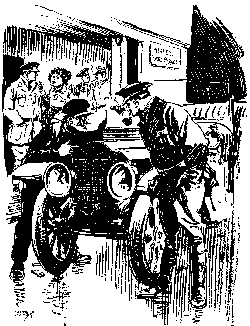
Henry puffed on his dreadnaught pipe and left the
lady from Oklahoma City to me
(blank page follows)
"Our Flag Is Still There"--157
means to France. Half a million tuberculars in her homes,
spreading poison there; two million homeless refugees quartered
beyond the war zone; millions of soldiers living in the homes
fifty miles back from the line, every month bringing new men to
these homes left by their comrades returning to the battle front;
air raids by night slaying women and babies; commerce choked with
the offering to the war god; soldiers filling the highways; food,
clothing and munitions taking all the space upon the railroads;
fuel almost prohibitively high; food scarce; and always talk of
the war--of nothing, absolutely nothing but the war and its
horrors. That France has held so long under this curse proves the
miracle of her divine courage! As we sat under the shrouded
torches in the inn courtyard and considered what life really
means to the men and women of St. Dizier, once more we wondered
how we at home would react under the terrific punishment which
these people are taking; what would Wichita do with her houses
bombed, her homes crowded with refugees; her parks and schools
and public buildings turned into barracks, her stores filled with
gaping empty shelves, her railroad yards clogged with munitions,
and ever the mourners going about the street and man to
158--Martial Adventures of Henry and Me
his long home. How would Emporia act with the pestilence that
stalketh in darkness for ever near her; with her women and
children slaughtered, merely to break the morale of the people
and cause them to plead for peace; with cripples from the war
hidden away in a hundred sad homes, with fatherless children and
children born out of wedlock among the things that one had to
face daily? Perhaps our young Jewish friend thought we were
wearying of her. For she rose and said, "Well, good-night,
gents--pleasant dreams!"
Pleasant dreams--indeed!
But in the morning we arose refreshed and hurried along a misty
plain, forty miles or so from the American troops. Always in the
background were great bushy trees, and lush green grass, and the
thing was composed. How the French manage to compose their
landscape is too much for me. But at any of a thousand points the
scene might have been photographed for a Corot, by getting a few
good-looking girls in nighties to dance on the grass of the
middle distance! American landscape has to be picked apart to
have its picture taken; a tree selected here, a hill there, a
brook yonder, and if ladies in nighties are needed, they are
brought from afar! They are
"Our Flag Is Still There"--159
not indigenous to the soil. But one feels that in France they
might come sidling out from behind any willow clump with their
toes rouged ready for the dance!
The road that morning seemed traversing a great picture gallery,
unwinding into life as from a dream within a dream! And then,
after two hours of joyous landscape, we waked and saw America!
Now America was not a vision; it was substantial, if not
beautiful. As we switched around a bend in the road we came upon
America full-sized and blood raw--a farmer boy--bronzed,
milk-eyed, good-natured, with the Middle West written all over
him. He wore a service hat at a forward pitch over his eyes; in
his hands, conched to tremulo the sound, he held an harmonica;
his eyes were aslit in the ecstasy of his own music; from the
crook of his arm dangled a bridle, and he sat cross-legged high
up on the quarter deck of a great four-story, fullrigged Missouri
mule. He didn't salute us but called "Hi" as we passed, and then
we knew that "our flag was still there" and that we were near our
troops.
The boys must be popular in the neighbourhood. For in the next
village, which by the way was a town of ten thousand, our
American Red
160-- Martial Adventures of Henry and Me
Cross uniforms were treated with distinguished courtesy. Henry
wanted a match. He could talk no French but a little boy at the
inn, seeing him fumbling through his clothes with an unlighted
pipe, came running to us with a little blue box of matches. Henry
gave the boy a franc--more to be amiable than anything else. The
boy flashed home to his mother proud as Punch! And just as we
were pulling out of the village the boy came running to us with
another little blue box of matches. We thought the boy had
discovered that matches would bring a franc a box from Americans
and was preparing to make his fortune. So Henry took the box, and
as the car was moving handed the boy another franc. We noticed
him waving his hands and shaking his head. And when we were a
mile out of the village Henry opened his second box and found his
original franc in it. The boy's mother was ashamed that he should
have taken any money for a box of matches, and had made him bring
back the money with another box to show how much the French
appreciate the Americans coming to France. We met many instances
like that.
Soon the road was cluttered up with American soldiers. They were
driving motors, whacking mules, stringing along the by-paths and
sweating
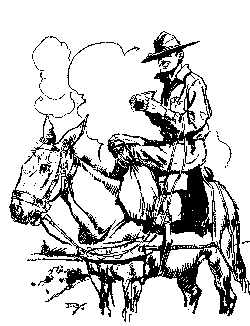
And he sat cross legged
(blank page follows)
"Our Flag Is Still There"--163
copiously under the autumn sun. We wondered in passing what an
American farmer boy and his self-respecting mule thought of the
two-wheeled French carts they were using. Then we turned the
corner and came into a new view; we saw our first troop of
American soldiers quartered in a French village. They were busy
building barracks. We stopped and visited them, and they showed
us their quarters: In barns, in lofts of houses, in cellars, in
vacant stores--everywhere that human beings could slip in, the
American soldiers had installed themselves. The Y.M.C.A. hut was
finished, and in it a score of boys were writing letters, playing
rag-time on the pianos, and jollying the handsome, wise-looking
American women at the counter across one end of the room. An
Irish Catholic padre in a major's uniform was in charge of the
sports of the camp and he literally permeated the Y.M.C.A. hut.
He was the leader of the men. The little village where this troop
lived faded into the plain and we rode again for five miles or
so, and then came to another and another and still another. At
that time thirteen villages in an arc of forty miles or so
contained most of our American troops. We stopped many times on
our long day's journey. Once we stopped for mid-day
164--Martial Adventures of Henry and Me
dinner and there came to Henry and me our first estrangement. It
is curious, as the poet sings, "how light a thing may move
dissension between hearts that love--hearts that the world in
vain has tried and sorrow but more closely tied." Well--the thing
that came between us was cooking--cooking that has parted more
soul mates than any other one thing in the world! For two
weeks more or less we had been eating in the French mess, or
eating at country hotels or country homes in France, eating good
French country cooking, and it was excellent. A mid-day meal
typically was a melon, or a clear soup, or onion soup, brown and
strong; a small bit of rare steak or chop, or a thin sliced roast
in the juice with browned potatoes or carrots, a vegetable
entree--peas, spinach, served dry and minced, or string beans;
then raw fruit, and cheese. The bread, of course, was black war
bread, but crusty and fine. That was my idea of a lunch for the
gods. What we got at the American mess was this: a thick, frowsy,
greasy soup--a kind of larded dish--water; thin steak fried hard
as nails, boiled beans with fried bacon laid on the beans--not
pork and beans, but called pork and beans--with the beans
slithery and hard and underdone; lettuce, cabbage, and onions
soused in vinegar, white bread
"Our Flag Is Still There"--165
cut an inch thick, soft and spongy, boiled potatoes that had
stood in the water after they were cooked done, and then bread
pudding, made by pouring water on bread, sticking in some
raisins, stirring in an egg, and serving a floury syrup over it
for sauce! There was enough, of course, to keep soul and body
together. But the cooking had spoiled a lot of mighty good food.
And Henry liked it! There were two preachers with us, and they
bragged about the "good old American cooking!" And when they
heard me roar they said, "He is insulting the star-spangled
banner," and Henry threatened to take my pajamas out of his black
valise!
After passing through many villages crowded with our troops we
came to the headquarters of the American Expeditionary forces. We
found General Pershing in a long brick building--two or three
stories high, facing a wide white parade ground. The place had
been used evidently as a barracks for French soldiers in peace
times, and was fitted to the uses of our army. We met a member of
his staff, a sort of outer guard, and with scarcely a preliminary
halt were taken to the general. He seems easy of access, which is
a sign that he plays no favourites and has no court. Anyone with
business can see him. He
166-- Martial Adventures of Henry and Me
met us in a plain bare room with a square new American-looking
desk in the midst of it. He sat behind the desk, cordial enough
but with the air of one who will be pleased to have business
start, and politenesses stop. So we plunged straight to the
business in hand. We were from the American Red Cross in Paris,
and our leader had come to get a definite idea of what part the
Red Cross was to play in the recreation activities of the army.
The Y.M.C.A. was spending millions upon recreation problems. The
Red Cross had millions to spend.
Recreation in Paris, of course, means soldier hostels, homes,
clubs, houses where American soldiers can go while in Paris on
leave of absence. The Red Cross had one single donation of one
million dollars to be devoted to a club for American soldiers in
Paris. The Y.M.C.A. had started to equip two or three great
Parisian hotels as clubs. The Red Cross had money donated for
certain other recreation purposes in camp. The Y.M.C.A. believed
it should control the camp and Parisian recreation activities of
the American troops.
We stated our case about as briefly as it is here written, and in
three minutes. In two minutes more General Pershing had assured
us that there
"Our Flag Is Still There"--167
would be no need to spend money for hotels or clubs in Paris,
that few soldiers would be given leave to go to Paris, and that
the lavish expenditure of American money in Paris would be bad
for America's standing in France.
And then he allotted the recreation problems of men in the
hospitals to the Red Cross, and the recreation enterprises for
men outside of hospitals to the Y.M.C.A.
He was brief, exact, candid and final. He stood for the most
part, as he talked; spoke low, fumbled for no word, and looked
into his hearers' eyes. The politician looks over their
shoulders. We spoke for two or three minutes with him about the
work of our troops this winter, and were impressed with the
decision of the man. He seemed--perhaps subconsciously--afraid
that public opinion at home would demand that he put our men into
the trenches to hold their own sector too early. He evidently
believed that during our first winter the men should go in by
squads and perhaps companies or later in regimental units for
educational purposes, working with the English and the French
learning the trench game. But we felt clearly that he believed
strongly that it would be spring before we should occupy any
portion of the line ourselves. There was a firm-
168--Martial Adventures of Henry and Me
ness about him, not expressed in words. No one could say that he
had said what we thought he had conveyed to us. Yet each of us
was sure that the General would not be moved from his decision.
He breathes confidence in him into people's hearts. He never
seems confidential; though he is entirely candid. Again one feels
sure that there is no court around him. He seems wise with his
own wisdom, which is constantly in touch with the wisdom of every
one who may have business with him. He will not be knocked off
his feet; he will do no military stunts. The American soldiers
will not go into action until we have enough troops to hold our
part of the line and we will not start an offensive until we can
back it up. This all came glowing out of the firm, kind, wise,
soldierly face of General Pershing, and it needed no words to
verify it. Superfluous words might have contradicted the message
of his mien; for they might have added boast to simple statement.
It is all so orderly, so organized, so American, this thing we
are doing in France. It is like the effective manipulation of a
great trust. The leadership of the American forces in France in
the army and in the Red Cross and the Y.M.C.A. is made up of men
known all over the
"Our Flag Is Still There"--169
United States; the names of those leaders who are soldiers may
not be mentioned. They have dropped out of American civilian life
so quietly that they are scarcely missed. Yet for weeks we
lived in the hotel with one of the prominent figures in American
finance who is working eighteen hours a day buying supplies,
assembling war material--food, fuel, clothing--putting up scores
of miles of barracks, building a railroad from tidewater to the
American headquarters, equipping it with American engines,
freight cars, and passenger coaches; sinking piles for the first
time in a harbour which has been occupied for two thousand years,
and unloading great ships there which were supposed to be too big
for that port. He is the marvel of the French. Hundreds like him
are over there lending a hand. They are about to handle in a year
an army half as large as the other allies have been three years
building. Houses, furniture, fuel, food, guns, ammunition,
clothing, transportation, communication, medicine, surgeons,
recreation--the whole routine of life for a million men and more
must be provided in advance by these organizing men. This work,
so far as these men consider it, is purely altruistic. They are
sacrificing comforts at home, money-making opportunities at
170--Martial Adventures of Henry and Me
home, and they are working practically for nothing, paying their
own expenses, and under the censor's wise rules these men can
have not even the empty husks of passing fame. For their names
may not be mentioned in the news of what the Americans are doing
in Europe. Yet wherever one goes in Europe he is running across
these first-class men. Their sincerity and patriotism may not be
questioned.
But they are getting something real out of it all. The renewal of
youth in their faces through unstinted giving is beautiful to
see. They are going into a new adventure--a high and splendid
adventure, and while many of them may snap back after the war to
the old egoistic individualistic way of looking at life, their
examples will persist, and their lives, when they go back to the
old rut, will never be the same lives that they were before.
But here is a story, an American story which has in it the
makings of a hero tale. It came to us in Paris, bit by bit. We
saw it and no one told it to us. Yet here it is, and it should
begin in form. Once upon a time in America when the people were
changing their gods, a certain major god of finance named James
Hazen Hyde, head of a great insurance company, fell into dis-
"Our Flag Is Still There"--171
favour; and the people, changing their gods, cast him away. If
men had been serving the old gods they would have said, "Go it
while you're young," to the youth, but instead they said
unpleasant things. So he went to France and vanished from the
map, but he did not entirely understand why he was banished. He
had done nothing that other young gods did not do and he was
amazed, but he faded. He lived in Paris as an exile, not as a
god, and he couldn't for the life of him tell why. But when the
war came he had a mighty human desire to serve his country; just
to serve, mind you, not to be exalted. He was fifty years old,
too old to pack a rifle; too old to mount an airship; too old to
stop a bullet without taking two or three other good men and
true, younger than he, to watch him. So he had hard work to find
service. Then along came the American Red Cross and it wanted
servants--not major generals, not even captains; but just
chauffeurs and interpreters and errand boys and things. And young
Jimmy Hyde, who had been the Prince of Wales of the younger
gods of fashionable finance, and who was cast out when the people
changed their gods, came to Red Cross headquarters with his two
cars. and offered them and himself to serve. And they
172--Martial Adventures of Henry and Me
put him in a uniform, with a Sam Browne belt, and a Red Cross on
his cap; and it was after all his country s uniform, and he was a
servant of his country. And men say that even in the days of his
young godhood he was not so happy, nor did his face shine in such
pride as it shines today. For he is a man. He serves.
After our visit to the American troops we went down to Domremy,
the birth place of Joan of Arc. It was good to view her from the
aspect of her Old Home Town. There is a church, restored, where
she worshipped, and the home where she was born and lived. It was
a better house than one is led to suppose she lived in, and
indicates that her people were rather of more consequence than
common. We visited the home, went into the church, and walked in
the garden where she met the angel; but we met postcard vendors
instead. Yet it is a fair garden, back from the road, half hidden
by a wall, and in it is a lovely drooping tree. A fair place it
was indeed for an angel to choose. Some way Joan leaves me
without much enthusiasm. Perhaps it is because she has had two
good friends who have done her bad turns. The Pope, who made her
a saint, and Mark Twain, who made her human. It is difficult to
say, off-hand, which did
"Our Flag Is Still There"--173
her the worse service. Some way, it seems to me, she could live
in our hearts more beautifully in the remote and noble company of
myths like the lesser gods, made by men to express their deepest
yearnings for the beautiful in life. The pleasant land in which
she lived, the gentle hills whereon she watched her flocks, and
the tender sky of France, all made me happy, and if Joan did not
get to me, perhaps it was because one can take away from a place
only what he brings there.
When we left Domremy, the mills--soft green hills, high but never
rugged, stretched away in the misty purple distance and we
dropped into those vales where Joan watched her sheep and heard
the voices. It did not seem impossible, nor even difficult to
hear voices amid such beauty. So we fell to discussing the voices
that reach this world. And Henry said: "Always there are voices
in this earth--always they come in youth, calling us forward and
upward. And if we follow hem, though they lead to long marches
and hard bivouacs, and to humiliation and sorrow, yet are we
happy and triumphant."
"But Germany?" insisted someone. " Where were her voices?"
"Her voices came when Heine sang, and Bee-
174--Martial Adventures of Henry and Me
thoven made music, and Goethe and Schiller wrote and Schopenhauer
thought! If ever a land had the philosophy and the poetry of
democracy Germany had it. Democracy tried to bloom in the
revolutionary days of the forties, but Germany strangled her
voices. And now--"
"And now there are no voices in the world!" sighed one of our
party: but even as he spoke from out of the purple distance came
the thin faint sound of a bugle trembling among the hills. It was
an American bugle. And Henry caught its significance, and cried:
"There is the new voice--the voice that the world must follow if
we find the old peace again on earth."
|


