CHAPTER III
IN WHICH WE ENCOUNTER BOMBS BURSTING
IN AIR
THERE is something, though Heaven knows not much, to be
said for war as war. And the little to be said is said when one
declares that it refreshes life by taking us out of our ruts.
Routine kills men and nations and races; it is stagnation. But
war shakes up society, puts men into strange environments, gives
them new diversions, new aims, changed ideals. In the faint
breath of war that came to Henry and me, as we wend about our
daily task inspecting hospitals and first aid posts and ambulance
units for the Red Cross there was a tremendous whiff of the big
change that must come to lives that really get into war as
soldiers. Even we were for ever pinching our selves to see if we
were dreaming, as we rode through the strange land, filled with
warlike impedimenta, and devoted exclusively to the science of
slaughter. By rights we should have been sitting in our offices
in Wichita and Emporia edit-
83
84--Martial Adventures of Henry and Me
ing two country newspapers, wrangling mildly with the pirates of
the paper mills to whom our miserable little forty or fifty
carloads of white paper a year was a trifle, dickering with
foreign advertisers who desired to spread before Wichita and
Emporia the virtues of their chewing gum or talking machines, or
discussing the ever changing Situation with the local statesmen.
At five o'clock Henry should be on his way to the Wichita golf
course to reduce his figure, and the sullen roar of the muffler
cut-out on the family car should be warning me that we were going
to picnic that night out on the Osage hills in the sunset, where
it would be up to me to eat gluten bread and avoid sugars,
starches and fats to preserve the girlish lines of my figure.
But instead, here we were puffing up a hill in France, through
underbrush, across shell holes to a hidden trench choked with
telephone cables that should lead underground to an observation
post where a part of the staff of the French army sat overlooking
the battle of the Champagne. As we puffed and huffed up the hill,
we recalled to each other that we had been in our offices but a
few weeks before when the Associated Press report had brought us
the news of the Champagne drive for hill 208. Among other things
the report had
"Bombs Bursting in Air"--85
declared "a number of French soldiers were ordered into their own
barrage, and several were shot for refusing to go into action
thereafter!" And now here we were looking through a peephole in
the camouflage at the battlefield! We were half way up the hill;
below us lay a weedy piece of bottom land, all kneaded and
pockmarked by shells, stretching away to another range of hills
perhaps five miles, perhaps ten miles away, as the valley widened
or narrowed. The white clay of the soil erupting under shell fire
glimmered nakedly and indecently through the weeds. It was hard
to realize that three years before the valley before us had been
one of the great fertile valleys of France, dotted with little
grey towns with glowing red roofs. For as we looked it seemed to
be "that ominous tract, which all agree hides the Dark Tower!"
There it all lay; the "ragged thistle stalk," with its head
chopped off; "the dock's harsh swart leaves bruised as to balk
all hope of greenness." "As for the grass, it grew scantier than
hair in leprosy; thin dry leaves pricked the mud, which
underneath looked kneaded up with blood!" It was the self-same
field that Roland crossed! In the midst of the waste zigzagged
two lines--two white gashes in the soil, with a scab of horrible
86--Martial Adventures of Henry and Me
brown rust scratched between them--the French and German trenches
and the barbed wire entanglements. At some places the trenches
ran close together, a few hundred feet or a few hundred yards
marked their distance apart. At other times they backed fearfully
away from one another with the gashed, stark, weed-smeared earth
gaping between them. We paused to rest in our climb at a little
shrine by the wayside. A communication trench slipped deviously
up to it, and through this trench were brought the wounded; for
the shrine, a dugout in the hillside, had been converted into a
first aid station. A doctor and two stretcher bearers and two
ambulance men were waiting there. Yet the little shrine, rather
than the trenches that crept up to it, dominated the scene and
the war seemed far away. Occasionally we heard a distant boom and
saw a tall cone of dirt rise in the bottom land among the
trenches, and we felt that some poor creature might be in his
death agony. But that was remote, too, and Major Murphy of our
party climbed to the roof of the dugout and began turning his
glasses toward the German lines. Then the trenches about us
suddenly grew alive. The Frenchmen were waving their hands and
running about excitedly. Major Murphy was a Major--a regular
United States Army major in a

One of our party climbed to the roof of the dugout and
began turning his glasses toward the German lines
(blank page follows)
"Bombs Bursting in Air"--89
regular United States army uniform so grand that compared with
our cheap cotton khaki it looked like a five thousand dollar
outfit. The highest officer near us was a French
second-lieutenant, who had no right to boss a Major! But
something had to be done. So the second lieutenant did it. He
called down the Major: showed him that he was in direct range of
the German guns, and made it clear that a big six-foot American
in uniform standing silhouetted against the sky-line would bring
down a whole wagon-load of German hardware on our part of the
line. The fact that the German trenches were two miles away did
not make the situation any less dangerous. Afterwards we left the
shrine and the trenches and went on up the hill.
The view from the observation trench on the hill-top, when we
finally got there, was a wonderful view, sweeping the whole
Champagne battle field. Hill 208 lay in the distance, still in
German hands, and before it, wallowing in the white earth were a
number of English tanks abandoned by the French. Lying out there
in No Man's Land between the trenches, the tanks looked to our
Kansas eyes like worn out threshing machines and spelled more
clearly than anything else in the landscape the extent of the
French failure in the
90--Martial Adventures of Henry and Me
Champagne drive of the spring of 1917. It may be profitable to
know just how far the pendulum of war had swung toward failure in
France last spring, before America declared war. To begin: The
French morale went bad! We heard here in America that France was
bled white. The French commission told us how sorely France
needed the American war declaration. But to say that the morale
of a nation has gone bad means so much. It is always a struggle
even in peace, even in prosperity, for the honest, courageous
leadership of a nation to keep any Nation honest. But when hope
begins to sag, when the forces of disorder and darkness that lie
subdued and dormant in every nation, and in every human heart are
bidden hy evil times to rise--they rise. Leadership fails in its
battle against them. For a year after the morale of the French
began to come back strong, the French newspapers and French
government were busy exposing and punishing the creatures who
shamed France in the spring of 1917. German money has been
traced to persons high in authority. A network of German spies
was uncovered, working with the mistresses of men high in
government--the kaiser is not above using the thief and the
harlot for his aims; money literally by the
"Bombs Bursting in Air"--91
cartload was poured into certain departments to hinder the work
of the army, and the tragic disaster of the Champagne drive was
the result partly of intrigue in Paris in the government, partly
of poverty, partly the result of three winters of terrible
suffering in the nation, and partly the weakening under the
strain of all these things, of this "too too solid flesh and
blood." During the winter of 1917 soldiers at the front received
letters from home telling of starvation and freezing and sickness
in their families. And trench conditions in the long hard winter
were all but unbearable. When a soldier finally got a leave of
absence and started home, he found the railroad system breaking
down and he had long waits at junction points with no sleeping
quarters, no food, no shelter. French soldiers going home on
leave would lie all night and all day out in the open, drenched
by the rain and stained by the mud, and would reach home bringing
to their families trench vermin and trench fever and trench
misery untold, to add to the woe that the winter had brought to
the home while the soldier was away. Then when he went back to
fight, he found that a bureaucratic clash had left the soldiers
without supplies, or food or ammunition in sufficient quantities
to supply the battle needs.
92--Martial Adventures of Henry and Me
In the bureaucratic clash some one lost his head in the army and
ordered the men into their own barrage. Hundreds were
slaughtered. Thousands were verging on mutiny. A regiment refused
to fight, and another threatened to disobey. The American
ambulance boys told us that the most horrible task they did was
when they hauled eighty poor French boys out to be shot for
mutiny! Spies in Paris, working through the mistresses of the
department heads, the sad strain of war upon the French economic
resources, and the withering hand of winter upon the heart of
France had achieved all but a victory for the forces of evil in
this earth.
And there we were that summer day, when time and events had
changed the face of fate, looking out across the blighted field
of Champagne at what might have been the wreck of France.
All is changed now. At every railroad junction the American Red
Cross has built cantonments, where beds and food and baths and
disinfecting ovens for trench clothes are installed for the
homeward bound soldiers of France. The American Red Cross has the
name of every French soldier's family that is in need, and that
family's needs are being supplied by the American Red Cross. And
the sure hope of victory
"Bombs Bursting in Air"--93
has given the leadership of France a mastery of the forces of
evil in the lower levels of the Nation's political consciousness
that will make it impossible for the kaiser's friends, the
courtesans to accomplish anything next winter.
We gazed across the field that afternoon and seeing the blotched
acres, weed blasted, shell-pocked, blistered with white trenches
and scarred with long jagged barbed-wire rents for miles and
miles, and we thought how perfectly does the spirit of man mark
the picture of his soul's agony upon his daily work.
It was late in the afternoon when we left the sector of the line.
We passed a bombed hospital where two doctors and three nurses
had been killed a night or two before. It was a disquieting
sight, and the big Red Cross on the top of the hospital showed
that the German airmen who dropped the bombs were careful in
their aim. Gradually as we left the Champagne front the booming
guns grew fainter and fainter and finally we could not hear them,
and we came into a wide beautiful plain and then turned into the
city of Rheims. It was bombed to death--but not to ruins. Rheims
is what Verdun must have been during the first year of the war, a
phantom city, desolate, all but uninhabited, broken and battered
94--Martial Adventures of Henry and Me
and abandoned. Here and there, living in caves and cellars, a few
citizens still stick to their homes. A few stores remain open and
an occasional trickle of commerce flows down the streets. We
went to the cathedral and found its outlines there--a veritable
Miss Havisham of a ruin, the pale spectre of its former beauty,
but proud and --if stone and iron can be conscious--vain of its
lost glory. A gash probably ten feet square has been gouged in
the pavement by a German shell, and the hole uncovers a hidden
passage to the Cathedral of which no one in this generation
knew. In the hovering twilight we walked about, gazing in a
sadness that the broken splendour of the place cast upon us, at
the details of the devastation. The roof, of course, is but a
film of wood and iron rent with big holes. The walls are intact,
but cracked and broken and tottering. The Gothic spires and
gargoyles and ornaments are shattered beyond restoration, and
the windows are but staring blind eyes where once the soul of
the church gazed forth. Men come and gather the broken bits of
glass as art treasures.
That evening at supper in Chalons, we met some American boys who
said the French were selling this glass from the windows of
Rheims made from old beer-bottles and blue bottles and
"Bombs Bursting in Air"--95
green bitters bottles, and still later we saw an English Colonel
who had bought a job lot of it and found a patent medicine trade
mark blown in a piece!
We had been in the place but a few minutes when we went to the
back of the cathedral where we found an excited old man on the
sidewalk with a broom in front of a postcard printing office. He
spoke to Henry and me, but we could not understand him. He
pointed to the stone dust and spawl freshly dropped on the
sidewalk and to a hole in the pavement, and then to a broken iron
shell. It must have weighed twenty-five pounds. He kept pointing
at it, and made it clear we were to touch it. It was still hot!
It
had dropped in but a few minutes before we came We went into his
shop to stock up on post cards and as Major Murphy and Mr.
Norton, who could talk French, learned that another shell would
be due in three or four minutes, we left town.
The road out of Rheims was in full view of the German lines,
hidden only, and at that rather poorly, by camouflage--straw
woven into mats and burlap, badly torn. We were between the
German guns five miles away, and the sunset. Great holes in the
ground beside the road indicated where they had been dropping
shells, so our
96--Martial Adventures of Henry and Me
driver tramped on the juice, the machine shot out at fifty miles
an hour and we skedaddled.
From the road out of Rheims we dropped into the valley of the
Marne, a most beautiful vine-clad valley, where the road turns
sharply from the German lines and soon passes out of the German
range and the shell holes at the side of the road disappear. But
even shell holes would not have taken our eyes from the beauty of
that valley as we wound down into it from the hill. Vines were
everywhere. Rows and rows of vines, marking a thousand brownish
green lines in the earth as far as the eye could see. The grapes
were ripe and they gave a tint of purple and brown to the
landscape. It glowed with colour. Half a score of little grey,
red roofed towns dotted the checkered fields. The sun was
slanting through the plain. Tall dark poplars slashed it with
sombre greens. As we whizzed through the quaint little villages
dashes of colour seemed doused in our faces; soldiers in horizon
blue with crimson trimmings and gold on their uniforms, black
Moroccans with their gaudy red fezes, flags of staff and line
officers fluttering from doors and window sills, all refreshed
our eyes with new, strange, gorgeous combinations of colours. And
when we passed a town where no
"Bombs Bursting in Air"--97
soldiers were quartered, there the dooryards were brilliant with
phlox and dahlias--even the door yards of those poor wrecked
villages deserted after the German bombardment--villages roofless
and grey and gaunt and wan, from which the population fled in
July, 1914, and from which the Germans themselves a few weeks
later were forced to flee, running pell-mell as they scurried
before the wrath of the French soldiers.
As we went down into the valley of the Marne where division after
division of the French army was quartered upon the population,
thousands in a village, where normally hundreds were sheltered,
we realized what social chaos must stalk in the train of war.
Every few weeks these soldiers go to the front and other soldiers
come in. Fathers, husbands, sweethearts of peace times are at the
front or dead. The visiting soldiers come "from over the hills
and far away," but they are young, and the women are young and
beautiful, and they live daily with these women in their houses.
Moreover, the emotions of France are tense. Death, doubt, fear
and hope lash the home-staying hearts every day. And amid those
raw emotions comes the daily and hourly call of the deepest
emotion in the human heart. It comes honestly. It comes
inevitably.
98--Martial Adventures of Henry and Me
And then, in a day or an hour, the lover is gone, and new faces
appear in the village, in the street, in the home. Five millions
of men during the last three years and a half have passed and
repassed, through those fifty miles or so back of the firing line
in which soldiers are quartered for rest, where in times of peace
less than a million men have lived. And the women are the same
honest, earnest, aspiring women that our wives and sisters are,
and the men are as chivalrous and gentle and as kind.
For nearly an hour we had been going through these villages
crowded with soldiers--kindly French soldiers who were clearly
living happily with the people upon whom they were billeted. Then
Henry burst forth, "My good Heavens, man--what if this were in
Wichita or Emporia! What if your house and mine had ten or twenty
fine soldiers in it, and we were away and our wives and daughters
were there alone? Thousands and thousands of these young girls
flitting about here were just little children three years ago
when their daddies left. What if in our streets soldiers were
quartered by the hundreds in every block, with nothing in the
world to do but rest! What would happen in Wichita and
Emporia--or back East in Goshen, New York,
"Bombs Bursting in Air"-- 99
or out West in Fresno or Tonapah? What an awful thing--what a
hell in the earth, war is!"
And yet we know that young hearts will express themselves as they
were meant to express themselves even in the wrack and ruin and
waste of war. And this strange picture of love and death sitting
together some way reminded us of the phlox and the dahlias
blooming in the dreary dooryards of the shattered homes near the
battle line. And then our hearts turned to the youth on the
boat--that precious load of mounting young blood that came over
with
us on the Espagne where we were the oldest people in the
ship's company. And we began talking of the Eager Soul and her
Young Doctor and the Gilded Youth. If the war could lash our old
hearts as it was lashing them, so that even our emotions were raw
and more or less a-quiver in the storm of the mingled passions of
the world that overwhelmed us, how much--how fearfully much more
must their younger hearts be stirred ? How could youth come out
of it all unscarred! And she was such a sweet pretty girl, the
Eager Soul, so fine and brave and wise--yet her heart was a
girl's heart, after all. And the Young Doctor, his keen
sensitive face showed how near to the surface was the quick in
him. As for the Gilded
100--Martial Adventures of Henry and Me
Youth, we had seen there on the hill in the misty night the great
hammer of the guns pound the dross out of him! And here they were
all three alone, in the fury of this awful storm that was testing
the stoutest souls in the world, and they were so young and so
untried!
The roads over which we had been travelling for two days in our
car were military roads. And we could tell instantly when we
were inside the thirty kilo limit of the firing line, by looking
at the road menders. If they were German prisoners we were
outside the thirty kilo strip. For when the Germans discovered
last spring that the Allies held more prisoners than the Germans,
the Germans demanded a rule for the treatment of prisoners, which
should keep them thirty kilos from danger. It was a rule that the
Allies had been observing; but the Germans were not observing it,
until they found that they might suffer by non-observance. So
when we left the German prisoners and came to French road
menders--generally French Chinamen or Anamites, or negroes from
Dahomey or other oriental peoples, we knew we were soon to come
in sound of the big guns. These road menders always were at work.
Beside every road a few yards apart, always were little neatly
stacked cones of road
"Bombs Bursting in Air"--101
metal. A road roller always was in sight. No road ever got bumpy
and at given distances along the road were repair stations for
the government automobiles. Nothing was allowed to stop the
machinery of war. At night along these country roads, thirty
kilos back from the line we travelled with lights; so that night
out of Rheims, we hurried through the night, passed village after
village swarming with soldiers, black and yellow and white; for
the colour line does not irritate the French; and we saw how gay
and happy they were, crowding into picture shows, listening to
the regimental band, sitting on the sidewalks before the
cafés,
or dancing with the girls in the parks. Then a time came when the
village streets were lonely and dark and we knew that the bugle
had sounded taps. And so in due course we came to the end of the
day's journey, at the end of a spur of the railroad, near one
sector of the Verdun front. There we found a field hospital of
four thousand beds. And when there is to be renewed French
activity on the Verdun sector, the first thing that happens is
the general evacuation of all the patients in the hospital. It
takes a great many railroad trains to clear out a hospital
wherein six thousand wounded men are jammed. We saw one hospital
train loading.
102--Martial Adventures of Henry and Me
This hospital had handled twenty-six hundred cases in one day the
week before we arrived. The big guns that we had heard booming
away for three days as we went up and down the line had been
grinding their awful grist. We walked through the hospital, which
covered acres of ground. It is a board structure, some of the
walls are not even papered, but show the two-by-fours nakedly and
the rafters above. Stoves heat most of the wards, and hospital
linoleum covers the runways between the rows of beds. Of course,
the operating rooms are painted white and kept spotless. The
French are marvellous surgeons, and their results in turning men
back to the line, both in per cent of men and time are up to the
normal average of the war; but they are not so finical about
flies and fresh air and unimportant dirt as the English or the
Americans. They probably feel that there are more essential
things to consider than flies and their trysting places! In this
hospital we saw our first wounded German prisoners. We saw boys
fifteen years old, whose voices had not changed. We saw men past
fifty. We saw slope-shouldered, hollow-chested, pale-faced men of
the academic type, wearing glasses an eighth of an inch thick. We
saw scrubby looking men who seemed to "be the
"Bombs Bursting in Air"--103
dirt and the dross, the dust and the scum of the earth."
And we saw also some well-set-up Germans, and in a bull-pen near
the railroad station waiting for the trains to take them to the
interior of France were six thousand German prisoners--for the
most part well-made men. Here and there was a scrub--a boy, a
defective, or an old man; showing that the Germans are working
these classes through the army; but indicating, so far as one
batch of prisoners from one part of the battle line may indicate,
that the Germans still have a splendid fighting army. But the old
German army that came raging through Belgium and northern France
in 1914 is gone. Germany is well past the peak in man power as
shown in the soldiers of the line. It is also likely that the
morale of the German line has its best days behind it. The
American ambulance men in the Verdun sector told us of a company
of German soldiers who had come across a few nights before to
surrender, after killing their officers. They appeared at about
ten o'clock at night, and told the French to cease firing at
exactly that time the next night for ten minutes and another
troop of Germans would come across. The French ceased at the
agreed hour and thirty more came
104--Martial Adventures of Henry and Me
over and brought the mail to their comrades! That, of course, is
not a usual occurrence. But similar instances are found. The best
one can say of the German morale in the army is that it is
spotted. In civilian life the nearer one gets to Germany the
surer one is that the civilian morale seems to be sound. These
things we found in the air up near the front line trenches, where
German prisoners talk, and where one sees the war "close up."
But we were going still nearer to the German lines, and the next
day we set out for Recicourt and arrived there about noon. It is
a little bombed village where a few thousand soldiers are
quartered, and a few score villagers huddle in cellars and caves
by night and go forth to their farms by day. The village lies in
a ravine. The railway runs in front of the town, and the week
we were there a big naval gun was booming away on the railroad
throwing death into the German lines eight or ten miles away. At
the back of the town, across a bridge over a brook the white
wagon road runs, and that day the road was black with trucks
going up to the front line with supplies. We could hear the big
guns plainly over in the woods a few miles away. But we had no
thought of danger as we tumbled out of
"Bombs Bursting in Air"--105
our car. We should have known that bombed villages don't just
grow that way! Something causes the gaping holes in roofs, the
shattered walls, the blear-eyed windows and battered
outbuildings! Generally it is German shells; but we had been
seeing bombed towns for days, and we forgot that sooner or later
we must meet the bombs that did the miserable work. As we stood
by the automobiles at Recicourt, kicking the wrinkles out of our
cotton khaki riding breeches--and mine, alas, had to be kicked
carefully to preserve that pie-slice cut from my shirt tail that
expanded the waistband from 36 to 44 inches--little did it seem
to Henry and me that we should first meet a German shell face to
face in a place like Recicourt. The name did not sound historic
But we had scarcely shaken hands around the group of American
Ambulance men who gathered to greet us before we heard a
B-A-N-G!--an awful sound! It was as if someone suddenly had
picked up the whole Haynes Hardware store--at Emporia--tinware,
farm implements, stoves, nails and shelf-goods, and had switched
it with an awful whizz through the air and landed it upon the
sheet-iron roof of Wichita's Civic Forum, which seats six
thousand! We looked at each other in surprise, but each realized
that he
106--Martial Adventures of Henry and Me
must be casual to support the other; so we said nothing to the
Ambulance boys, and they, being used to such things, let it pass
also. We went on talking; so did Major Murphy, being a soldier.
So did Mr. Richard Norton, being head of the American Ambulance
Service. In a minute there was a fearful whistle--long, piercing,
and savage, and then they had taken the Peters Hardware stock in
Emporia and dumped it on the Wichita Union Station. This time we
saw a great cone-shaped cloud of dirt rise not 400 feet
away--over by the wagon road, across the brook from us. Still no
one
mentioned the matter. It seemed to Henry and me to be anything
but a secret, but if the others had that notion of it, far be it
from us to blab! An ambulance driver came lazying around the
corner and began to start his car.
"Any one hurt, Singer?" asked a handsome youth named Hughes, of
the Corps.
"Man hit by the first shell up here by the railroad. I'm going
after him."
"Hurt badly?" asked another boy.
"Oh, arm or shoulder or something blown off. I'll be back for
lunch."
The details interested us; we could see that the secret was
being uncovered. Again came an
"Bombs Bursting in Air"--107
awful roar and another terrific bang--this time the dust cloud
rose nearer to us than before--perhaps 300 feet away. Every one
ducked. In five seconds they had taught me to duck. It's curious
how quickly the adult mind acquires useful information. But Henry
for some reason got a bad start, and his duck needed correction.
To duck, you scrooch down, and shrink in, to get as much as
possible of your body under the eaves of your steel helmet.
Somewhere between the second and third bang, they got a helmet on
me. No one knows where it came from, nor how it got there. But
there it was, while they were correcting Henry's duck. In spite
of them, when he ducked, Henry would lean forward, thus
multiplying his exposure by ten. But it really does a fat man
little good to duck anyway; the eaves of his helmet hardly cover
his collar. It was while they were trying to telescope Henry that
some one grabbed me by the arm and said:
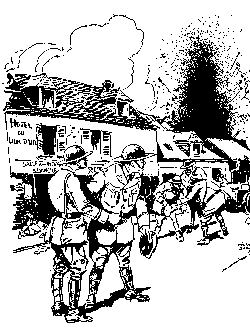
"Come on! Let's go to the abri!"
Abri was a brand new word to me, but it seemed to be some place
to go and that was enough for me.
"Where" (read this line with feeling and emphasis) "is the abri?"
The ambulance boy took me by the arm and led me on a trot to a
dugout
108--Martial Adventures of Henry and Me
covered with railroad iron, and logs and sand bags, and we went
in there and found it full of French officers. They have some
sense. The abri would not turn a direct explosion of a shell; but
it would shield one against a glancing blow and against the
shrapnel which sprays itself out from the point where the shell
hits like a molten iron fountain. After the ninth bomb had come
over we left the abri. The Germans had been allowancing Recicourt
to nine a day. But that day they gave us three more prunes for
dessert. They came very close and fairly fast together. As they
came Henry was sitting in the barn where the ambulance boys had
their meals. Lunch was on the table and Henry was writing. The
shells sounded just outside the barn. "What are you writing, Mr.
Allen?" asked Major Murphy. "I'm sketching," stuttered the
Wichita statesman, "a sort of a draft of the American terms of
peace!"
After three extra bombs had come in the Germans turned their guns
from the town, and we had our lunch at our ease. And such a
lunch! A melon to begin with; a yellow melon that looks like the
old-fashioned American muskmelon and tastes like a nectar of the
gods, followed by onion soup. Then followed an entree, a large
thin slice
"Come on! Let's go to the abri!"
(blank page follows)
"Bombs Bursting in Air"--111
of cold sausage which they afterward told us was made of horse
meat, a pate of some kind, then roast veal sliced thin and
slightly underdone with browned potatoes; then new beans served
as a separate course; then fruit and cheese and coffee and
cigars! And that in a barn!
We had to go up to a first aid station after lunch so we piled
into an ambulance, were buttoned in from the back by the driver,
and went sailing up the hill and into the woods. They told us
that we were in the Avecourt Woods in the Forest of Hess. We
remembered that but a few weeks before when we were in our
newspaper offices, that the Avecourt Woods had been the scene of
some fierce and bloody fighting. And as we rode up the hill we
heard the French cannon roaring all about us. We were told that
four thousand cannon were planted in the Avecourt Woods, but only
about a thousand of them were active that day. Yet we could see
none, so completely were they hidden by camouflage. The woods
were barren of leaves or branches though they should have been in
foliage. We gazed through the windows of the ambulance into
the stark forest with its top off, and then rather gradually it
occurred to me that the white objects carefully corded against
the tree trunks were
112--Martial Adventures of Henry and Me
not sticks of cord wood at all, as they seemed, and as they
should have been if the wood had been under the ax instead of
under fire. They were French seventy-five shells--deadly brass
cartridges two feet long, all nicely and peacefully corded
against the trunks of the big trees! We rode through them for
several miles. Beside the road always were the little heaps of
road metal, little heaps of stone, and always the engineers
stood ready to refill the holes that might be made by the
incoming shells. And occasionally they were coming in; though
they seemed to be landing in a distant part of the forest. The
ear becomes curiously quick at telling the difference between
what are known as arrives and departs. The departs were going out
that day at the ratio of 32 to one arrive. For the Germans had
wasted enough ammunition on the Verdun sector and were trying to
economize! Still the arrives were landing in the Avecourt wood
every minute or so, and they were disquieting. Only the chirping
of our own broad-mouthed canaries there in the roofless forest
gave us cheer. For some way the sound of the shells of our own
guns shrieking over us is a deep comfort: it is something like
the consolation of a great faith.
At last, seven or eight miles in the forest, we
"Bombs Bursting in Air"--113
came upon the first aid post, a quarter of a mile from the
opposite edge of the wood and but half a mile from the front line
trenches of Verdun. The first aid post there was a cellar, half
excavated, and half covered with earth, and roofed with iron
rails, logs and sandbags. The usual French doctors, stretcher
bearers and American Ambulance men were there. And there was the
little cemetery, always found at a first aid post where those are
buried who die on the stretchers or in the dugout. It was
lovingly adorned by the French with the tri-colour of France,
with bronze wreaths, with woodland flowers, and was altogether
bright and beautiful in the bare woods. They showed us a shell
by the cave--a gas shell that had come over during the morning
and had hit on the oblique and had not exploded. It was gently
leaking chlorine gas, which we sniffed--but gingerly. Other
shells were popping into the place and fairly near us with some
regularity and enthusiasm, and it seemed to Henry and me that we
had no desire to stare grim war's wrinkled front out of
countenance, and we hoped that the Major and Mr. Norton were
nearly ready to go back. But we heard this:
From the Major: "How far forward can we go toward Hill 304; we
would like to see it, but
114--Martial Adventures of Henry and Me
have no desire to go further than you care to have us."
And from the French lieutenant in charge: "Go to Berlin if you
want to!"
It occurred to Henry and me, considering our feelings, that the
Major's nonchalant use of that "we" was without the consent of
the governed. But when he started forward we followed. Our moral
cowardice overwhelmed our physical cowardice, and our legs
tracked ahead while our hearts tracked back. The Major Swung
along the road at a fast clip: Mr. Norton went with him. For
short-geared men we followed as fast as we could, but it was at a
respectful distance. Nearer and nearer we came to the open field,
and by the same token, quicker and nearer and hotter came the
German shells. We were continually on the duck. Our progress had
an accordion rhythm that made distance come slow. We came to a
dead mule in the road. He had been bombed recently, and was not
ready for visitors. Now a mule is not nature's masterpiece at his
best; but in the transition state between a mule and hamburger, a
mule leaves much to be desired. As we passed the forward reaches
of the mule, Henry began his kidding. He always begins to guy a
situation under emotion. "Bill," he cried, "if
"Bombs Bursting in Air"--115
we die we'll at least save our nice new hundred dollar uniforms
down there in Paris! "And from me he got this: "And say,
Henry--if we die we won't have to face our wives and tell 'em we
paid that much for a two-piece suit! There's that comfort in
sudden death!"
It seemed to Henry and me that we had seen all there was to be
seen of the war. Hill 304 would be there after the treaty of
peace was signed and the Major and Norton then could come to see
it. But they were bound for Berlin; so we slowly edged by that
poor mule; he seemed to be the longest mule we had ever--well, he
seemed to be a sort of trans-continental mule, but we finally got
past him and came to the edge of the woods. It took about three
ducks to twenty yards, and passing the mule we had four downs and
no gain. That gave the Germans the ball. So when we got to the
edge of the wood and were standing looking into the French
trenches and at Hill 304 off at our right, after the Major had
handed Norton the field glasses and Norton had considerately
handed them to Henry, who passed them to me for such fleeting
glance as politeness might require, the Germans came back with
that ball. It came right out of Berlin, too. One could hear it
howl as it crossed the Thier-
116--Martial Adventures of Henry and Me
garten and went over Wilhelm Strasse and scream as it whizzed
over Bavaria. There never was another such shell. And we ducked--
all of us. Henry said he never saw me make such a duck--it was
the duck of a life-time. And then that shell landed. It was a
wholesale hardware store that hit--no retail affair. The sound
was awful. And then something inside of me or outside tore with
an awful rip. We had been reading Dr. Crile's book on the
anesthesia of fear, and suddenly it occurred to me that the
shell had hit me and torn a hole in me and that fear had deadened
the pain. Slowly and in terror my right hand groped back to the
place of the wound, expecting every moment to encounter blood and
ragged flesh. We were still crouched over, waiting for the
fountain of junk to cease spraying. Nearer and nearer came the
shrinking fingers to the wound. They felt no blood, but something
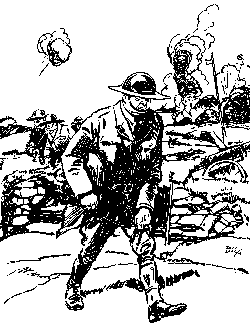
more terrible! There, dangling by its apex, hung that pie-shaped
slice of shirt from those cotton khaki trousers--ripped clear
out! And Paris fifty miles away!
Slowly we unfolded ourselves from the duck. And as we came
up--sping! went a sharp metallic click on Norton's helmet. A bit
of
shrapnel had hit it. Under a hat he would have been
Bombs Bursting in Air"--117
killed! So we went back to the first aid post--me holding those
khaki trousers up by sheer force of will, and both hands!
So long as Norton and the Major had led the way from the dugout,
it simultaneously flashed over Henry and me that we should lead
the way back, and not leave all the exertion to our companions.
So we set the pace back.
At the first aid post we stopped for breath. The French welcomed
us back, and we rested a moment under their hospitality. Our own
French guns were carolling away; the arrives were coming in. It
seemed to Henry and me that we were not so badly frightened as we
knew we were. For we kept a running fire going of airy
persiflage--which was like the noise of boys whistling through a
graveyard. Henry said: "That German gunner is playing by ear!
His time is bad, or else it's syncopated." Then to Major Murphy:
"Nice sightly location that Hill 304; but I noticed real estate
going up a good deal in the neighbourhood!" And to the assembled
company in the dugout he remarked as he pulled out his pipe, a
short Hiram Johnson, bulldog model that he had bought on the Rue
de Rivoli, "If you gentlemen will get out your gas masks now I'll
light my dreadnaught!" Which
118--Martial Adventures of Henry and Me
he did and calmed his iron nerves. So in a few moments we came
out of the post and went to our ambulance which would take us
back to Recicourt. Clouds had blown across the sky and as we
passed the gay little cemetery by the dugout, we were shocked to
see the body of a French lieutenant laid ready for burial. He had
met death while we played the fool in our twenty minutes' walk.
We rode to Recicourt greatly sobered, and it was hours before we
could get back our spirit. Of course, eventually, kind hands
pinned up the rent in the corsage of those khaki trousers. They
used a dozen big steel safety pins as large as railway spikes.
And that night as we were preparing for bed in a shack near a
hospital, Henry gazed curiously at the job as it glittered before
him in our corner, when, his friend's tunic being removed, the
wealth of metal was uncovered. Henry was impressed. "Bill," he
said gently, as he gazed admiringly at his friend's armour, "I
don't know as I ever saw a man before with so much open plumbing
on him as you're wearing these days!"
For a long time we lay awake and talked about the day's
experience, and particularly our half day under fire. We agreed
that really it was not so bad. We were scared--badly scared; but
we
So we went back--me holding those khaki trousers
up by sheer force of will and both hands!
(blank page follows)
"Bombs Bursting in Air"--121
could laugh at it, even at the hottest of it, and it was never so
exceedingly hot. Yet we might have been killed. Thousands who
died, went out in just such mild places as we had been through,
and probably went out laughing as we might have gone, by a jiggle
of a quarter of an inch one way or another of the German's gun.
Our Wichita and Emporia soldiers, we said, would doubtless live
days and weeks under what we had seen and would grow fat on it.
Then Henry mused: "I wonder if that young French lieutenant there
in the woods went out smiling!" And then for a long time no one
spoke, and at last we slept.
|


