CHAPTER II
IN WHICH WE OBSERVE THE "ROCKET'S RED
GLARE"
BORDEAUX is the "Somewhere in France" from which cablegrams
from
passengers on the French liners usually are sent. This will be
no news to the Germans, nor to Americans who read the
advertisements of the French liners, but it may be news to
Americans who receive the mysterious cablegrams "from a French
port," after their friends have landed. It is a dear old town,
mouldy, and weather-beaten, and mediaeval, this Bordeaux, with
high, mysterious walls along the streets over which hang dusty
branches of trees or vines sneaking mischievously out of bounds.
A woe-begone trolley creaks through the narrow streets and
heart-broken cabmen mourning over the mistakes of misspent lives,
larrup disconsolate horses over stony streets as they creak and
jog and wheeze ahead of the invisible crows that seem always to
be hovering above ready to batten upon
43
44--Martial Adventures of Henry and Me
their rightful provender. For an hour in the morning before our
train left for Paris we chartered one of the ramshackle cabs of
the town and took in Bordeaux. It was vastly unlike either
Emporia or Wichita, or anything in Kansas, or anything in
America; or so far as that goes, to Henry and me, it was unlike
anything else in the wide and beautiful world. "All this needs,"
said Henry, as he lolled back upon the moth-eaten cushions of the
hack that banged its iron rims on the cobbles beneath us, and
sent the thrill of it into our teeth, "all this needs is Mary
Pickford and a player organ to be a good film!" The only thing
we
saw that made us homesick was the group of firemen in front of
the engine house playing checkers or chess or something. But the
town had an historic interest for us as the home of the
Girondists of the French Revolution; so we looked up their
monument and did proper reverence to them. They were moderate
idealists who rose during the first year of the revolution; we
thought them much like the Bull Moosers. So we did what homage we
could to the Girondists who were run over by the revolutionary
band wagon and sent to the guillotine during the Terror. For we
knew; indeed into the rolly-poly necks of Henry and me, in our
own politics, the
The "Rocket's Red Glare"--45
knife had bitten many times. So we stood before what seemed to be
the proper monument with sympathetic eyes and uncovered heads for
a second before we took the train for Paris.
All day long we rode through the only peaceful part of France we
were to see in our martial adventures. It was fair and fat and
smiling--that France that lay between the river Gironde and
Paris, and all day we rode through its beauty and its richness.
The thing which we missed most from the landscape, being used to
the American landscape, was the automobile. We did not see one in
the day's journey. In Kansas alone there are 190,000 continually
pervading the landscape. We had yet to learn that there are no
private automobiles in France, that the government had
commandeered all automobiles and that even the taxis of Paris
have but ten gallons of gasoline a day allotted to each of them.
So we gazed at the two-wheeled carts, the high, bony, strong
white oxen, the ribbons of roads, hard-surfaced and beautiful,
wreathing the gentle hills, and longed for a car to make the
journey past the fine old chateaux that flashed in and out of our
vision behind the hills. War was a million miles away from the
pastoral France that we saw coming up from Bordeaux.
46--Martial Adventures of Henry and Me
But in Paris war met us far out in the suburbs, where at dusk a
great flock of airplanes from a training camp buzzed over us and
sailed along with the train, distancing us and returning to play
with us like big sportive birds. The train was filled with our
shipmates from the boat and we all craned our necks from the
windows to look at the wonderful sight of the air covey that
fluttered above us. Even the Eager Soul, our delicious young
person with her crinkly red hair and serious eyes, disconnected
herself long enough from the Gilded Youth and the Young Doctor
"for to admire and for to see," the airplanes.
But the airplanes gave us the day's first opportunity to talk to
the Eager Soul. Until dusk the Gilded Youth had kept her in his
donjon--a first class compartment jammed with hand-baggage, and
where she had insisted that the Young Doctor should come also. We
knew that without being told; also it was evident as we passed
up and down the car aisle during the day that she was acting as a
sort of human Baedeker to the Young Doctor, while the Gilded
Youth, to whom chateaux and French countryside were an old, old
story, sat by and hooted. But the airplanes pulled him out of his
donjon keep and the Young
The "Rocket's Red Glare"--47
Doctor with him. He wasn't above showing the Young Doctor how
much a Gilded Youth really knows about mechanics and airplanes,
and we slipped in and chatted with the Eager Soul. We had a human
interest in the contest between the Gilded Youth and the Young
Doctor, and a sporting interest which centered in the daily
score. And we gathered this: That it was the Young Doctor's day.
For he was in France to help the greatest cause in the world; and
the Gilded Youth affected to be in France--to enjoy the greatest
outdoor game in the world. But he had made it plain that day to
the Eager Soul that working eighteen hours a day under shell
fire, driving an ambulance, was growing tame. He was going back,
of course, but he was thinking seriously of the air service. The
Doctor wanted no thrills. He was willing to boil surgical
instruments or squirt disinfectant around kitchens to serve. And
the Eager Soul liked that attitude, though it was obvious to us,
that she was in the war game as a bit of a sport and because it
was too dull in her Old Home Town, "somewhere in the United
States." And we knew also what she did not admit, even if she
recognized it, that in the Old Home Town, men of the sort to
attract women of her spirit and intelligence were scarce--and she
48--Martial Adventures of Henry and Me
was out looking for her own Sir Galahad, as he went up and down
the earth searching for the Holy Grail. The war to her, we knew,
was a great opportunity to enjoy the new freedom of her sex, to
lose her harem veil, to breathe free air as an achieving human
creature--but, alas! one's forties are too wise. Pretty as she
was, innocent as she was, and eager as her soul was in high
emprise of the conflict of world ideals into which she was
plunging, we felt that, after all, hidden away deeply in the
secret places of her heart, were a man and a home and children.
We whizzed through the dusk in the suburbs of Paris that night,
seeing the gathering implements of war coming into the landscape
for the first time--the army trucks, the horizon blue of the
French uniform, the great training camps, the Red Cross store
houses, the scores and scores of hospitals that might be seen in
the public buildings with Red Cross flags on them, the munition
plants pouring out their streams of women workers in their
jumpers and overalls. The girl porters came through and turned on
the lights in the train. No lights outside told us that we were
hurrying through a great city. Paris was dark. We went through
the underground where there was more light than there was
The "Rocket's Red Glare"--49
above ground. The streets seemed like tunnels and the tunnels
like streets. We came into the dingy station and a score of women
porters and red capped girls came for our baggage. They ran the
trucks, they moved the express; they took care of the mail, and
through them we edged up the stairway into the half-lighted
station and looked out into the night-black, lampless, engulfing-
and it was Paris!
It was nine o'clock as we stood on the threshold of the station
peering into the murk. Not a taxi was in the stand waiting; but
from afar we could hear a great honking of auto-horns, that
sounded like the night calls of monster birds flitting over the
city. The air was vibrant with these wild calls. We were an hour
waiting there in the gloom for a conveyance. But when we left the
wide square about the station, and came into the streets of
Paris, we understood why the auto horns were bellowing so. For
the automobiles were running lickety-split through the darkness
without lights and the howls of their horns pierced the night.
The few street lights burning a low candle power at the
intersections of the great boulevards were hooded and cast but a
pale glow on the pavements. And as we rode from our station and
passed the Tuileries and the Rue
50--Martial Adventures of Henry and Me
de Rivoli, save for the dim outline of the iron railings of the
Gardens ten feet from our cab window, we had no sign to mark our
way. Yet our cab whizzed along at a twenty-five mile gait, and
every few seconds a great blatting devil would honk out of the
darkness, and whirl past us, and sometimes we would be abreast of
another and the fiendish horns of us would go screaming in chorus
as we raced and passed and repassed one another on the broad
street. The din was nerve racking--but highly Parisian. One
fancied that Paris, being denied its lights, made up its quota of
sensation by multiplying its sound!
We went to the Ritz--now smile; the others did! Not that the Ritz
is an inferior hotel. We went there because it was really the
grandee among Paris hotels. Yet every day we were in Paris when
we told people we were at the Ritz, they smiled. The human mind
doesn't seem to be able to associate Henry and me with the Ritz
without the sense of the eternal fitness of things going
wapper-jawed and catawampus. We are that kind of men. Wichita and
Emporia are written large and indelibly upon us; and the Ritz,
which is the rendezvous of the nobility, merely becomes a
background for our rusticity--the spotlight which reveals the
everlasting jay in us!
The "Rocket's Red Glare"--51
We went to the Ritz largely because it seemed to me that as a
leading American orator, Henry should have proper European
terminal facilities. And the Ritz looked to me like the proper
setting for an international figure. There, it seemed to me, the
rich and the great would congregate to invite him to dinners, and
to me, at least, who had imagination, there seemed something
rather splendid in fancying the gentry saying, "Ah, yes--Henry J.
Allen, of Wichita--the next governor of Kansas, I understand!"
Henry indicated his feeling about the Ritz thus: The night we
arrived he failed, for the first time in two weeks, to demand a
dress rehearsal in our $17.93 uniforms from 43rd Street in New
York. The gold braided uniforms that we saw in the corridors of
the Ritz that night made us pause and consider many things. When
we unpacked our valises, there were the little bundles just as
they had come from 43rd Street. Henry tucked his away with a
sigh, and just before he went to sleep he called across the
widening spaces between sleep and wakening: "I suppose we might
have bought that $23.78 outfit, easy enough!"
It was in the morning that the veneer of the Ritz began to wear
off for Henry. He had
52--Martial Adventures of Henry and Me
pulled a bath and found it cold; they were conserving fuel and no
hot water was allowed in the hotels of Paris excepting Friday and
Saturday nights. The English, who are naturally mean, declare
that the French save seventy-five per cent of the use of their
hot water by putting the two hot water nights together, as no
living Frenchman ever took a bath two consecutive days. But it
did not seem that way to Henry and me. And anyway we heard these
theories later. But that morning Henry, who doesn't really mind a
cold bath, was ready for it when he happened to look around the
bathroom and found there wasn't a scrap of soap. There he was, as
one might say, au natural, or perhaps better--if one should
include the dripping from his first plunge--one might say he was
au jus! And what is more, he was au mad. He jabbed the bell
button that summoned the valet, and when the boy appeared Henry
had his speech ready for him. "Donnez mo-i some soap here and be
mighty blame toot sweet about it!" The valet explained that soap
was not furnished with the room. It took some time to get that
across in broken French and English; then Henry, talking very
slowly and in his best oratorical voice, with his foot on the
fortissimo, cried: "Say! We are paying," at the
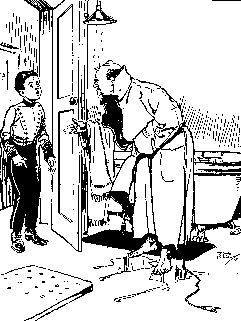
"Donnez moi some soap here and be mighty blame
toot sweet about it!"
(blank page follows)
The "Rocket's Red Glare"--55
dazed look in the valet's face Henry repeated slower and louder,
"We are paying, I say, fifteen-dollars--fif-teen dollars a day
for these rooms. You go ask Mrs. Ritz if she will furnish soap
for twenty?" And he waved the valet grandly out.
An hour later we sallied forth to see Paris in war time. Our way
lay through the lonely Vendome, out by the empty Rue Castiglione,
down the Rue de Rivoli. So we came into the great beautiful Place
de la Concorde; and what a wide and magnificent waste it was. Now
and then a wayfarer might be seen crossing its splendid
distances, or a taxicab spinning along through the statuesque
grandeur of the place. But the few moving objects in the white
stretch of marble and cement only accented its lonely aspect. The
circle of the French provinces was as desolate as the Pompeiian
Forum, and save for the bright colours of the banks of flowers
that were heaped upon the monuments to Alsace and Lorraine, the
place might have been an excavation rather than the heart of a
great world metropolis. Before the war, to cross the Place de la
Concorde and go into the Champs Elysees was an adventure of a
life time. One took one's chances. One survived, but he had his
thrills. But that morning
56--Martial Adventures of Henry and Me
we might have walked safely with bowed head and hands clasped
behind us through the Place, across the Elysian fields; there we
sat for a moment in one of the Babylonian cafés and saw
nothing more shocking than the beautiful women of France
gathering in the abandoned cafes and music halls to assemble
surgical dressings for the French wounded.
In due course, in that first day of our pilgrimage in Europe, we
came to the headquarters of the American Red Cross in the Place
de la Concorde. The five floors of a building once used for a
man's club are now filled with bustling, hustling Americans.
Those delicately tinted souls in Europe who are homesick for
Broadway may find it in the office of the American Red Cross; but
they will find lower Broadway, not the place of the bright
lights. The click and clatter of typewriters punctuate the air.
Natty stenographers, prim office women, matronly looking heads of
departments, and assistants from perhaps the tubercular
department, the reconstruction department, the bureau of home
relief in Paris, or what not, move briskly through the corridors.
In the reception rooms are men from the ends of the
earth--Rumanians, Serbians, Armenians, Belgians, Boers, Russians,
Japs--every nation
The "Rocket's Red Glare"--57
at peace with America has some business sometime in that Paris
office of the American Red Cross. For there abides the
commissioner of the Red Cross for all Europe. At that time he was
a spare, well made man in his late thirties,-- Major Grayson
M.-P. Murphy; a West Pointer who left the army fifteen years ago
after service in the Philippines, started "broke" in New York
peddling insurance, and quit business last June vice-president of
the largest trust company in the world, making the climb at
considerable speed, but without much noise. He was the quietest
man in Paris. He was so quiet that he had to have a muffler
cut-out on his own great heart to keep it from drowning his
voice! There is a soft lisp in his speech which might fool
strangers who do not know about the steel of his nerves and the
keenness of his eye. He sat in a roomy office with a clean desk,
toyed with a paper knife and made quick, sure, accurate decisions
in a low hesitant voice that never backed track nor weakened be-
fore a disagreeable situation. He is the man who more than anyone
else has laid out the spending of the major part of the first one
hundred millions gathered in America by the Red Cross drive
last summer. He held his rank as Major in the United States army,
and wore his uniform as
58--Martial Adventures of Henry and Me
though it were his skin, clean, unwrinkled and handsome, with
that gorgeous quality of unconscious pride that is, after all,
the West Pointer's real grace.
As we sat in that noble room, looking out across the Place de la
Concorde, past the Obelisk to the House of Deputies beyond the
Seine, it was evident that Henry was thinking hard. The spectacle
of Major Murphy's young men in their habiliments of service, Red
Cross military uniforms that made them look like lilies of the
valley and bright and morning stars, gave us both something to
think about. The recollection of those $17.93 uniforms of ours in
the rooms at the Ritz was disquieting. We had service hats; these
young gods wore brown caps with leather visors and enameled Red
Crosses above the leather. We had cotton khaki tunics unadorned,
and of a vintage ten years old. They had khaki worsted of a cut
to conform to the newest general order. They had Sam Browne belts
of high potency, and we had no substitute even for that insignia
of power. They had shiny leather puttees. We had tapes. They had
brown shoes--we had not given a fleeting thought to shoes. We
might as well have had congress gaiters! So when the conversation
with Major Murphy turned to a
The "Rocket's Red Glare"--59
point where he said that he expected us to go with him to the
French front immediately he took a look at our Sunday best
Emporia and Wichita civilian clothes and asked casually, "Have
you gentlemen uniforms?" For me right there the cock crowed three
times. Henry heard it also, and answered slowly, " Well, no--
not exactly."
"Mr. Hoppen," said the Major, "take these gentlemen down the
street and show them where to get uniforms!" Which Mr. Hoppen
went and did. Now Mr. Hoppen is related to the Morgans--the J.
Pierpont Morgans--and he has small notion of Emporia and Wichita.
So he took us to a tailorshop after his own heart. We chose a
modest outfit, with no frills. We ordered one pair of riding
breeches each, and one tunic each, and one American army cap
each. The tunic was to conform to the recent Army regulation for
Red Cross tunics, and the trousers were to match; Henry looked at
me and received a distress signal, but he ignored it and said
nonchalantly, "When can we have them?" The tailor told us to call
for a fitting in two weeks, but we were going to the front before
that. That made no difference; and then Henry came to the real
point. "How much," he asked, "will these
60--Martial Adventures of Henry and Me
be?" The tailor answered in francs and we quickly divided the sum
into dollars. It made $100. "For both?" asked Henry hopefully.
"For each," answered the tailor firmly. There stood Mr. Hoppen,
of Morgans. There also stood Wichita and Emporia. Henry's eyes
did not bat; Mr. Hoppen wore a shimmering Sam Browne belt.
Looking casually at it Henry asked:
"Shall we require one of those?"
"Gentlemen are all wearing them, sir," answered the tailor.
"How much?" queried Henry.
"Well, you gentlemen are a trifle thick sir, and we'll have to
have them specially made, but I presume we may safely say $14
each, sir!"
Henry did not even look at me, but lifted the wormwood to his
lips and quaffed it. "Make two," he answered.
The world should not be unsafe for democracy if Wichita and
Emporia could help it!
We went to a show that night with the feeling of guilt and shame
one has who has betrayed his family. That $114 with ten more to
come for brown shoes, flickered in the spot light and babbled on
the lips of the singers. They danced it in the ballet. Each of
was thinking with guilty horror of how he would break the news of
The "Rocket's Red Glare"--61
that uniform bargain to his wife. So we went home tired that
first night, through the grim dark streets of Paris and to our
rooms. And there were those 43rd street uniforms still unwrapped
in the bureau drawer. Henry again demanded dress rehearsal. He
insisted that as we were going to have to wear them to the front
we ought know how we looked inside of them. But we were weary and
again put off the dread hour. The next morning we bought our ten
dollar brown shoes, and concluded that there was a vast amount of
foolishness connected with this war.
During the long fair days while we waited for Major Murphy to
take us to the front, we wandered about Paris, puffing and
spluttering through the French language. Henry never was sure of
anything but toot sweet and some devilish perversion was forever
sticking sophomore German into my mouth, when French should have
risen. The German never actually broke out. If it had, we should
have been shot as spies. But it was so close that it always
seemed to be snooping around ready to jump out. That made it
hard for me to shine in French.
These adventures with the French language were not exactly the
martial adventures that Charley Chandler, of Wichita, and Warren
Fin-
62--Martial Adventures of Henry and Me
ney, of Emporia, thought we would be having at the Front, when
they trundled us out to win the war. Yet these adventures were
serious. They were adventures in lonesomeness. We could imagine
how the American soldier boy would feel and what he would say
when this language began to wash about his ears and submerge him
in its depths. We could fancy American soldiers wandering through
the French villages, unable to buy things, because they couldn't
understand the prices. We could understand the dreary, bleak,
isolated lives of these American boys, with all the desolation of
foreigners hungering always for human companionship, outside of
the everlasting camp. And we came to know the misery of
homesickness that hides in the phrase, "a stranger in a strange
land!"
So we were glad to summon the Eager Soul to dine with us, and we
let her order a dinner so complicated that it tasted like a
lexicon! We learned much about the Eager Soul that night. She
told us of her two college degrees, her year's teaching
experience, her four years' nursing, and her people in the old
home town. Bit by bit, we picked out her status from the things
she dropped inadvertently. And that night in our rooms we
assembled the parts of the puzzle thus; one ram-
The "Rocket's Red Glare"--63
bling Bedford limestone American castle in the Country Club
district; two cars, with garage to match; a widowed mother, a
lamented father who made all kinds of money, so naturally some of
was honest money; two brothers, a married sister; a love for
Henry James, and Galsworthy substantial familiarity with Ibsen,
Hauptman, Bergsen, Wagner, Puccini, Brahms, Freud, Tschaikovsky,
and Bernard Shaw; a wholehearted admiration for Barrie; and a
record as organizer in the suffrage campaign which won in her
state three years ago, plus a habit of buying gloves by the dozen
and candy in five pound boxes! We could not prove it, but we
agreed that she probably bossed her mother and that the brother
wives hated her and the sister's husband loved her to death! She
was one of those socially assured persons in the Old Home Town
who are never afraid of themselves out of it! She confessed that
she had seen more or less of the Gilded Youth, before he left for
Verdun, and in a pyrotechnic display of dimples, she admitted
that she had gone to the station to bid the Young Doctor
good-bye. She had been assigned to hospital near the Verdun
sector, and was going out the following day. When we left her at
the door of the Hotel Vouillemont, we plunged back
64--Martial Adventures of Henry and Me
into the encircling gloom of the French language with real
regret.
As we went further into the life about us, we felt that all the
men were in uniform and all the women in mourning. The French
mourn beautifully. France today is the world's tragedy queen
whose suffering is all genuine, but all magnificently done. In
the shop windows of the boulevards, and along the Avenue of the
Opera are no bright colours--excepting for men's uniforms. In the
windows of the millinery shops, purple is the gayest
colour--purple and lavender and black prevail. On every street
are blind
windows of departed shops. Some bear signs notifying customers
that they are closed for the duration of the war; others simply
stare blankly and piteously at passersby who know the story
without words.
Yet if it is not a gay Paris, it is anything but a sad Paris.
Rather it is a busy Paris; a Paris that stays indoors and works.
For an hour or two after twilight the crowds come out: Sunday
also they throng the boulevards. And the theatres are always well
filled: and there the bright dress uniforms of the men overcome
the sombre gowns of the women and the scenes in lobbies and
foyers are not far from brilliant. Bands and
The "Rocket's Red Glare"--65
orchestras play in the theatres, but the music lacks fire. It is
beautiful music, carefully done, artistically executed, but the
orchestras are made up for the most part of men past the military
age. We heard "La Tosca" one afternoon and in the orchestra sat
twenty men with grey hair and the tenor was fat! As the season
grew old, we heard "Louise," "Carmen," "Aphrodite," "Butterfly"
(in London), and "Aida" (in Milan), and always the musical
accompaniment to the social vagaries of these ladies who are no
better than they should be, was music from old heads and old
hearts. The "other lips and other hearts whose tales of love"
should have been told ardently through fiddle and clarinet are
toying with the great harp of a thousand strings that plays the
dance of death. That is the music the young men are playing in
Europe today. But in Paris, busy, drab, absent-minded Paris, the
music that should be made from the soul of youth, crying into
reeds and strings and brass is an echo, an echo altogether lovely
but passionless!
Finally our season of waiting ended. We came home to the Ritz at
midnight from a dinner with Major Murphy, where we had been
notified that we were to start for the front the next morning. We
told him that the new uniforms were
66--Martial Adventures of Henry and Me
not yet ready and confessed to him that we had the cheap
uniforms; he looked resigned. He had been entertaining a regular
callithumpian parade of Red Cross commissioners from America, and
he probably felt that he had seen the worst and that this was
just another cross. But when we reached our rooms that midnight,
Henry lifted his voice, not in pleading, but in command. For we
were to start at seven the next morning, and it was orders. So
each went to his bedroom and began unwrapping his bundles. In ten
minutes Henry appeared caparisoned like a chocolate divinity!
With me there was trouble. Someone had blundered. The shirt went
on easily; the tunic went on cosily, but the trousers--someone
had shuffled those trousers on me. Even a shoe spoon and
foots-ease wouldn't get them to rise to their necessary height.
Inspection proved that they were 36; now 36 doesn't do me much
good as a waist line! There is a net deficit of eight tragic
inches, and eight inches short in one waistband is a catastrophe.
Yet there we were. It was half past twelve. In six hours more we
must be on our way to the front--to the great adventure. Uniforms
were imperative. And there was the hiatus! Whereupon Henry rose.
He rang for the valet; no response. He rang for
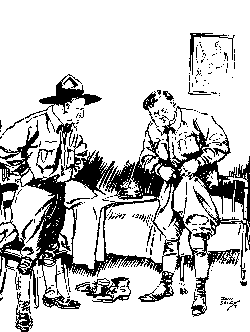
Eight inches short in one waistband is a catastrophe
(blank page follows)
The "Rocket's Red Glare"--69
the tailor; he was in bed. He rang for the waiter; he was off
duty. There was just one name left on the call card; so Henry
hustled me into an overcoat and rang for the chambermaid!
And she appeared as innocent of English as we were of French. It
was an awful moment! But Henry slowly began making gestures and
talking in clear-ly e-nun-ci-a-ted tones. The gestures were the
well-known gestures of his valedictory to the Republican party at
the Chicago Auditorium in 1912--beautiful gestures and
impressive. The maid became interested. Then he took the
recalcitrant trousers, placed them gently but firmly against his
friend's heart--or such a matter, showing how far from the ideal
they came. Then he laid on the bed a brown woollen shirt, and in
the tail of it marked out dramatically a "V" slice about the
shape of an old-fashioned slice of pumpkin pie--a segment ten or
a dozen inches wide that would require two hands in feeding. Then
he pointed from the shirt to the trousers and then to the ample
bosom of his friend, indicating with emotion that the huge
pie-slice was to go into the rear corsage of the breeches. It was
wonderful to see intelligence dawn in the face of that
chambermaid. The gestures of that Bull Moose speech had touched
her
70--Martial Adventures of Henry and Me
heart. Suddenly she knew the truth, and it made her free, so she
cried, "Wee wee!" And oratory had again risen to its proper place
in our midst! At two o'clock she returned with the pumpkin pie
slice from the tail of the brown shirt, neatly, but hardly
gaudily inserted into the rear waist line of the riding trousers,
and we lay down to pleasant dreams; for we found that by standing
stiffly erect, by keeping one's tunic pulled down, and by
carefully avoiding a stooping posture, it was possible to conceal
the facts of one's double life. So we went forth with Major
Murphy the next morning as care-free as "Eden's garden birds." We
looked like birds, too--scarecrows!
Our business took us to the American Ambulance men who were with
the French army. Generally when they were at work they were
quartered near a big base hospital; and their work took them from
the large hospital to the first aid stations near the front line
trenches. Our way from Paris to these men led across the
devastated area of France. As the chief activity of the French at
the time of our visit was in the Verdun sector, we spent most of
our first week at the front near Verdun. And one evening at twi-
light we walked through the ruined city. The
The "Rocket's Red Glare"--71
Germans had just finished their evening strafe; two hundred big
shells had been thrown over from their field guns into the ruins.
After the two hundredth shell had dropped it was as safe in
Verdun as in Emporia until the next day. For the Germans are
methodical in all things, and they spend just so many shells on
each enemy point, and no more. The German work of destruction
is thorough in Verdun. Not a roof remains intact upon its walls;
not a wall remains uncracked; not a soul lives in the town; now
and then a sentinel may be met patrolling the wagon road that
winds through the streets. This wagon road, by the way, is the
object of the German artillery's attention. Upon this road they
think the revitalment trains pass up to the front. But the
sentinels come and go. The only living inhabitants we saw in the
place were two black cats. It must have been a beautiful city
before the war--a town of sixty thousand and more. It contained
some old and interesting Gothic ecclesiastical buildings--a
cloister, a bishop's residence, a school--or what not--that, even
crumbled and shattered by the shells, still show in ruins grace
and charm and dignity. And battered as these mute stones were, it
seemed marvellous that mere stone could translate so delicately
the highest
72--Martial Adventures of Henry and Me
groping of men's hearts toward God, their most unutterable
longing. And the broken stones of the Gothic ruin, in the
freshness and rawness of their ruin, seemed to be bleeding out
human aspiration, spilling it footlessly upon the dead earth.
And of course all about these ecclesiastical ruins were the ruins
of homes, and shops and stores--places just as pitifully
appealing in their appalling wreck--where men had lived and loved
and striven and failed and risen again and gone on slowly
climbing through the weary centuries to the heights of grace
toward which the tendrils of their hearts, pictured in the
cloister and the apse and the tower, were so blindly groping. A
dust covered chromo on a tottering wall; a little round-about
hanging beside a broken bed, a lamp revealed on a table, a work
bench deserted, a store smashed and turned to debris and left to
petrify as the shell wrecked it--a thousand little details of a
life that had gone, the soul vanished from a town, leaving it
stark and dead, mere wood and stone and iron--this was the Verdun
that we saw in the twilight after the Germans had finished
their evening strafe.
From Verdun we hurried through the night, past half a dozen
ruined villages to a big base hospital. We came there in the
dark before
The "Rocket's Red Glare"--73
moonrise, and met our ambulance men--mostly young college boys
joyously flirting with death under the German guns. They were
stationed in a tent well outside the big hospital building.
They gave us a dinner worth while--onion soup, thick rare steak
with peas and carrots, some sort of paste--perhaps macaroni or
raviolli, a jelly omelet soused in rum, and served burning blue
blazes, and cheese and coffee--and this from a camp kitchen from
a French cook on five minutes' notice, an hour after the regular
dinner. The ambulance men were under the direct command of a
French lieutenant--a Frenchman of a quiet, gentle, serious type,
who welcomed us beautifully, played host graciously and told us
many interesting things about the work of the army around him;
and told it so simply--yet withal so sadly, that it impressed his
face and manner upon us long after we had left him. Three or four
times a day we were meeting French lieutenants who had charge of
our ambulance men at the front. But this one was different. He
was so gentle and so serious without being at all solemn. He had
been in the war for three years, and said quite incidentally,
that under the law of averages his time was long past due
and he expected to go soon. It didn't seem to
74--Martial Adventures of Henry and Me
bother him. He passed the rum omelet with a steady hand. But his
serious mien had attracted the ambulance boys and upon the room
of his office in the big brick hospital they had scrawled in
chalk, "Défense absolutement de rire!" "It's absolutely
forbidden
to laugh." Evidently American humour got on his nerves. As we
dined in the tent, the boys outside sang trench songs, and
college songs with trench words, and gave other demonstrations of
their youth.
So we ate and listened to the singing, while the moon rose, and
with it came a fog--more than a fog--a cloud of heavy mist that
hid the moon. We moved our baggage from the tent to a vacant room
in a vacant ward in the big hospital. We saw in the misty
moonlight a great brick structure running around a compound. The
compound was over 200 feet square, and in the centre of the
compound was a big Red Cross made of canvas, painted red, on a
background of whitewashed stones. It was 100 feet square. On each
side of the compound a Red Cross blazed from the roof of the
buildings, under the Geneva lights--lights which the Germans had
agreed should mark our hospitals and protect them from air raids.
The "Rocket's Red Glare"--75
At midnight we left the hospital to visit those ambulance men who
were stationed at the first aid posts, up near the battle line.
It was an eery sort of night ride in the ambulance, going without
lights, up the zigzags of the hill to the battle front of Verdun.
The white clay of the road was sloppy and the car wobbled and
skidded along and we passed scores of other vehicles going up and
coming down--with not a flicker of light on any of them. The Red
Cross on our ambulance gave us the right of way over everything
but ammunition trucks, so we sped forward rapidly. It was
revitalment time. Hundreds of motor trucks and horsecarts laden
with munitions, food, men and the thousand and one supplies
needed to keep an army going, were making their nightly trip to
the trenches. When we reached a point near the top of the long
hill, which we had been climbing, we got out of the ambulance
and found that we were at a first aid dugout just back of the
hill from whose top one could see the battle. The first aid post
was a cave tunnelled a few yards into the hillside covered with
railroad iron and sandbags. In the dugout was a little operating
room where the wounded were bandaged before starting them down
the hill in
76--Martial Adventures of Henry and Me
the ambulance to the hospital, and three doctors and half a dozen
stretcher bearers were standing inside out of the misty rain.
As we had been climbing the hill in the ambulance, the roar of
the big guns grew louder and louder. We believed it was French
cannon. But when we got out of the car we heard an angry whistle
and a roar which told us that German shells were coming in near
us. As we stood before the dugout shivering in the mist we saw
beyond us, over the hill, the glare of the French trench rockets
lighting up the clouds above us weirdly, and spreading a sickly
glow over the white muddy road before us. On the road skirting
the very door of the dugout passed a line of motor trucks and
carts--the revitalment train. The mist walled us in. Every few
seconds out of the mist came a huge grey truck or a lumbering
two-wheeled cart; and then, creaking heavily past the dugout
door, plunged into the mist again. Never did the procession stop.
At regular intervals the German shells crashed into the woods
farther up the hill beyond us. But the silent procession before
us--looming out of the mist, passing us, and fading into the
mist, kept constantly moving. In the ghostly light of the misty
moonshine, the procession seemed to be
The "Rocket's Red Glare"--77
spectral--like a line of passing souls. A doctor came out of the
dugout and started up the hill. He, too, was swallowed in the
mist. Ahead of us up the road were noises that told us the
Germans were landing bombs there, not half a mile--perhaps not
much more than a quarter of a mile away. The stretcher bearers
told us that the Germans were shelling a cross-road. They shelled
it every night at midnight to smash the revitalment train. The
shells were landing right in the road whereon all these trucks
and horse carts were passing. The doctor who left us returned in
a few minutes in an ambulance--wounded. Another ambulance came up
with four or five wounded. A shell had crashed in and wiped out a
truck load of men. But the procession under the misty moon never
stopped--never even hesitated. No driver spoke. No teams or
trucks cluttered up the road. As fast as a bomb shattered the
road out there behind the mist, or made debris of a truck, the
engineers hurried up, cleared the way, removed the debris and the
ceaseless procession in the ghostly moonlight moved on. Another
ambulance brought in two more wounded.
After one o'clock the bombing stopped. Some other cross-road was
taking its turn. Five men
78--Martial Adventures of Henry and Me
were buried that night in the little cemetery there by the
dugout. We stood or sat about for a while! no one had much to
say. The grey mist thickened and enveloped us. And we became as
very shadows ourselves. Somewhere in the mist up the hill, near
where the rocket's red glare flushed on the dim horizon, a man
began whistling the intermezzo from "Thais." It fitted the un-
reality of the scene, and soon two of us were whistling together.
He heard me and paused. Then we walked toward one another
whistling and met. It was the Gilded Youth from the ship--the
Gilded Youth whose many millions had made him shimmer. He was not
shimmering there on the sloppy hillside. He was a field service
man, and we went back to his machine and sat on it and talked
music--music that seemed to be the only reality there in the
midst of death, and the spirit that was moving men in the
moonlight to forget death for something more real than death. And
so it came about that the crescendo of our talk ran thus:
And courage--that thing which the Germans thought was their
special gift from Heaven, bred of military discipline, rising out
of German kultur--we know now is the commonest heritage of men.
It is the divine fire burning in the souls of
The "Rocket's Red Glare"--79
us that proves the case for democracy. For base and
underneath
we are all equals. In crises the rich man, the poor man, the
thief, the harlot, the preacher, the teacher, the labourer, the
ignorant, the wise, all go to death for somethinq that defies
death, somethinq immortal in the human heart. Those
truck-drivers, those mule whackers, those common soldiers, that
doctor, these college men on the ambulances are brothers tonight
in the democracy of courage. Upon that democracy is the hope of
the race, for it bespeaks wider and deeper kinship of men.
So then we knew that under the gilding of the Gilded Youth was
fine gold. He was called for a wounded man. As he cranked up his
car he asked rather too casually, "Have you seen our friend from
the boat--the pretty nurse?" We started to answer; the stretcher
bearer called again and in an instant he went buzzing away and we
returned to the hospital.
We slept that night in a hospital bed. The week before three
thousand men had passed through that hospital--some upon the long
journey, so we rose early the next morning. For some way to Henry
and me there seemed a curious disquietude about those hospital
beds.
In the early morning just after dawn we saw
80--Martial Adventures of Henry and Me
them taking out the dead from the hospital. The stretcher bearers
moved as quickly as they could with their burden through the
yard. A dozen soldiers and orderlies were in the hospital
compound, but no one turned a head toward the bearers and their
burden. There were indeed, in sad deed, "a dearth of woman's
nursing and a lack of woman's tears." No one knew who the dead
man was. He wore his identification tag about him. No one cared
except that it should be registered. If he was an officer he went
to one part of the little graveyard just outside the fence; if he
was a private he went inside. It was a lonely, heart-breaking
sight. And it occurred to Henry and me--we had been among the
ghosts on the hill the night before and had slept uneasily with
the ghosts in the hospital--that we should give one poor fellow a
funeral. So we lined up in the chill dawn, and followed the
stretcher bearers and marched after some poor Frenchman to his
tomb. It was probably the only funeral that the hospital yard
ever had seen, for the soldiers and orderlies and attendants
turned and gaped at the wonder, and nurses peered from the
windows.
Four days later we were sitting in the court-
yard of a little tavern in St. Dizier. A young
The "Rocket's Red Glare"--81
French soldier came up, and tried his English on us. He found
that we had been to Verdun. And he asked, " Have you heard the
news from the big base hospital?" We had not. Then he told us
that the night before the German airmen had come to the hospital
early in the night and had dropped their eggs--incendiary bombs.
An hour later they came and dropped some high explosives. They
came again at midnight and because there were no anti-aircraft
guns near by--the allies until those August and September German
raids never had dreamed that hospitals would be raided--they came
again swooping low and turned their machine guns on the doctors
and the nurses in the compound who were taking the wounded out of
the burning building. Then toward morning they came and dropped
handbills which declared, "If you don't want your hospitals
bombed, move them back further from the front!"
The Germans were not acting in the heat of passion. They were
fighting scientifically, even if barbarously. For every mile a
hospital is moved back of the line makes it that much harder to
stop gangrene in the wounded. And by checking gangrene we are
saving a great majority of our wounded to return to battle.
82-- Martial Adventures of Henry and Me
Nine doctors and fifteen nurses and many wounded were killed that
night at Vlaincourt. "And the French officer de liason between
the French army and the American ambulance, what of him?" we
asked.
"He slept in the hospital and was killed by a bomb," answered the
Frenchman.
So our serious faced French lieutenant knew all too well why "It
is absolutely forbidden to laugh" in war!
|


