-
VOICES, KANCOLL'S ONLINE MAGAZINE


|
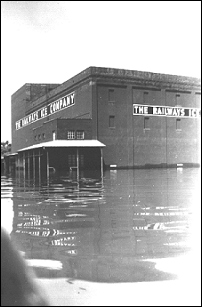
In 1951, the Korean War continued; peace talks began, broke off, and began again. It was the year that the Battle for Heartbreak Ridge was fought. Meanwhile, in the United States, Julius and Ethel Rosenberg were tried and convicted of espionage. The first electricity from nuclear power was generated. Americans were singing "Getting to Know You" and "In the Cool, Cool, Cool of the Evening." They were reading James Jones' new book, From Here to Eternity and watching "I Love Lucy" on television. The Yankees beat the Giants in the World Series, "The King and I" opened on Broadway, and The African Queen played in the theaters. There was also a flood. The 1951 Flood was devastating. Rain began in April, and by July rivers were overflowing. The flood hit Topeka on July 12 and Kansas City on July 13 (a Friday). Thousands of people evacuated; forty in Kansas died. The flood covered over a million acres in Kansas and almost that many in Missouri, affecting over 180 cities and towns in both states. Evidence of the power of the tumbling waters: the Santa Fe Bridge in Topeka was weighted down with four locomotives, a total of more than 340,000 pounds, but that was no match for the rushing, swollen river -- the bridge was simply swept away. Rebuilding after this disaster cost millions of dollars, and to encourage Kansas Citians in their efforts to put the city back together, Hallmark founder Joyce Hall commissioned a painting from Norman Rockwell. The painting, "The Spirit of Kansas City," captured the determination and energy of Missourians and Kansans to set things right again: a tall man in the foreground is rolling up his sleeves as he holds blueprints in one hand. In the background you see the Kansas City skyline, an airplane against the clearing skies, a well-fed steer, and shocks of wheat and corn. Members of the Internet mailing list Kansas-L were asked what they remembered about the 1951 Flood, and they generously responded with stories about this disaster, which happened when most of them were quite young. Jim Banister said, "I remember the '51 flood quite well. I was a 12-year old living on a farm west of Basehor. Vividly remember water rushing through the guardrail of the old Bonner Springs bridge which seemed to me to be about a mile above the river. Looking south from the north approach, water stretching to the Johnson County hills two miles away, I thought "this must be what the ocean looks like." 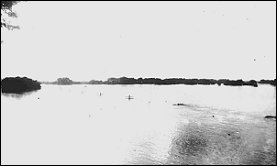 Don B. Dale recalled, "In front of our three story brick home on West 50 in Garden City the water over flowed the curbs and soaked everything. We had in the middle of the circular drive a lily pond in which I remember depositing at various times gold fish from a school carnival and an occasional bull head caught from a neighbors pond. We, my brother and I, were standing in front of the house watching all the water go by when lo and behold there was this fin sticking up out of the water. The excitement of that moment was and is my memory of the flood. "We immediately fanned out to surround the 'fin', obviously a fish of unknown description and size, and captured it. Through sheer energy and persistence, the fish was soon trapped. As memory serves it was about three or four pounds, no make that 7 or 8, my memory is getting fuzzy and as I think back that darn fish seems to grow in size. Anyway to make a long story short, the fish - it turns out that it was a white bass - have never caught one or seen one since - and it was quickly deposited into the lily pond. For a week or so until it passed on to the big river in the sky, we had a memento of that flood. I always wondered how that bass came to be in front of our house, from where it came originally, and have also wondered why I never caught one in the many trips to the Ar-Kansas river following that memorable day." 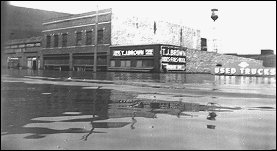 More memories of that time came from Rick Housh. "Well, I lived here in Kansas City, at the time. I was 16, and we lived in the Northeast section of town, on Gladstone Blvd., which was high up on the bluff forming the south boundary of the Missouri River flood plain and not directly threatened by the water, but the flood was overwhelming to the whole city. I have never seen devastation like that, and hope never to again..... My recollections are full of almost unbelievable images of the devastation, but not much romance or drama, I'm afraid. I'm not sure what the death toll was. "Fortunately this kind of flood, unlike an earthquake or flash flood, is preceded by considerable warning, so while many people lost homes and property, they had time to escape with their lives. "I remember driving with my father to the top of 'Signal Hill' at 31st and Summit Streets (there was no Southwest Trafficway then). It was (and is) called Signal Hill because WDAF-TV had built Kansas City's first TV broadcasting tower at the top (1949) of it, one of the highest spots in town. From there one can see the entire West Bottoms area, from Southwest Boulevard at the foot of the hill, to 'North of the [Missouri] River', all of which was under water, including all the railroad freight yards, both airports, K.C. MO Municipial, and K.C. KS Fairfax. You can still see watermarks at the maximum level on some of the old buildings in Rosedale and Argentine at the 12 - 15 foot levels, I would estimate. This extended all the way across the Missouri flood plain, several miles, as I recall. I remember all kinds of things floating by, including water towers from who knows what cities and towns, and many, many railroad cars. The thing that really sticks in my mind though, were the literally hundreds of drowned cattle, each with four legs sticking straight up in the air, moving down what normally would have been busy streets, at a very rapid speed. Although I didn't see any myself, there were plenty of human bodies too, of some killed in the flood, as well as washed up from flooded cemeteries. "I also remember that the entire city water supply became contaminated, and we were required to either boil the water or use those little purification pills. If you were home you could boil it, but if not, you couldn't rely on anything, and had to carry a little cup, and treat each cupful with a pill, waiting long enough for it to have had its effect before drinking it. We were very religious about doing this, and I don't recall anyone who wasn't. "Kansas City wasn't as large then as now, obviously, but it wasn't small either, and there was serious concern of typhoid and other epidemics. Fortunately, probably because of the extent of cooperation with sanitary efforts, the fears never materialized. However, there was no such thing as flood insurance then, of course, and many, many businesses were ruined. It was really quite a number of years before the city completely recovered from that flood, and some will say it never did. There was a great rebuilding spirit, but, to my mind it was not that rapid, because of the importance to do something to reduce the potential for floods before pushing ahead with the effort. "Despite some criticism, the Army Corps of Engineers has done a wonderful job over a long period of time of taming most of the dangers from flooding on the Missouri and Kansas Rivers since then. We have had some flooding recently, but the scale is minuscule compared to the tragedy in 1951." 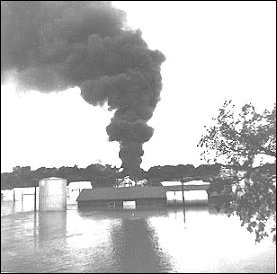 Alice Berg Beauchene was in Manhattan, Kansas, at the time. "I was in school at Kansas State when the 1951 flood took place. I remember catching a very small fish at the entrance to the city park on Poyntz. Kept him for a number of months. "And then some of us in MYF shoveled the mud from some of the houses in eastern Manhattan. "My aunt, uncle and their four children lived in North Topeka at the time of the flood. They had an older two story house with a bathroom that was one step lower than the rest of the upstairs. They took the burner out of the gas furnace in the basement and laid it on the bathroom floor. The flood did ruin it but did not get the upstairs floors. And the house was above the level of the street so the water was very deep. The floor in the middle room of the downstairs (dining room?) suffered a partial collapse. They tore off the front room downstairs and upstairs and used some of that lumber (and much more) to build a new house in the hills of southeast Topeka." Gary Presson wrote, "In 1951, I was 13 yrs old, and our Boy Scout troop sand-bagged at the 13th Street bridge over the Little Arkansas river around North High, here in Wichita. Now we have the "Big Ditch" which shunts this kind of flood on both the Ark rivers, around the city. It, however, doesn't do anything for the folks out west, who live on the flood plain of some of the lesser creeks and streams."  Adds Linda Morgan Clark, "I can remember Hutchinson flooding frequently in my childhood, from Cow Creek (pronounced "crick," of course!) and the Ar Kansas river. It may have been '51 when we sandbagged our basement walls on 17th Street. The brownish water rose higher than the curbs I remember one year in particular and got up into the yard but never made it all the way to the house. There was a bridge over the Creek on the west end of 17th so the street was one of the main channels for bringing the water into town. "I believe it was after that that the flood control dikes were built west of town to keep the water out there on the farmer's fields. I can remember my parents debating the morality of sparing the town at the expense of the farmers' wheat fields. "The creek and river are so well under control now (as far as the town is concerned, anyway) that the area of South Main that was built over the creek and was covered up by buildings and streets for several city blocks, has been uncovered. The buildings have been torn down and the creek channelized through a real pretty park below street level on South Main. The creek's really not much more than a trickle these days. And South Main's primary attraction is no longer the fact that it ends in Carey Park." 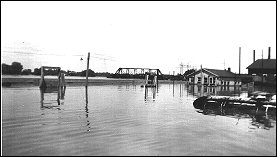 Mike Hayes recollected, "I think I remember the same flood Linda wrote about. I've always thought it was pretty flat around Hutchinson (with good reason), but discovered Jefferson Street, on which we lived, had a definite slope between 19th and 18th. I was six in 1951. That's about what size I was when I recall water flowing up over the curbs and stopping just short of the house. I had a bright yellow and blue inflatable row boat that I carried up to the corner of 19th and Jefferson. The ride down to 18th may have been a bit less dramatic than that white water stuff they do in the Grand Canyon, but it impressed me. I was soon joined by an armada of neighborhood kids, most of whom had liberated inner tubes in order to join the adventure. I might have continued right on downstream to joined Huck and Jim on the big river if my parents hadn't been standing by to cancel the cruise as it passed our house. I seem to recall there was quite a bit of damage downtown but I was too young to be concerned about much beyond navigating the mighty Jefferson. My father had a dry cleaning establishment near B and Main, near where Cow Creek flowed under the city. I think that was the summer he redecorated--with good reason."
|