"A distressed time, to say the least, was had by
all who were here last year. Not only is this a new
place, and no one knew what to expect or that he owned
when he came here. At the same time, I must testify that
this excells any other Welsh settlement in the states
because we had gotten our land for so little, and thus we
had kept the money which we would have had to pay for
land in any other settlement to support ourselves and
live. And though it turned out that the preceding year
had been very dry, we were very glad to be here. We are
able to live well on the fruits of the money which the
speculators of the other settlements had taken
from our compatriots, that is, the first payment for the
land. By now our large fields are full of abundant crops.
Not only is our wheat fruiting out pleasantly, but the
oats and Indian corn also -- we are able to expect from
50 to 75 bushels an acre at least. Some of the land here
has been cultivated before, and some land has been plowed
for the first time this year; but we know that no one
expected such a large crop of sod corn. It looks as if it
will produce about 50 bushels to an acre. In the future
we will laugh about it and be ready to rejoice. We had
everything for that year without going to the settlement
to ask for it, and we were able to buy many of the
necessities of life there; we had but to go there. This
was done, and some new things still come there, and it is
much more comfortable than if we had had to go 25 miles
to ask for everything for our satisfaction and pay almost
double prices for it as we had been compelled to do in
the past year. Things have changed now because we have a
store in the settlement which sells all
necessary goods, and the old settlers have made some
changes in their method of returning the seed to the
ground now that wheat and flour can be purchased. The
first settlers had the advantage of getting cheap land,
but that has almost all been taken here at the present
time. The advantage to the settlers during the second
year is that every other thing is cheaper for them than
it had been for the settlers before them. We now have a
store, a blacksmith, etc. in the town of Y Bala instead
of being compelled to go as far as Manhattan to do all
such tasks. The old settlers were forced to pay $4 an
acre for plowing their land; but that can be done now for
from $3.50 to $3. There were three strong oxen in the
settlement last year, but the Welsh this year have from
15 to 20 good teams of oxen and they are still
increasing. New settlers are continuing to come here, so
that the number now is from 300 to 400, although the
settlement is only a bit larger than it was a year ago.
Our town is not growing as quickly as many of the towns
in the new settlements because we believe that it is best
to construct our houses first, and then to build up the
town. I believe that this is the best way of all, not to
build the town first, and after spending our money to
make good buildings in the town, to have nothing to spend
on the farm. We have now in Y Bala only six homes, a
store, an office, and a smithy already established, but
there are two or three places already started, and the
town hall, which will be intended for the use of the
public and for religious services because we do not have
a church there yet, although it is likely that we will
not be much longer without one. We have a union church
there now although we have a minister, the Rev. Henry
Davies, a Congregationalist, formerly of Big Rock,
Illinois. [74] The Rev. R.
Gwesyn Jones of Utica and the Rev. H. E. Thomas of
Pittsburgh were here two weeks ago and we had a very good
meeting on the Sabbath with them. There was excellent
preaching and the two have gone to settle on their high
land until there is a "Session of Y Bala" in truth. The
following Thursday a meeting was held and the evidence of
the settlers about the settlement was written and we
intend to publish it in letters and to distribute it."
Here
is the testimony of two of the settlers about Powys and Y
Bala in Kansas. They give an accurate picture of the
settlement from its beginning to the present time. Before
the end of the next two years it will have grown and
succeeded greatly and all the land near Y Bala will have
been bought and settled on. I believe that more should be
done to encourage good Welsh settlements in Riley, Clay,
Pottawattamie [sic], Marshall, Washington,
Republic, and Shirley [75]
counties which are near Powys, Kansas. The Welsh settlement
of Powys is about 70 miles further north than Emporia and
Arvonia, but one is able to go from the one to the other on
the railroad through Junction City or Topeka and Manhattan.
[76] The officers of the Land
and Emigration Society are the following trustworthy
gentlemen: President, Rev. Rhys Gwesyn Jones of Utica;
Vice-president, Rev. John Moses of Newark, Ohio; Treasurer,
Rev. D. T. Davies of Utica, N.Y.; Secretary, Rev. Isaac
Thomas of Utica; Agent, J. H. Jenkins, [77]
Powys, Manhattan, Riley Co., Kansas. One can get
shares from the Company for $100 each from the
above persons, from the Rev. H. E. Thomas, Pittsburgh, Pa.,
or Mr. J. W. Howells, Scranton, Pa. The main office of the
Society is 104 Genesee Street, Utica, Oneida Co., N.Y.
12. BANGOR, COFFEY CO. [78]
This new town is located
about 10 miles south-west of the city of Burlington in the
same county in a healthful and fruitful area. It is not far
from the boundaries of Greenwood and Woodson counties where
one is able to buy the best lands in the state from Wm. P.
Jones, Esq. [79] and others
for from $3 to $7 an acre. There are several small streams
running past it to Bangor and there is a little timber
growing on their banks. The railroad will soon be running
from Kansas City, Ottumwa, and Burlington through Bangor to
Eureka, and from there to Santa Fe. [80]
Many new settlements will be established in the great and
fruitful Neosho Valley, and it is hoped that Bangor will be
one of the major ones. Several respected Welshmen have
settled there already. The first step will be the necessary
one of buying land in that area.
Notes
DR. PHILLIPS G. DAVIES is professor of
English at Iowa State University, Ames, and holds
advanced degrees from Northwestern University, Evanston,
Ill. His previous publications have been on literary
figures such as Thackeray, Shelley, and Hemingway.
Material on Iowa,
Missouri, Illinois, and Ohio from the Thomas book, edited
by Dr. Davies, has been or soon will be published in
other historical journals.
1. Most
of this biographical information comes from Memorial
Volume of Welsh Congregationalists, U.S.A. by Rev.
David Jones (Utica, N.Y., Press of Utica, 1934); some
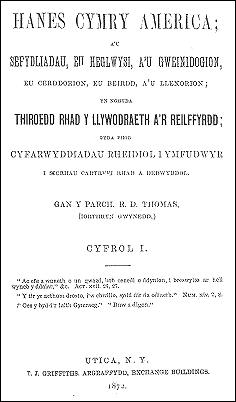
additional data has been found in Thomas's own Hanes
Cymry America. 
2. For
more information about the Welsh in this community,
see Carolyn B. Berneking, "The Welsh Settlers of
Emporia: A Cultural History," Kansas Historical
Quarterly (KHQ), v. 37 (Autumn, 1971), pp. 269-280.
Berneking says that the first Welsh immigrants came to
Emporia in 1857, the year when the city initially was
established, but there were Welsh settlers in Lyon county by
1856.
3. This
line of the Missouri, Kansas and Texas (or "Katy") railway
was being extended from Junction City southeastward through
Emporia and Parsons, across the southern border of Kansas,
and through the Indian territory during the early 1870's
when Thomas wrote his book. The main line of the Atchison,
Topeka and Santa Fe railroad (to which he refers in an
awkward manner as if it were two lines) reached Emporia from
Topeka via Burlingame and Reading in 1870, and was extended
on to the western state boundary by the end of 1872. --
See V. V. Masterson, The Katy Railroad and the
Last Frontier (Norman, University of Oklahoma Press,
1952), pp. 31-192; Joseph W. Snell and Don W. Wilson, "The
Birth of the Atchison Topeka and Santa Fe Railroad --
Concluded," KHQ, v. 34 (Autumn, 1968), pp. 325-356.
4. A
Welsh physician named Thomas Morris was listed on p. 3 in
the 3d ward of Emporia in the 1870 federal census for Lyon
county, archives department, Kansas State Historical Society
(KSHS). Dr. Morris advertised in the Emporia News
on August 6, 1869, that he specialized in obstetrics and
diseases of women and children.
5. It is
very difficult to identify individual Welshmen when only
their last names are known. Most Welsh immigrants shared
about a dozen very common surnames. Jones and Thomas could
have been references to a number of people in Emporia who
were listed as natives of Wales in the 1870 federal census.
6. An
advertisement in the May 12, 1871, issue of the Emporia
News indicates that Wm. B. Jones was associated
with C. B. Bacheller and J. P. Pinkerton, both of whom were
attorneys in Emporia, in selling real estate and insurance.
7. The
1870 federal census listed 41 farmers and 11 farm laborers
who were natives of Wales living in Emporia township
(including the city of Emporia). Scattered throughout the
remainder of Lyon county there were nine more farmers who
were Welsh immigrants. See J. Neale Carman,
Foreign-Language Units of Kansas; I. Historical Atlas
and Statistics (Lawrence, The University of Kansas
Press, 1962), pp. 186-187, for additional information about
the Welsh population of Lyon county.
8.
According to Berneking, "Welsh Settlers of Emporia," p. 270,
Rev. George Lewis reached Lyon county in 1856. Born in
Carmarthen, South Wales, he had served as a minister in Ohio
and Iowa before coming to Kansas. The articles he wrote for
Y Drych, a Welsh-language newspaper published in
New York, helped stimulate interest in Emporia among Welsh
immigrants.
9. This
Rev. Mr. Jones probably was Ebenezer Jones, who was born in
Merthyr Tydfil, Brecknockshire, South Wales, in 1827. Before
coming to Emporia in May, 1868, he served as pastor of
congregations in Wales, Pennsylvania, and Ohio. Until he
retired from the ministry in 1870 and became a farmer near
Emporia he preached at the Welsh Union church. -- See A
Brief History of the Sardis Congregational Church,
1871-1949 [Emporia Sardis Congregational church,
1949], pp. 4, 32. A. T. Andreas and W. G. Cutler,
History of the State of Kansas (Chicago, A. T.
Andreas, 1883), p. 849, says that the Welsh Congregational
church in Emporia, known as the Bethany Congregational or
Second Congregational, was organized in the spring of 1866
and gives the credit to G. C. Morse and a man named Fox.
10.
Rev. Henry Rees, born in Carmarthenshire, South Wales,
October 24, 1820, was educated at a Welsh college and Oxford
University in England. He came to the United States in 1869.
He was pastor of the Second Congregational church in Emporia
during the early 1880's when Andreas and Cutler prepared
their History of the State of Kansas (p. 859).
See, also, A Brief History of the Sardis
Congregational Church, p. 14.
11.
This was the Sardis Congregational church which was
organized in 1871 and incorporated in 1872 as the First
Congregational church of Dry Creek. Rees also helped form a
third church, known as Peniel or Coal Creek Congregational,
which met at the Coal Creek schoolhouse six miles southeast
of the Sardis church. For a time he was pastor of all three
churches, but eventually only of the two rural
congregations. -- See A Brief History of the Sardis
Congregational Church, pp. 12-13.
12.
Berneking, "Welsh Settlers of Emporia," p. 277, says that
Rev. John Jones lived in Middle Granville, N.Y., for six
years after immigrating from Wales. He then became pastor of
the Welsh Salem (or Dry Creek) Presbyterian church, south of
Emporia, not long after it was organized by Rev. R. M.
Overstreet in 1869. In 1871 Jones was instrumental in
establishing the Second Presbyterian church (Welsh). He held
both pastorates for over two decades and remained minister
of the Salem church until his death in 1901. -- See
"Passing of Old Salem Church Revives Memories of Early
Days," Emporia Gazette, January 9, 1936, in
"Presbyterian Church Clippings," v. 1, pp. 225-226, KSHS;
also A Brief History of the Sardis Congregational
Church, p. 10; and Andreas and Cutler, History of
the State of Kansas, p. 849. An unusually lengthy and
laudatory obituary for Jones was published on the front page
of the Emporia Gazette on July 21, 1901.
13. The
Drych and the Faner (the latter mentioned
subsequently) were Welsh-language newspapers. The former was
begun in New York City in 1851. Its circulation was over 5
000 copies in the 1870's. It still exists, now totally
written in English and edited in Milwaukee. The
Faner was founded in the late 1860's and was
published in Scranton, Pa.
14. A
number of items printed in the Burlingame Osage
Chronicle on April 10, May 15, August 28, and November
27, 1869, indicate that Arvonia initially was established in
April 1869; that John Mather Jones was a resident of Utica,
N.Y., where he published Y Drych (see
footnote 13); and that he had printed thousands of pamphlets
promoting Welsh immigration to Kansas. The 1870 federal
census for Arvonia township in Osage county, p. 10,
indicates that Jones was a 40-year-old native of Wales and
lists his occupation as land agent.
15. The
county seat of Osage county was moved from Burlingame to
Lyndon in 1875 after a bitter struggle between the two
communities.
16. The
Diminished Reserve was the remaining portion of a
30-mile-square reservation received by the Sac and Fox
Indians of the Mississippi in 1842 when they relinquished
their hunting grounds in Iowa. In 1859-1860 the tribe ceded
about 300,000 acres in trust to the government and kept the
Diminished Reserve of 150,000-160,000 acres, mostly in
eastern Osage county, until 1867-1868. -- See
William Frank Zornow, Kansas: A History of the Jayhawk
State (Norman, University of Oklahoma Press, 1957), pp.
49, 97-99, 104; Burlingame Osage Chronicle,
November 14, 1868.
17. For
a number of years there was much talk about construction of
a railroad up the Marais des Cygnes river valley from
Ottawa, through Arvonia, to Emporia. J. Mather Jones and his
associates were very active in railroad promotional activity
in 1870 and 1871, but this dream of Arvonia residents did
not materialize.
18.
There were some who expressed doubts about the leadership
provided by J. Mather Jones. The Burlingame Osage
Chronicle noted on May 29, 1869, for example, that the
Emporia News recently had claimed many Welsh
immigrants were settling in Lyon county instead of at
Arvonia because they thought Jones and his associates were
guilty of misrepresentations in their promotional efforts.
Jones defended himself in a letter to the
Commonwealth after that Topeka newspaper reprinted
the Emporia News article. He insisted that
promoting Welsh immigration to Kansas was his fundamental
objective, and it did not bother him if some preferred other
counties. In this instance and several others the local
newspaper defended Jones or praised his efforts. --
Osage Chronicle, May 22, November 27, 1869.
19.
Sobriety was highly valued by the promoters of Arvonia. They
placed restrictive clauses in all the deeds to town lots
prohibiting the sale of intoxicating beverages and expressed
their determination "to use every legal and moral influence
to preserve this community from the desolation of the rum
traffic." -- Burlingame Osage Chronicle, April 2,
1870.
20.
Thomas Jones was a very common Welsh name, and there were at
least four or five men with this name living or visiting in
Osage county in 1869.
21.
Jesse E. Evans was the Osage county surveyor during 1869. --
Burlingame Osage Chronicle, November 7, 1868, April
10, 1869.
22.
John Rees was an associate of J. Mather Jones and James A.
Whitaker in the sale of land in the Arvonia vicinity. Both
the 1870 federal census (p. 10) and the 1875 state census
for Arvonia township (p. 1) in Osage county (archives
department, KSHS) listed him as a land agent. Born near
Conway, Wales, December 21, 1822, he emigrated to the United
States in 1842 and moved to Arvonia in 1869.
23.
According to the Topeka Commonwealth, May 25, 1870,
Jones and Whitaker had purchased 80,000 acres of land in
Osage county. A much different report, however, was
published by the Burlingame Osage Chronicle, May
29, 1869: ". . . Messrs. Jones & Whitaker are preparing
to do a much larger business with the view of disposing to
actual settlers the large tract of land which Mr. J. Mather
Jones has the exclusive right to sell, and which are known
as the lands of R. S. Stevens, and Northup & Chick.
Besides the above lands Messrs. Jones & Whitaker have
purchased since in this county, about eight thousand acres
of choice lands from Messrs. Seyfert, McManns
[sic] & Co., of Reading, Pennsylvania,
which secures to them the exclusive control of nearly all
the lands for nine miles north, nine miles east, five miles
south and five miles west of the point selected for their
town. . . ."
24. The
1870 federal census for Arvonia township, p. 15, listed
Thomas Grijeffyild (?) Jones as a 38-year-old preacher. He
had a wife, Rebecca, and four daughters. "Tafalaw" was
Jones's bardic name. It was customary for poets and other
serious writers to assume a pen name when they submitted
their works to eisteddfods and other literary competitions.
25. The
Sac and Fox Indians left Osage county for their new
reservation in the Indian territory in November, 1869, and
thus were gone by the time this book was published. --
Burlingame Osage Chronicle, November 6, 1869.
26. A
cornerstone was laid for a college building in Arvonia, but
construction of it was never completed. -- Evans, "Arvonia,"
p. 2.
27.
According to the 1875 state census for Arvonia township, pp.
5, 14, Owen Jones was a 61-year-old farmer who was a native
of Wales, but who had come to Kansas from New York.
28. The
1870 federal census for Arvonia township listed 26 farmers
and four farm laborers who were natives of Wales. Elsewhere
in Osage county there were five additional Welsh farmers.
29. Of
the 594 people living in Arvonia township in 1870, 203 were
born in Wales, according to the 1870 federal census. In
addition, there were a number of children born in the United
States in the families of the Welsh immigrants.
30.
See the Burlingame Osage Chronicle, April
2, 16, 1870, for an interesting exchange of letters
concerning the ecumenical spirit manifested in this Union
church and the merits of sectarianism.
31.
Rev. William Thomas was 53 years old when the 1870 federal
census for Arvonia township (p. 8) was taken. He was married
to a woman named Margaret, but had no children living at
home.
32.
This probably was a reference to Rev. John Barrows, a
graduate of Yale College whose father was president of
Olivet College in Michigan. On September 11, 1869, the
Burlingame Osage Chronicle mentioned him as an
example of the "substantial men" who recently had purchased
property in and near Arvonia.
|