
The Ranch at Cimarron Crossing
by Louise Barry
Autumn, 1973 (Vol.
XXXIX, No. 3), pages 345 to 366
Transcription & HTML composition by Larry E. & Carolyn L.
Mix;
digitized with permission of The Kansas State Historical Society.
NOTE: The numbers in brackets are links to footnotes for this
text.
RATHER
predictably the middle and generally-used ford of the
Arkansas on the Santa Fe trail's Cimarron desert route came
to be known as Cimarron Crossing. However, prior to the
1860's this name was little used! Scattered information,
brought together for the first time here, supplies proof,
also, that the middle crossing was relocated at least twice
between 1827 and the 1860's. In 1827 it was near "The
Caches." From an early period (early 1830's?) till 1852, the
main ford was west of present Ingalls. In a move instigated
by the military, "Cimarron Crossing" then was shifted some
eight and a half miles downriver to a site west of present
Cimarron. (See map below, "Some Trails to Santa Fe Through
Southwest Kansas.") Some
Trails to Santa Fe Through Southwest Kansas Joseph
C. Brown (the trail's surveyor, 1825-1827), in his report,
located the middle crossing as follows: Josiah
Gregg (who first went to Santa Fe in 1831), in his
Commerce of the Prairies (1844), had this to say of
fording the Arkansas: Dr.
Frederick A. Wislizenus, en route to Mexico with Albert
Speyer's train (22 large, heavily laden wagons, each drawn
by 10 mules; several smaller vehicles; 35 men), in 1846,
wrote: It
is likely that the first change of "middle" fords occurred
in the 1830's, but the earliest evidence is in Gregg's Santa
Fe trail table of distances, 1844, where "Ford of Arkansas"
is listed as 20(?) miles above "The Caches" (instead of near
them). Maps by Gregg (1844), Emory (1847), and Wislizenus
(1848), also show the middle crossing miles above "The
Caches ." [4] Fort
Mann, or Mann's Fort -- a government stockade -- was built
on the Arkansas, below, but within sight of "The Caches," in
1847. (It was abandoned for good in the fall of 1848.) Maj.
James H. Carleton (in 1848) listed the distance from Fort
Mann to "Crossing of Arkansas" as 26 miles. John A. Bingham
(in 1848) recorded it as, 30 miles in his table of
distances. Bvt. Maj. Henry L. Kendrick (who camped "Near
Fort Mann" in 1849) put down the distance to "Crossing of
Arkansas" as 22.99 miles. Despite the discrepancies,
presumably they all had reference to the same ford -- that
is the crossing used in 1844 (which means, not surprisingly,
that Gregg's mileages were estimates, and not accurate).
Another table (not identified), apparently of about 1849
date (but published in an 1859 guidebook), gave the distance
from Fort Mann to Lower [i. e., Middle]
Crossing of the Arkansas" as 25.34 miles. This, no doubt,
was a reliable statistics. [5] Between
"The Caches" and Fort Mann another landmark -- Fort Atkinson
-- was constructed in 1850. This short-lived army post
(abandoned 1853; but used as a summer camp, 1854) was
located some, three quarters of a mile above Fort Mann.
Asst. Surg. Aquila T. Ridgely, stationed at Fort Atkinson in
1851-1852, reported: "It [the fort] is twenty-six
miles below the 'crossing of the Arkansas', . . ." 2Lt.
William D. Whipple, on his way to the southwest in the
summer of 1852, wrote: "twenty-five miles beyond Fort
Atkinson is the old and main crossing of the Arkansas River
to take the Cimmarron route." From figures supplied by
Francis X. Aubry, it was stated in the Missouri
Republican of May 18, 1852, that the distance "From
Cimarone crossing, to Fort Atkinson" was 25 miles. (Aubry's
is the earliest-located mention of the middle ford of the
Arkansas as Cimarron Crossing.)" [6] As
for Lieutenant Whipple's reference, above, to "the old and
main crossing," there was significance in his use of "old."
Other fords, nearer the army post, were being tried, one of
which, by 1853, became the new main crossing. William Carr
Lane (en rotate to New Mexico to become its territorial
governor) left Fort Atkinson in August, 1852, with Maj.
James H. Carleton's command (a company of dragoons, a brass
cannon, two baggage wagons, and an ambulance). In his diary
he wrote:
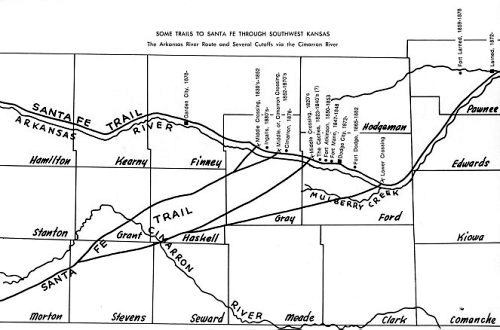
The Arkansas River Route and Several Cutoffs via the
Cimarron River
Some
turn off at a place known to the Santa Fe travelers by
the name of the "Caches," [storage holes dug by
traders in 1823, west of present Dodge City] near to
which is a rocky point of a hill at some distance from
the river, composed of cemented pebbles, and therefore
called Gravel Rocks. At about 3 miles southwest from this
rock is a place of crossing for those who travel the
lower route, or directly to the aforenamed Semaron
Spring. . . . [1]
.
. . during the greatest portion of the year, the channel
is very shallow. Still the bed of the river being in many
places filled with quicksand, it is requisite to examine
and mark out the best ford with stakes, before one
undertakes to cross. The wagons are then driven over
usually by double teams, which should never be permitted
to stop, else animals and wagons are apt to founder, and
the loading is liable to be damaged. . . .
[2]
.
. . we arrived at the usual fording place of the
Arkansas. . . . The river is here several hundred yards
wide, very sandy but not deep, and generally easily
forded. The road, which continues to run up the river on
its northern bank, leads to Bent's Fort . . . but
[the] shorter route by crossing here the
Arkansas, and striking southwest for the Cimarron, is
preferred by the Santa Fe traders. . . . [On June
10] The whole morning was spent in crossing the
wagons. To each of the large wagons from 8 to 10 couple
of mules were put, and in about six hours all stood safe
on the other side. . . . [3]
Crossed
the Arkansas about 18[?] miles from the Fort and
had some difficulty in the transit. . . . The Arkansas
river was a little over a quarter of a mile in width and
is just up to the bottom of the carriages, but we escaped
any wetting. The banks are low and it don't appear that
the river ever rises more than about eight feet, and that
it overflows its banks. The waters are as muddy as the
Missouri river. The banks are bare of timber and
underbrush and do not contain any rock. The east side is
sheltered with a range of sand hills some eight or ten
miles wide. [7]
|
G. Harris Heap, westbound in 1853, noted in his "Itinerary" that it was 10[?] miles from Fort Atkinson to "1st Crossing of S. Fe trail"; and from that point to the "2d Crossing" it was five[?] miles. This "2d Crossing," which by Heap's calculation was 15 miles above the army post, must have been the one Line described as "about 18 miles from the Fort." Heap made no reference at all to the "old" crossing 25 or 26 miles above Fort Atkinson. Though his distances must be questioned, Heap's "Itinerary" does confirm that the new middle crossing, nearer Fort Atkinson, had been established by 1853. [8] W. W. H. Davis, who went to New Mexico with the November, 1853, mail party, gave no mileages, and had only this to say in his book El Gringo: "We encamped . . . at the middle crossing among the sand-hills. We forded the river the next morning opposite our campground, and stopped on the other side for breakfast. There were herds of buffaloes and antelopes grazing near. . . ." [9] Robert M. Peck, recalling (in 1903?) the year 1857, and his travels then, and subsequently, across Kansas as a cavalryman, wrote as follows: About fifteen or eighteen miles west of the ruins of old Fort Atkinson was the Santa Fe crossing of the Arkansas. The crossing was opposite -- almost under -- a high bluff, that overlooked the ford and surrounding country for some distance. In recent historical sketches, I have noticed some diversity of opinion between writers as to the relative location of and distance between old Fort Atkinson and the Santa Fe crossing, varying from eight to twenty-six miles. I have traveled the road and camped many times at both places, and we always considered it a short day's march between them, and we usually called the distance fifteen or eighteen miles, but I never knew the exact measurement. [10] In the fall or winter of 1858, Dr. J. W. Reed traveled the Santa Fe trail (by way of its upper Arkansas, or Bent's Fort branch). From his 1859-published guidebook the following is quoted -- not for his mileages, which are incompatible with those in other published tables of distances -- for his statements on Arkansas crossings: ". . . thence to old Fort Mann or Atkinson [i. e., Fort Atkinson], 15 miles . . . ; thence to the present crossing of the Arkansas, 13 miles. Here the road crosses, leading to Fort Union and Santa Fe; thence to the old crossing, 18 miles; thence to the Pawnee Fort, 14 miles. . . ." [11] In Randolph Marcy's The Prairie Traveler, published in 1859, is a table of distances "From Westport, Missouri, to the gold diggings . . ., via the Arkansas River," which states: "At 17 miles [beyond Fort Atkinson] pass a ford." No other crossing is mentioned. [12] Listed here are the ways in which some 1859 guidebooks' tables of distances referred to the middle Arkansas crossing: Tierney: "the Santa Fe crossing of the Arkansas river"; Parsons: "Cross[ing] Santa Fe tr[ail]"; Gunn: "Arkansas Crossing"; Pratt and Hunt: "Cross[ing] Santa Fe trail." Clearly, the middle ford was not generally known as Cimarron Crossing in the 1850's. In February, 1861, travel on the Cimarron route was reduced when the Santa Fe mail stages began using the Upper Arkansas (or, Bent's Fort) road. The change was made to supply mail service to Fort Lyon (established 1860 as Fort Wise; renamed in 1862). Freighting of government supplies increased during the Civil War years, but the amount of traffic using Cimarron Crossing and the old Cimarron route cannot be determined. In 1907, when a project to place Santa Fe trail markers along the route was under way, there was public debate as to the relative importance of the Cimarron route and the Upper Arkansas branch. Robert Wright (western Kansas pioneer of 1859) was quoted as follows: "I will say that the biggest trail and by far the most travel long before 1859, was west of the Cimarron crossing, on the north side of the Arkansas river. After 1863 [i. e., 1864] when the Indians broke out, more than three-fourths of all travel took this route as far as Bent's Fort. . . ." [13] A stage station known as Adkins's ranch was built on the Arkansas about eight and a half miles below the Fort Atkinson ruins sometime in 1863. Although in existence but briefly (Indians burned it in 1864) the name survived by appearing on two mid-1860's tables of distances. More importantly, Adkins's ranch was the site selected in April, 1865, for a new army post -- Fort Dodge. (On the original land survey plat the fort is shown on Sec. 3, T. 27 S., R. 24 W.) [14] "Fort Dodge is . . . about 10 miles east of old Fort Atkinson . . ." -- so stated Bvt. Ltc. G. A. Gordon, post commandant, on April 28, 1866. His successor, Bvt. Maj. Andrew Sheridan, wrote, on October 10, 1866: ". . . this post . . . is distant about Nine (9) miles from old Fort Atkinson, in an easterly direction." [15] The information below is extracted from three Santa Fe trail tables of distances published in the mid-1860's: (1) Kansas
City (Mo.) Daily Journal of Commerce, May 28, 1865
-- (2) Kansas
Weekly Tribune, Lawrence, January 25, 1866 -- (3) J. West
Goodwin's Pacific Railway Business Guide . . .
(1867), p. 185 -- The mileages speak for themselves. Noteworthy is the regular use of "Cimarron Crossing" as the name for the middle Arkansas ford in these tables of the 1860's. [16] II. The Ranch at Cimarron Crossing (1866-1868) From New Hampshire, in the fall of 1865, John Francis (Frank) Hartwell, aged 30, and his brother William H. Hartwell, 21, arrived in Kansas to seek their fortune." At Topeka they met a man named Ripley who was en route, with his wife, to Big Turkey Creek stage station (73 miles west of Council Grove). He recommended that they, too, buy a Santa Fe trail ranch. The Hartwells purchased Six-Mile Creek station, 22 miles beyond Council Grove. [18] During the winter business was poor; and the situation did not improve in the spring of 1866. Also, there was news that the stage line's starting point would be moved westwards. [19] For these reasons the Hartwells wanted to sell out. The division superintendent of the stage line told them the company was in need of a ranch at Cimarron Crossing, but warned that it was a dangerous undertaking because of hostile Indians. Quoting William Hartwell's reminiscences of his ranching years: Cimeron Crossing of the Arkansas River -- twenty six miles west of Ft. Dodge was represented as a no. one place for a good ranch. At this point the two routes to New Mexico separated, the Cimeron route crossing the river, . . . while that known as the Raton followed up the north side, crossing at Bent's old fort in Colorado. The result was, that Frank, Ripley, Dutch Henry and myself enter[ed] into company and accept[ed] the enterprise. The two former, accompanied by four others -- all well armed, started for Cimeron to commence building, I remaining at six mile only long enough to dispose of our ranch . . . [20] I then lost no time in loading up our household stuff, and with a good team, took the risk of being plundered and scalped, by pushing forward, part of the time alone, until I arrived safely, in due time at our destination. At full force (in 1866) there were 12 well-armed men at Cimarron (Crossing) stage station. In 1866 the Plains tribes still were observing the peace treaties made in October, 1865, and limiting their hostile actions to stock raids. Indians ran off "a few hundred dollars worth" from the ranch, but later some of the stolen animals were recovered. Generally speaking, 1866 seems to have been a satisfactory year for the Hartwells and their partners. [22] William Hartwell's account of an incident at the ranch in January, 1867, is given here in slightly edited form: The river was frozen and one day a band of young Arrapahoe bucks, out on a marauding expedition, under John Sullivan -- a blustering warrior -- crossed and came up to the ranch, entering the storeroom as coolly as if come to trade, passing the usual sign of peace -- "how." I went out for some purpose, and coming back presently, I met Ripley, who had just left the room as white as a sheet. Said he, "they are taking everything there is in there." The door opened from behind the counter and stepping in there was John Sullivan, assisted by two bucks passing out the things to the others. "See here," I said, "You thieving rascals puck-a-chee, puck-a-chee, you pap-poose chief." With that lie came toward me, spitting on his fingers and snapping them in my face. I grabbed up a wagon-spoke that happened to be within reach and dealt him a blow over the head with such force as to fell him like an ox, prone upon his face in the dust, the two other bucks fairly tumbling from behind the counter. Sullivan in the meantime staggering to his feet was kicked out before regaining his senses. By this time the others had sprung for their bows, but our navies (Frank was behind the stove) were drawn on them. At a motion they threw their weapons down and pleaded, "no shoot" "bueno chief" "heep goot," at the same time piling their plunder back on the counter. On the upper Cimarron, about the end of February, Cheyennes took four mules and two horses from "Mr. [Jim] Baker" and his cotrappers. Subsequently the white men came to Cimarron Crossing. In mid-March Maj. Henry Douglass, Fort Dodge commandant, after talking with their leader, reported on the 19th: "Mr. Baker stated to me that after 23 years experience in dealing with Indians his opinion, derived from the present aspect of affairs and condition of the Indians was that they would break out in open hostility in the spring." Later in the month Douglass learned that a retaliatory raid, without regard to tribe, was being planned by the trappers. He sent a letter to "Mr Baker Cimmarone Ranch" warning him to abandon the idea. However, on April 17 Baker and eight cohorts stole 12 horses from Little Raven's Arapahoe band -- then friendly to the whites -- and headed for the Upper Arkansas. [23] News reached Fort Dodge in mid-April, 1867, that Cheyennes and Sioux would probably attempt to cross the Arkansas at or near Cimarron Crossing. On April 17 Maj. Wickliffe Cooper received orders to proceed to that area with his Seventh U. S. cavalry squadron (Companies B and C); set up camp; and send out patrols to intercept and capture all Indians who crossed. At Cimarron Crossing, on the 19th, a scout discovered a few Indians skulking in the area. Lt. Matthew Berry and a detachment of 20 men went to investigate, were fired on, and returned fire. All six of the Cheyennes and Sioux fought until killed. Among the effects of one warrior was a white woman's scalp which appeared to be quite fresh. Pvt. George Wimard, of Company C, received a bullet in his thigh; and one trooper's horse received an arrow wound probably fatal. [24] On April 28 Company I, 37th U. S. infantry, reported at Fort Dodge for duty. [25] Some of the men were sent to Cimarron ranch. William Hartwell's reminiscences state: "The stage coaches were now coming in doubled, accompanied with an escort of blue jackets, while eleven soldiers were placed at each station. This increased our force at Cimeron to twenty five men. We strengthened our fortifications, though not an Indian until the 2nd[?] of June." [26] It was June 7, 1867, when the first Indian attack of the year occurred at Cimarron Crossing. Juan Montoya, of Simitar, Rio Abajo, had 33 head of mules run off by a band of Kiowas on that date. No lives were lost in the raid, which apparently occurred south of the ford. Montoya later complained that he not only got no assistance at Fort Dodge (25 miles downriver), but five of his men were hired to work there, leaving him short of teamsters. According to Major Douglass, the Mexican train was inadequately armed. On June 12, east of Fort Dodge, upwards of 160 Kiowas, headed by Satanta, got away with 71 horses of Company B, Seventh cavalry. Pvt. Joe Spillman, a herder, received arrow wounds from which he died next day. [27] Major Douglass, in a June 18, 1867, letter reported: . . . on the 16th inst. a band of Indians numbering 70, attacked the Stage Station at the Cimmaron Crossing, and at the same time attacked the portion of the train of Mr. C[harles] G. Parker, en route for the states, which was crossing the river at that point. The Indians were repulsed at the station by the Guard of 37th Inf. stationed there; the portion of the train attacked was guarded by three Americans, two of them were killed, and one escaped by swimming the river. The wagons were plundered, and eight head of mules and 20 head of Cattle were run off. Immediately on receiving intelligence of this, I despatched Lieut. [Henry M.] Karples 37th Infantry with forty men of the 37th Inf. in wagons to the station, and they covered the crossing of the balance of the train, exchanging a few shots with Indians. . . . The Indians were supposed to be Cheyennes & Sioux. [Later, Kiowas were credited with these raids.] Lieut. Karples lost one man by the accidental discharge of his rifle. [28] |
|
William Hartwell, in his recollections, wrote of the above attack: A mule train from Santa Fe arrived on the south, or opposite side of the river, but the water being high a partial crossing was made a hundred yards above the regular ford. After six wagons were over, a herd of mules, in care of four men, were left still on the farther side to graze -- the pastures being good. They were some two hundred yards away from their wagons, when in an instant the Indians were upon them, a band of fifty, at least, riding in a circle and fighting as they rushed up. We stood at the ranch, overlooking the bottom, and witnessed the whole affair. Puffs of smoke and crack, crack, crack arose from the tall grass in the circle, the red-skins sheering off at each shot, only to rush on again between fires, and yet the men gained their wagons, where one of them fell shot dead. The second one broke for, and gained the waters of the friendly river, while the third, a Frenchman, hurriedly climbed into a wagon loaded with wool and crawled under the sacks. The Indians gathered around, stripped off the cover, ripped open the packs and pulled the unhappy wretch out by the hair of the head. In addition to the report of Maj. Henry Douglass, Fort Dodge, and the reminiscences of rancher William Hartwell, there is extant another graphic account of the June 16 affair. It is in a letter by Mabillion W. McGee, of Kansas City, Mo., written on June 17, 1867, at Cimarron Crossing, addressed to Adam Hill, Independence, Mo., father of one of the victims: I arrive[d] here this morning to finde Charley Parker hear with his train. The Indians made an attact on this train [yesterday] when there was eight wagons on this side [of the Arkansas] and some three in the river at the time. There was two Mexicans and one French man left with the wagons on this in company with a young man name[d] Hill [i. e., Curtis Hill]. The Frenchman and Hill was killed and the Mexicans run into the river Hill had a good rifle and revolvers He had nineteen shots and emptied evry one He was kill[ed] rite between the wheels The rest of the men was in and on the other side of the river. The Indians got evry thing he had They took eight mules and cut the bales of wool open and took the cloths and the wagon sheets In a July 23, 1867, letter, Maj. Henry Douglass, Fort Dodge, reported: . . . a train of ten wagons carrying Govt. freight & owned by John Blackman was attacked by Indians, about 15 miles above this post on the Santa Fe road. [No date is given, but it appears to have been July 18 when this incident -- 10 miles below Cimarron Crossing -- occurred.] The number of men on the train was twenty (20), and they had an addition of five convalescent soldiers on their way to Fort Union. They fought with great bravery, and with the exception of one Boy mortally wounded & one ox killed, sustained no loss. I promptly dispatched thirty men in wagons to their assistance under command of Lieut. S[tanley A.] Browne [i. e., Brown, of the U. S. Volunteers -- serving with the] 3rd U. S. [Vol.] Inf. . . . Though not mentioned by Major Douglass, Pvt. James Collins, Company F, Third U. S. infantry, wounded in an engagement with Indians at Cimarron Crossing, was received at the Fort Dodge hospital on July 20. Presumably he was one of Lt. Stanley A. Brown's men. [31] These are William Hartwell's reminiscences, in edited form, of the attack on the hay cutters at Cimarron Crossing July 18: The Stage Company was in need of hay and offered us two thousand dollars for the putting up of a hundred tons. We took the contract and went to mowing in the tall grass of the river bottom. On the 17th [i. e., 18th?] of July we grew careless -- not having so far been molested, although a week had passed since beginning work. The warm day, too, made us forgetful. Barney and Sam -- I can't now recall their surnames -- Frank and I went to the grounds that day. Frank and Barney were mowing with a team of four horses, while Sam and I were raking with one horse. We had two wagons, from which six yoke of oxen were unyoked and turned loose to graze. The day, as I before said, was hot, so that we had -- all but Frank -- left our guns and revolvers with our coats at the wagons. |
|
On the night following, one of the oxen of the six yoke came up dragging a Iariat and with several pointless arrows sticking in his neck. They had cut the beast-straps and tugs, and before running the horses and mules off, had attempted to burn the mower with hay not dry enough to take fire. The long grass was trampled and a broken sickle bar at the end of a crooked swath showed that they had quite a time in securing the frightened and refractory team. . . . I was heartily sick of ranching. I was also haunted with the thought that my brother might still be in the hands of the savages and a victim of their cruel torture, and to make matters worse, cholera had come West, it was bad at Ft. Dodge, and already two had died at Cimeron. Finally, I found a man to whom I sold my share of the ranch, and bid farewell to Cimeron. In October, when the river was low, the body of my brother was found, shot through the head and scalped. He was doubtless in the stream when killed, and the Indian who went in after his scalp took off his moccasins -- being those I found on the bank when looking for him and his companion. . . . [32] A. J. Anthony (36) and Robert M. Wright (26) "bought out the Cimarron ranch, twenty-five miles west of Fort Dodge." It appears the change of ownership took place early in August, 1867. Anthony was "an old 'Overland stage messenger' [who] had seen lots of ups and downs with the Indians on the plains, and rather enjoyed them" -- according to his partner. Wright had built some of the stage stations along the trail, and, with another partner, had operated the ranch at Fort Aubrey for two years. Indians and cholera were the two chief hazards in the Cimarron Crossing area during the summer of 1867. Wright was cholera-stricken after attending the ranch cook who died of it. The Barlow, Sanderson & Company owners had him taken to Fort Dodge, where he recovered after treatment from army doctors. Wright recollected: "The cholera was perfectly awful . . . ; it killed soldiers, government employees, Santa Fe traders, and emigrants. Many new graves dotted the roadsides and camping places, making fresh landmarks." [33] For one period of several weeks the ranchers had a respite from Indian harassment; and later learned that cholera was the reason. Haymaking was the imperative summer-and-fall operation at Cimarron Crossing ranch. Anthony and Wright recruited "some of the old-timers and went to making hay." In reminiscences, Wright recalled: Day after day the Indians would harass us in some manner . . . they repeatedly ran off our stock, fired into and broke up our camp, until even the old-timers . . . began to grow tired. . . . Still we persisted, were hopeful, and continued to hire new men at from $75 to $100 a month for common hands. . . . Well, the Indians finally exhausted us of our horse stock, and we had to resort to ponies; but they were too small and we got along very slowly. We were compelled to purchase a big span of mules of the United States mail company, for which we paid $600. Mr. Anthony was very proud of them, as he had often sat behind them when he was a messenger on the overland routes. They were named Puss and Jennie. The first morning they were sent to the haystack Anthony was in the corral stacking. After a while he came to the house, looking as proud as a peacock, and said to me: "Hear that machine? Ain't Puss and jenny making it hum? " But the, sound did not seem natural to me, so I grabbed a spy-glass and ascended to the lookout on top of the building. Sure enough, just as I expected, I saw two Indians come up, one on each side of the mules, pounding them over the back with their bows, and they were making it hum, while the boys in the camp were shooting as fast as they could load and fire, protecting the poor driver, who was running toward them for his life, with about two dozen of the red devils after him, whooping, yelling and shouting as they charged upon him. The two Indians who attacked the driver . . . had . . . rushed out of the brush on the bank of the river, and were upon him before he had the slightest idea of their presence, and running off with the mules. His two revolvers were strapped upon the machine, and he could do nothing but drop off behind from his seat, leave his weapons, and run for his life. . . . Near Cimarron Crossing on September 11, 1867, a train westbound with a military escort was ambushed by Indians. Four men were killed and five wounded at first fire; 12 mules were captured. Another train near Fort Lyon, lost 60 mules -- also on the 11th(?); and the same night Cimarron ranch was robbed of 10 mules. Letters from Fort Dodge, received in St. Louis, September 19, reported that the Cheyennes, Arapahoes, Comanches, and Kiowas were "consolidated," and that 2,000 of them were on the war path. [34] On Sunday, September 29, 1867, occupants of Cimarron ranch spent several hours in jeopardy. Three drunken soldiers "running amuck" threatened to kill them. Writing from Fort Dodge two weeks after the affair, an 18th Kansas cavalryman sent this account to a Leavenworth newspaper: At about 7:30 A. M. on Tuesday, Sept. 27th [i. e., September 29 -- Sunday] Sergeant [William] Gleason, intoxicated, went to Cimarron Ranche and asked Mr. S. J. [i. e., A. J.] Anthony, one of the proprietors, for a drink. It was given him on condition that he would behave himself and ask for no more. This was promised. In about fifteen minutes he returned with private John Smith, of the same company, and demanded more. Mr. A. refused to give him any. He threatened to break in the door; on being still refused, John Smith broke open the door, and threatened to shoot Geo. Woods, a crippled citizen, because he would not furnish them with liquor. Finally, he aimed his piece at Mr. Anthony and Geo. Woods, and threatened to shoot them unless their demands were complied with. Mr. A. gave them some whisky, as it was dangerous to deny them again. About 10 o'clock a train arrived, escorted by fifteen men of Company "I," same [37th infantry] regiment, under command of Sergeant Iveson. Corporal Cortigan, of Iveson's party, excited the wrath of Gleason and Smith. The offence was fancied, and, although Gleason and Smith chased him around, attempting to kill him, he escaped. Charles Raber and several other freighters, homeward-bound from Fort Union (N. M.), forded the Arkansas, and arrived at Cimarron Crossing ranch while the "small riot' was in progress. Raber told about it some years later: . . . There were no civilians in sight when we arrived. They had taken refuge in the house with the doors and windows barricaded. [Martin] Keck took the trains down the river about a mile and made camp, while [William] Crenshaw, [Louis] Breyfogel, [William] Barr and myself remained. |
|
Seeing that we could not assist our friends, we withdrew and went a short distance down the river toward camp to await the outcome, but we soon found it advisable to mount and get farther away as a stray shot kicked up the dust too close for comfort. We next saw a man make a break from the house and run for his life towards our camp. He was followed by a shower of bullets, but they went wild and he reached the camp unharmed. He was one of the stage messengers, and his name was King. Next we saw the forage train come out of the corral and pull over the ridge. In a short time the escort returned deployed in skirmish line, carrying a white flag. Before they got near the station Gleason and "Smithy" opened fire on them, which was returned immediately by a volley from the skirmish line -- killing "Smithy" and putting a ball through Gleason's right shoulder. That quelled the riot and the disturbers were placed under guard. We rode back to learn the details of the trouble. The men in the house were all safe and glad to be rescued. One of them was a friend of ours, Andy Wright from Jackson county, Mo. He was one of the messengers of the Overland Stage Company. The casualties were as follows: A contractor from Fort Dodge by the name of Wood [or Woods], who had come up to spend Sunday with some friends at the station. He was down at the river and was on his way to the station when the trouble started, and was killed before he could get into the house; the state driver who was sleeping in the tower, and "Smithy" the soldier; while Gleason and another soldier were wounded. The man that was sent out from the station during the trouble reached Fort Dodge and notified the commander. Next day we, met a detail on their way to the station to investigate, and at their request we told them all that took place while we were there. [36] Company D, 18th Kansas cavalry, which had left Fort Larned September 29, on a five days' scout, arrived at Cimarron Crossing on October 3. Pvt. Edward Treacey, in a letter which included a brief (arid error-filled) account of the September 29 affair, stated: "The ranch presents a bad appearance; the doors and windows are pierced with many bullet-holes, and the general appearance of the place denotes a most determined attack." [37] Robert Wright, referring to the four-week interval when the Plains tribes had not bothered them (because of cholera), recollected: We had recruited up considerably, were in high hopes, and had started in fresh, as it were, when one morning . . . [the Indians] swooped down upon us again to the number of 2000, it appeared to me; but there was not that many, of course; still they were thick enough. It looked as if both of the banks of the Arkansas were alive with them, as well as every hill and hollow. There were Indians everywhere. Our men were all in the hay-field, with the exception of two, and my partner, Mr. Anthony, was with them. Anthony was a cool, brave man; knew exactly what to do and when to act. I think that his presence saved the party. I could see the whole affair from the lookout. These attacks evidently came on, or about, October first. The Junction City Union of the fifth reported: "We learn from Col. [Jared L.] Sanderson, proprietor of the Southern Overland Mail Line, who returned last evening from [Fort] Harker, that a band of Indians, numbering seventy-five, attacked the escort of U. S. Paymaster Smith (sixty in number), a short distance west of Cimeron crossing, on Nine Mile Ridge. They fought desperately for four hours, when the escort succeeded in driving them off. Nobody killed." On October 3, at Fort Dodge, Maj. Henry Douglass sent Maj. Horace L. Moore and his command of 18th Kansas cavalry troops on a field mission to "scour the country between Cimarron Crossing & Bluff Ranche" and surrounding areas, for Indians. From Cpt. David L. Payne's Company B, of the 18th Kansas battalion, a sergeant and 11 privates were ordered to the Cimarron mail station, "to protect the hay cutting party" of the Southern Overland Mail Stage Company. [38] Later in October -- on the 21st and 28th -- the Plains tribes signed peace treaties with the United States. And again, for a time, there was a respite in warfare with the Indians. In mid-January, 1868, Maj. Henry Douglass, Fort Dodge, reported that a party of Indians who said they were Cheyennes had halted a government train (Frank Origon, wagonmaster) at Cimarron Crossing, pointed revolvers at the freighters and taken most of their rations. The train was bound for Forts Lyon and Reynolds. Also, some Indians who claimed to be Arapahoes had visited the "Cimarron Ranche stage station" of which "Mr. Wright" was the proprietor. [39] Wright, who had sent for his family (staying in Missouri) to come and live at Cimarron ranch soon after the Indian peace treaties were signed, recalled the Arapahoes' visit: ". . . one Sunday morning, during a terrible snow-storm, and no help at the ranch but two stage-drivers and a Mexican boy, I threw open the large double doors of the storeroom, and, before I could even think, in popped forty Indians, all fully armed, equipped, and hideous with their war paint on. I thought to myself: "Great God, what have I done; murdered my wife and little ones!" Wright found out, after some anxious minutes, that the Arapahoes were en route to the mountains to steal horses from the Utes, and only wanted to be fed. This, the rancher was glad to do. (". . . we cooked them several camp-kettles full of bacon and beans, many of the same full of coffee, two gallons of black molasses, plenty of sugar, and [gave them] a box of hardtack. . . .") Reportedly, some time in January, 1868, a party of Arapahoes, Apaches, and Cheyennes had a fight with Kansa Indians and their allies "near Cimarron crossing." Charley Bent and some 20 Cheyennes were said to have been killed in this engagement. [40] Cimarron ranch probably was abandoned in July, 1868. Maj. Henry Douglass, Fort Dodge, in a June 20, letter stated that the Southern Overland Mail agent had informed him that on "Monday next" mail communication between "this Post" and Hays City would cease. In an August 2 letter Douglass reported he had sent, that day, Lt. D. W. Wallingford and 40 men of the Seventh cavalry to Bluff ranch to bring in "the wagons and other property to this post." (Bluff ranch was the next station above Cimarron Crossing.) It is a fair assumption that Cimarron ranch was closed prior to that date, for there is an August 12 letter by Major Douglass reporting that a band of Cheyennes had robbed the camp of R. M. Wright of two horses and some arms. [41] The Fort Dodge "Post Return" for August, 1868, noting this same August 12 incident, stated that R. M. Wright was the lime contractor for Fort Dodge; that the camp was on the middle branch of the Pawnee; and that four Cheyennes had taken three revolvers and two horses from him. Robert Wright, in his reminiscences, said only: "The ultimate fate of the old [Cimarron] ranch was, that the Indians burnt it, together with several hundred tons of hay, the day after Mr. Anthony abandoned it, by order of Major Douglass, commanding Fort Dodge. Upon the loss of our ranch, Mr. Anthony and I thought we would take our chances again, and burn lime on the Buckner, or middle branch of the Pawnee, about 30 miles north of Fort Dodge." Cimarron ranch might have been untenable in the summer of 1868 in any case. Plains Indians -- Kiowas? -- were in the vicinity in force. The latter part of August they captured a 10-wagon Mexican train at, or near Cimarron Crossing; killed and scalped 15 men; and burned the bodies along with the wagons. Another Mexican train of 35 wagons and 50 men, also traveling the Cimarron route, after four days of fighting Indians, corralled on the south bank of the Arkansas near the Crossing, unable to proceed farther. (Two men had been killed; two horses, and 75 head of cattle run off.) A Mexican from the train reached Fort Dodge about 2 A. M. on September 1, to seek help. Lt. D. W. Wallingford, and 24 men of Troop B, Seventh cavalry went to Cimarron Crossing on that mission. [42] Surveyors in late October, 1871, marking out the line of the proposed Atchison, Topeka & Santa Fe railroad, were at work in present Gray county. On, or about October 25 they were at the site of "Cimmarron Crossing" and "Old Stage Ranch" and noted the location of both on their manuscript map. See a section of their map reproduced facing p. 353. [43] 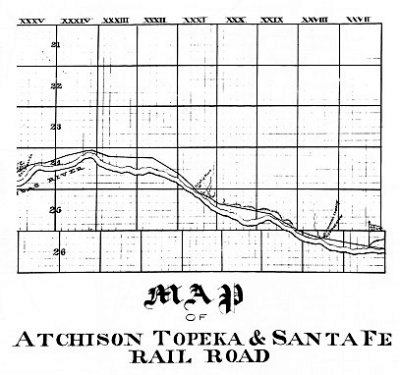
Between October 25 and November 4, 1871, the line of the proposed Atchison, Topeka & Santa Fe railroad, along the north side of the Arkansas river, was surveyed from the eastern boundary of present Gray county to the Kansas-Colorado border. The eastern half of the surveyors' original manuscript map (the Gray and Finney county section of today) is reproduced here. Notably, it shows the location of Cimarron Crossing and the short lived (1866-1868) "OLD STAGE RANCH," in Sec. 3, T. 26, R. 28 W -- about a mile west of present Cimarron. |


