by Louise Barry
Summer, 1971 (Vol. XXXVII, No. 2), pages 121 to 147
Transcription & HTML composition by Larry E. & Carolyn L.
Mix;
digitized with permission of The Kansas State Historical Society.
NOTE: The numbers in brackets are links to footnotes for this
text.
|
IN THE summer of 1855 two hardy, experienced plainsmen, William Allison and Francis Boothe, ventured to establish a Santa Fe trail trading post at Walnut Creek Crossing, on the great bend of the Arkansas. The site was in the heart of the buffalo range, and 132 miles beyond the frontier settlement -- Council Grove. [1] Locating in the domain of the nomadic Plains tribes involved some risk but Allison and Boothe, as former conductors of the Santa Fe-route monthly U. S. mail, [2] had become acquainted with the Indians, and were fully aware of the hazards. One objective of these Missourians was to set up trade relations with the Kiowas and Comanches. [3] This account was published in a late-July, 1855, issue of the Occidental Messenger, Independence, Mo.: Mr. Wm. Allison and Booth, known as famed prairie men, have determined to make a settlement at Walnut Creek on the Santa Fe road. A short time since . . . they started on an expedition to the gold region; their mules and provisions giving out, and not being able to purchase any on the road from any train, they abandoned the idea of going further toward the Wichita diggings, and returned here, determined to settle on Walnut Creek. Booth left a month or two since, and Allison this week, and from last reports of Booth's progress he was busily engaged in building houses and carrals etc. -- The Occidental Messenger of August 25 reported that the "new fort of Allison and Boothe, on the Santa Fe road at Walnut Creek was pretty well advanced toward completion," and its owners hoped "to open a trade with the surrounding Indians and be prepared to furnish any [travelers] in want with provisions and aid as they journey." Also, a party which recently had left Independence on a gold-hunting expedition had stopped "at Allison and Boothe's ranch" and "made quite a successful game-hunt, and feasted on buffalo to their heart's content." [5] The site was "about 100 yards from the crossing of Walnut creek, on the east side, and north side of the [Santa Fe] road" (according to James R. Mead, writing at a later time). Obridge Allen's guide book (published early in 1859) simply stated: " . . . north side of the road Allison's ranch, east side of the creek. . . . [6] Available descriptions do not give a clear picture of the trading post's appearance. William B. Parsons (in June, 1858) wrote: "This ranch is a large building made of logs of equal length, set endwise in the ground. It is large, commodious, and strong enough to resist the attack of hundreds of Indians or white men, unless they have the assistance of artillery." [7] H. B. Möllhausen (in July, 1858) referred to it as "the log cabin on the river bank." [8] David Kellogg (in October, 1858) called it "a stockade." [9] In May, 1859, A. E. Raymond recorded that the ranch was "built of Poles inclosed with Sod. The roof is nearly flat one story high. The Stone Walls and Sods inclose about an Acre of Land. This affords a strong protection against Indians." [10] Santa Fe trader James J. Webb called it "a small mud fort." [11] Theodore Weichselbaum recollected the ranch was "of adobe, a one-story house, long and square." [12] In a later-day account, ex-cavalryman Robert M. Peck (who first crossed Walnut creek in 1857) commented on the "frontier 'ranches'" which were "mere trading posts" and gave this generalized description: As a necessary precaution against Indian attacks . . . [they] were always enclosed by walls or palisades, the ranch buildings being strung around the inside of the enclosure, leaving an open court or corral in the center of sufficient capacity to contain all the animals belonging to the establishment. For traffic with Indians a long, narrow opening, about waist-high, to be closed when need be by a drop-door on the inside was made in that side of the storeroom that formed a part of the enclosing wall, and through this slit all trade with the redskins was conducted. . . . A watch tower was frequently built on a prominent corner of the wall, and in dangerous times a lookout was maintained day and night. [13] Walnut Creek ranch had some sort of lookout in 1860, according to a later-day account. No contemporary description mentioned it. The New York Tribune of January 4, 1856, published this item: "On the 21st . . . [of December, 1855] Messrs. L. N. Ross, Daniel Patterson and William Allison returned to Independence, Mo., from the Plains, where they have been for some weeks on a buffalo bunt. The party brought in over 10,000 pounds of dried buffalo meat and tongues. They killed over 50 buffalo and more than 200 wolves." [14] Wolf-killing was the principal winter activity at Walnut Creek ranch, according to James J. Webb. Dick Wootton stated: "The gray wolf was an animal which followed the buffalo. . . . Their skins were valuable, and Allison was taking them by the hundred by what he called the strychnine method." As Wootton described it this involved no more than the thorough poisoning of a buffalo carcass. Webb indicated a more sophisticated technique was required. "They would kill a buffalo and cut the meat in small pieces and scatter it about in all directions a half a mile or so from camp, and so bait the wolves for about two days." Then, small chunks of poisoned meat (which all hands meantime had been preparing) were put out. Webb says one morning the ranchers picked up 64 wolves within a mile and a half of camp, and that the "proceeds from that winter's hunt [year not specified] were over four thousand dollars. [15] Presumably Francis Boothe (and companions) occupied the ranch in Allison's absence. The winter of 1855-1856 was a severe one on the Plains. Traders reaching Missouri in March, 1856, reportedly said it was "the hardest ever experienced" up to that time. The Arkansas river froze to its bottom. A Santa Fe bound mail party which left Independence February 1 had to return because of the "immense depth of snow on the plains." The February eastbound mail got through (in 25 days) but encountered "severe winter weather and heavy snows." [16] All Santa Fe trail travelers, in this season of blizzards, undoubtedly stopped at the new shelter on Walnut creek. In April, 1856, en route from Fort Union, N. M., to Kansas City, Mo., in charge of a wagon train, Richens L. "Dick" Wootton had some trouble with his Mexican teamsters at Ash creek camp. He rode ahead to "'Bill' Allison's Fort" and enlisted the help of this "brave, daring fellow," who "had but one arm, but . . . handled a gun as well as anybody, and wasn't afraid of anything." Recounting the episode, Wootton stated: "When the train came up next morning, we rode out to meet it, with four six-shooters each, stuck in our belts, and our rifles in our hands. As the teamsters came up, we compelled them to step to one side, and lay their guns, pistols and knives in a pile. The Americans [about half the drivers were "Americans"] were also required to give up their arms. All these arms were stored away in Allison's fort, and we went on our way without any arms, except such as were in the hands of myself and a few trusted employees." [17] Late in the year -- on December 24 -- a post office was authorized for "Walnut Creek," and William Allison was appointed postmaster. (Less than a year later it was discontinued.) [18] The winter of 1856-1857 also was severe on the Plains; and again the Allison & Boothe ranch served as haven for trail travelers. "Mr. Wells" with the January mail got as far west as Walnut creek. Then, despite a heavy snowstorm, he struggled on to Pawnee Fork (28 miles beyond). Meeting there the nearly exhausted mail party from Santa Fe (on pack mules; "Mr. [Preston?] Beck" a "passenger") he turned around and went back to Walnut creek, and to Missouri, in their company. (Wells left Independence again on February 2; and after an extraordinarily difficult trip, reached Fort Union, N. M., with "letter mail" on the 25th.) [19] In February, 1857, the Santa Fe Gazette published this notice: Walnut Creek Station. Allison & Booth. Respectfully informs their friends, and the public generally, that they have established a trading house and general depot, at Walnut Creek, on the Santa Fe road; where they keep constantly on hand Groceries, and provisions, suitable for travellers. Also for Forage. With Corrals, and enclosures for the security of animals. . . . Prices reasonable. [20] Maj. John Sedgwick and four First cavalry companies, on an expedition against the Cheyennes, passed Allison & Boothe's ranch in mid-May, 1857. (A day earlier, while approaching the great bend of the Arkansas, the troops had come close to being overrun by stampeding buffaloes.) The traders at Walnut creek told Sedgwick "that the Cheyennes had taken their families up into the mountains, and with the assistance of some young Sioux warriors were preparing for war." [21] Other mid-May arrivals included Joseph Cracklin and 14 Douglas county companions who were looking for a place to settle. But prospects seemed uninviting at Walnut creek. Cracklin (in a June letter) wrote that they had found it "a poor, miserable country," and that "Mr. Booth, at the Indian trading post, informed me that they had tried to raise corn and could not. . . ." Cracklin added: "There were at the post about eighty Rappahoe Indians, several of whom visited our camp and seemed very friendly and anxious to trade. We obtained some very nice robes and moccasins, for a mere trifle compared to what you would have to pay a trader." [22] Robert C. Miller, Indian agent, with a wagon train of annuity goods for the Plains tribes, reached Walnut creek on July 3, 1857. Next morning "a band of Kiowas, who had been out in search of the Pawnees . . . came into Allison's and Booth's ranche." They said they were poor and hungry. Miller saw that they were fed, and gave them a few presents. The Kiowas then left "apparently well pleased, to join their people whom they expected to find near [old] Fort Atkinson [in the present Dodge City vicinity]." [23] J. J. Lease, wagonmaster of "Kitchen's train," who passed Walnut Creek ranch in mid-July, reported, on arriving at Westport, Mo., that "Boothe & Allison were endeavoring to bring the Camanches, Kaws and Socks together for a treaty of amity." [24] In September, 1857, the Allison & Boothe partnership ended abruptly. This item was in the Santa Fe Gazette of October 31: "The Mexican who brutally murdered Mr. Booth at Walnut Creek, last month, by splitting his head open with an ax, was arrested in San Miguel county last week. . . ." [25] By the spring of 1858 William Allison had neighbors only 42 miles to the east. William Wheeler, and associates, had located at Little Arkansas Crossing, to trade with the Kansa, and build a toll-bridge. [26] Several travelers this year wrote about the ranch at Walnut creek, and the Indians in that vicinity. Augustus Voorhees (traveling west with the "Lawrence party" of gold seekers), in a June 13 diary entry, stated: ". . . drove to the walnutt and Camped at Allisons trading post and stoped for Sunday; had a Call from some Cheyenneys and arapahoes who are Camped up the river; saw seven tame buffaloes." On the 14th he recorded: "the mail met us this morning. Drove to pawne fork 25 miles. passed the indian village of two hundred lodges and 800 warriors, Cheyennes arapohahoes with some Camanches and apaches about 2000 men women and Children they Came out in swarms to beg and trade mockasins and buffalo robes. . . ." [27] On July 8, some 30 miles west of Walnut Creek Crossing, H. B. Möllhausen (and other eastbound members of the Ives expedition) met three young men (on "wild horses") from Allison's ranch. They were about to visit the Comanche village where "a few wagons with articles for trade" already had been sent. Möllhausen and companions (one of whom was George H. Peacock), on reaching the trading post, camped near by for the night. Allison was absent, having gone to Missouri to sell furs and buy new goods. Seven "young people" (including the three earlier met) were occupying "the log cabin" to protect his property, which included "a nice herd of cattle." (These, and six young "tamed buffalo" were driven "into an enclosure formed by strong palisades.") Several of the travelers bought "soft Indian moccasins" from Allison's store. Another purchase was "some poor whisky" (which led to the suspicion that liquor was an item traded to the Indians). To Möllhausen it seemed the ranch residents had an easy life. Fresh meat "to supplement a supply of flour" was always available. (Buffalo were plentiful in the area, and "when on a fast horse, it took only a little effort to kill one or more of them.") The Plains Indians were "glad to have a trader there," and "molested them but little." However, the ranch occupants did not feel "entirely safe." During the winter months "numerous visits from the natives" could be expected. Indians would come to be fed, and "could not be rejected if the traders did not want to spoil their chances for trade with the whole tribe." [28] In the middle of July, 1858, Agent Robert Miller and William Bent (whose train of wagons carried Indian annuity goods) arrived at Walnut creek. On the 19th they reached Pawnee Fork where the Kiowas and some Comanches, in restive mood, were assembled. (The Cheyennes, Arapahoes, and Apaches had left several days earlier, and William Bent went to bring them back.) Miller reported that the Kiowas and Comanches made an attack "in sight of my camp, while [I was] preparing to distribute presents to them, upon two Mexican trains which they robbed of all their provisions." (He blamed Comanche chief Buffalo Hump for these depredations.) [29] On a mid-October day in 1858, the "Larimer party" en route to the South Platte, stopped at Walnut Creek ranch. William H. H. Larimer, in reminiscences, wrote: "Mr. Allison in his buckskin suit was a fine specimen of frontiersman. He kept a fine stock of Indian goods and had a good trade with the Indians. All around the ranch buffalo by the hundreds, undisturbed, were grazing like cattle. Mr. Allison tried to leave the impression on our minds that the Indians were not, just now, on the best terms with the whites. . . . He might have done this only to intimidate us, but we took it as good advice and exercised great caution." From Walnut creek to beyond Pawnee Fork, according to Larimer, "the country was black with . . . [buffalo]." [30] Sometime in 1858 Hall & Porter, mail contractors on the Santa Fe route, built a mail station at Walnut Creek Crossing. This log cabin was on the "west side of the creek." (Allison's ranch was on the east side.) [31] Also this year, in the autumn, Asahel Beach and son settled at Cow creek (only 24 miles east of Walnut creek). Their establishment was known as "Beach Valley." (In February, 1859, a post office was authorized there, with Dr. A. I. Beach as postmaster.) [32] Early in December, 1858, Charles C. Spalding and "two old residents of Kansas City," on horseback, with pack mules, passed "Allison's Ranche" on their way to have a look at the "gold mines of Western Kansas." (They had purchased provisions and forage at Council Grove to last them as far as Walnut creek.) In a narrative of the journey Spalding wrote: "We here [at Allison's] found plenty of corn for our mules, and bacon, flour, sugar, coffee, and other prairie entrees for ourselves." (Around December 31 these travelers, eastbound, were again at Walnut Creek ranch, after a quick trip out to the Cherry Creek-Denver area and back.) [33] In the spring of 1859 traffic was heavy on the Santa Fe trail. Freighting was on the increase; so was the Mexican wool trade; and gold-seekers were flocking to the "Colorado" diggings. (By early June hundreds of disillusioned "Pike's Peakers" were eastbound on the trail as well.) [34] Trade at Allison's ranch probably was brisk, but the owner was not there in April. He had gone to Missouri. At Independence, on April 19, William Allison "died suddenly of heart failure." The Western Journal of Commerce notice of his death stated that he had "spent the greater portion of his life in the mountains and upon the plains," and that he had "sustained most intimate relations with the various Indian tribes of the interior." It gave no biographical information. [35] George H. Peacock, of Independence, Mo., and lately of California -- a ranch visitor in July, 1858, see p. 127 -- was Allison's successor at Walnut Creek trading post. (A later-day account says he "rented" it.) Formerly in the Santa Fe trade, and more recently, in charge of the Ives expedition's mule train, Peacock was an experienced plainsman and adventurer in the West. [36] Some gold-seekers westbound in May, 1859, mentioned the ranch, but not its occupants, in their diaries. A. E. Raymond, who crossed Walnut creek on May 5 noted: "Here is a Mail Station, Store, Tavern, Corn & Hay, etc." William W. Salisbury reached Walnut Creek Crossing on the 21st. Of the ranch he wrote: "it is a small trading post one house plenty timber and water The Kioway Indians are here there [are] a great many at our camp at noon." Charles C. Post on May 31 recorded: "This day we passed Allison's ranch (or fort), Walnut Creek, and encamped about two miles from river. No water except slew water, which is so thick we could almost pick it up with our fingers." [37] As in 1858, this summer many Kiowas and Comanches were camped near the mouth of Walnut creek, in the vicinity of Peacock's ranch. In July it was reported that the "Camanche, Arapahoe, Kioway, Otoe, Osage and Kaw tribes of Indians' were "having a friendly meeting on Walnut creek." [38] C. G. Parker's wagon train, at Walnut Creek Crossing in late August, met "large numbers of Comanche and Kiowa Indians" who were "perfectly peaceful" and said that they wanted no more fights with Americans ." [39] On his way to Missouri in September, Agent William Bent had a talk with Cheyenne and Arapahoe leaders on the 15th, in the Pawnee Fork area. (These tribes, he reported, had "scrupulously maintain[ed] peaceful relations with the whites and other Indian tribes" in 1858 and 1859, despite provocations.) On Walnut creek, next day, he met the Kiowas and Comanches (whose warrior strength he placed at 2,500). They professed to want peace. The Comanches said they intended to winter on the Arkansas. In his report (October 5) Bent summed up the Plains tribes' plight. "A smothered passion for revenge agitates these Indians," he wrote. "[It is] perpetually fomented by the failure of food, the encircling encroachments of the white population, and the exasperating sense of decay and impending extinction with which they are surrounded." He anticipated trouble. [40] If William Bent stopped at Walnut Creek ranch on September 16 he found the owner absent. Peacock had gone to Kansas City, leaving "Rickman and Flournoy" in charge. The Western Journal of Commerce of September 11 reported: "Mr. George Peacock successor to Allison, merchant and Indian trader at Walnut Creek . . . came in yesterday morning with three wagons loaded with furs and skins that he obtained from the Kiowa and Comanche Indians. . . . These furs are received in exchange for trinkets, calico, blankets etc. The following is the invoice brought in yesterday and purchased by Messrs. Hubbell, Wheatly & Co.: 300 Buffalo robes, 900 calf robes, 100 skins, 5 bales of furs." [41] A military party, eastbound, forded Walnut creek two days after William Bent crossed there. Cpt. William D. DeSaussure and his First cavalry troops had spent three months on the Arkansas (their base of operations near old Fort Atkinson) guarding the Santa Fe trail, and now were returning to Fort Riley. 2Lt. George D. Bayard wrote his sister: We arrived at Walnut creek on the eighteenth and there met Satanke, the war chief of the Kiowas, and Buffalo-Hump, the chief of the band of Camanches with which [Bvt. Maj. Earl] Van Dorn has had two fights in Texas. We had a long talk, in which Satanke promised that his tribe would preserve peace with all white men, and Buffalo Hump promised to return to Texas, and make peace. Both these chiefs are remarkably fine-looking men. Buffalo Hump has a pleasant face, with a kind and generous expression. Satanke, on the contrary, has a cruel, severe expression of countenance, though his features are fine. I should not like to have my life dependent on his mercy. [42] The First cavalry force left Walnut creek on the 19th, moving eastward on the trail, and stopping to hunt buffalo. About two P. M. on September 21, 1859, there was trouble at Peacock's ranch. Cpt. William S. Walker gave this account: . . . two sub-chiefs of the Kiowas, Pawnee, the reported brother of Tehorsen [To-hau-sen, or Do-ha-san], head chief of the tribe, and Satanke, both under the influence of liquor, the latter slightly, went to the ranche occupied by Messrs. Rickman and Flournoy, and demanded a quantity of goods from them. Upon refusal they became angry, and Satanke went out, filled his mouth with blood and spit in Rickman's face. He then twice endeavored to stab him with his knife. Rickman with difficulty and with the assistance of Flournoy avoided his blows. Rickman then got a revolver to defend himself, upon which both the Indians drew their arrows to the head and aimed at him but were afraid to shoot. Satanke then climbed to the top of the house and commenced tearing off the roof; they finally went outside and endeavored to shoot into the house, and after awhile left, threatening to return and demolish it." [43] Shortly after this "outrage" Bvt. Maj. James L. Donaldson (and a small train), New Mexico-bound, arrived at Walnut Creek Crossing. He hurriedly sent an express to Captain DeSaussure, whose command now was camped at Cow creek. In the early morning hours of the 22d, Captain Walker, with Companies G and K, First cavalry, marched to Peacock's ranch. The advance troops reached there at 6:30 A. M. Walker's report details what happened after that: Upon my arrival I found Pawnee ["the reported brother of Tehorsen"] near the house, and that Capt. [George H.] Steuart, who with lieutenants [William N. R.] Beall and [Elmer] Otis had arrived in advance of the column, had ordered him to remain. He had mounted his horse on some pretence when I ordered him to dismount and go into the store. It was my intention to visit the Kiowa camp to make a full investigation of the affair, and require such satisfaction as I thought the circumstances justified. No violence was offered or intended to Pawnee, who was then perfectly sober, nor did I put a guard over him till he ran to a room in the rear of the house where there were several loaded shot guns. I immediately followed him, called him back and put a sentinel over him. He afterwards attempted to leap the counter of the store to get his bow and arrows. I thought it necessary to detain Pawnee as one of the perpetrators of the outrage, and also to prevent him from reporting our arrival to the Kiowas. . . . I therefore ordered Lieut. Bayard . . . to take charge of him with a proper guard. The command had been dismounted about a hundred yards from the store, and before the sentinel could return with his horse Pawnee mounted and made his escape. Lieut. Bayard ordered him to stop, and went in pursuit calling out Pawnee! stop! friend! friend! which he understood, as he had been a good deal with the whites as a spy. After a chase of half a mile he overtook him and ran in front of him. The Indian doubled upon him and rode on. Lieut. Bayard then fired his pistol over his bead. Having thus exhausted all peaceful means to stop him, he was obliged to shoot him to prevent his escape. He died within ten minutes after he was shot. . . . [44] Since the whole Kiowa tribe "was reported to be assembled within fifteen miles, and a large band of Camanches were encamped in their neighborhood," and because these Indians "were known to be already exasperated at the refusal of the government to supply them with the usual presents," Captain Walker sent an express to DeSaussure for reenforcement; meanwhile his squadron "encamped near the ranche for its defence." Captain DeSaussure (with F and H companies) arrived early on September 23, and a cavalry force went up Walnut creek to the Kiowas' camp, but they had gone. "We were much disappointed," Lieutenant Bayard wrote, "as we expected a fight. We got back in the afternoon at four, having marched thirty miles." [45] Late on September 23, while the cavalry troops were camped at Walnut Creek Crossing, a Santa Fe-bound mail stage arrived. Three employees -- Michael Smith, his brother Lawrence, and William Cole -- were aboard. Captain DeSaussure assigned 2Lt. Elmer Otis and a 25-man detail to escort the mail-carriers to Pawnee Fork. Early on the 24th they set out. Subsequently, some four miles beyond Pawnee Fork, 15 or 16 Kiowas waylaid the stagecoach, killed the Smith brothers, and severely wounded William Cole. The day following, only a few miles from that point, the same party of Indians murdered four returning "Pike's Peakers." (Other Kiowa aggressions followed -- mostly in the area between Coon creek and Cimarron Crossing, and farther up the Arkansas.) On November 1 a Denver-bound man wrote: "The Indians have positively killed 9 whites in all, and maybe 13, on this road." [46] Meanwhile, on September 24, DeSaussure and his command set out from Walnut creek for Fort Riley. (At Cow creek Lt. Eli Long and 40 men were left to escort the next mail as far as Cimarron Crossing.) [47] No doubt it was also on the 24th that Walnut Creek ranch was abandoned as its occupants departed for Missouri. A Santa Fe mail party which arrived at Kansas City, Mo., September 27, reported that when they passed Peacock's "fort" the "men in charge . . . were about to leave"; and that "They [Rickman and Flournoy] . . . [thought] they could have reconciled the Indians had not the killing [of Pawnee] taken place." [48] East of Council Grove, on October 2, the Hon. Grantley F. Berkeley (heading westward on a buffalo hunt) met Missouri-bound travellers. Among them were "some of Mr. Peacock's men," with "a considerable drove of oxen," and two wagons. "The retreating whites looked as wild as their cattle," Berkeley wrote, "and all seemed to have been pricking in hot haste out of danger's way." [49] On October 22, 1859, Cpt. George H. Steuart and Company K, First cavalry, arrived at Pawnee Fork Crossing -- 32 miles west of Walnut Creek ranch -- to establish a military camp for the protecttion of a new mail station at that place, and to serve as base for troops escorting mail stages. (The "Camp on Pawnee Fork" -- its sod quarters, plus stables and corral, fairly well completed by late November -- was renamed "Camp Alert" in February, 1860.) [50] |
|
The dangers of Santa Fe trail travel this fall were not underestimated by William Bent, who was "taking out a large quantity of Indian goods and hardware" to his trading fort at the Big Timbers. About November 4 eastbound travelers met "Bent's train with 2 pieces of artillery at Big Bend." [51] Walnut Creek ranch may have been in operation again when Bent passed there. Later in the month, on November 27, Captain Steuart and some of his Company K men, returning to Fort Riley, camped on the Arkansas, below the trading post. Cavalryman Lambert B. Wolf wrote: "We find the ranch occupied by the parties that the Kiowas ran off early in the fall." [52] If Plains Indians were in the Great Bend vicinity during the winter of 1859-1860 they caused no alarm. To the west, at "Camp on Pawnee Fork," the garrison was small -- never more than 55 -- and the troops, in detachments of eight or 10 (traveling in muledrawn wagons), were kept busy escorting the mail stages. (From November 26 till December 22, only Lt. David Bell and 29 men of Company K, First cavalry, were stationed there. Then Lt. John D. O'Connell, with 23 Company B, Second infantry, soldiers arrived as reenforcement.) [53] During the winter of 1859-1860 a bridge was constructed at Pawnee Fork Crossing. (Lt. J. E. B. Stuart, on May 23, 1860, wrote in his diary: "Bell's bridge. Substantial structure built by Bell D. [Lt. David Bell] & mail agent [William Butze]. Camp Alert on west bank and above. . . .") [54] Perhaps it was in this season, too, that a man named Thompson built a small trading post at Ash Creek Crossing -- six miles east of Pawnee Fork, and 26 miles west of Walnut Creek ranch. (Lieutenant Stuart noted it in his diary as "Ash creek -- a ranch.") [55]
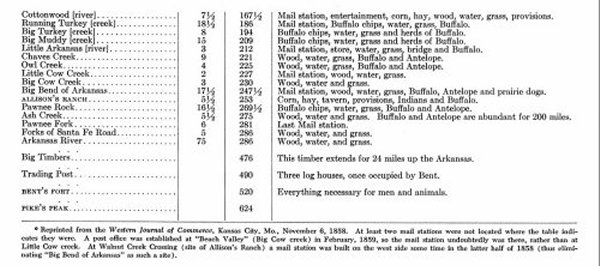
 Allison's Ranch at Walnut Creek Crossing is pointed out (by arrow) on this map reprinted from the November 6, 1858, Western Journal of Commerce, Kansas City, Mo. The flags represent Hall & Porter's U. S. mail station sites selected by surveyor L. J. Berry in March, 1858. Station No. 14 (a log cabin) was erected at Walnut Creek Crossing within the year. But Station No. 15, at Pawnee Fork, because of opposition by Plains Indians, was not built till late in 1859, when Camp Alert (forerunner of Fort Larned) was established at that location. At Walnut Creek ranch the residents were occupied in killing wolves and collecting the pelts. Their winter's haul was sizeable. On April 7, 1860, the Kansas City Journal of Commerce reported: "Mr. Peacock, of Peacock's Ranch, better known by the old name of Allison's Ranch, arrived here yesterday with several wagons loaded with furs. Among the rest were 2,000 wolf skins. They were sold to Messrs. W. T. Wheatley & Co. This firm alone has bought over 5,000 wolf pelts this spring, besides a large amount of other furs. There are several other firms that have, probably, received as many. . . ." William Butze, the postmaster and mail agent at "Pawnee Fork" (see Footnote 50], also reached Kansas City on April 6. He had news of the Plains Indians: Butze says the Kiowas are divided on the question of joining the Comanches in a war with the Whites. Their old chief Tahausen says he never will raise the scalping knife on the white man again under any circumstances, and with this intention he has left Sautuck [Satank] at the head of the Kiowas, except about 60 lodges that followed him, and gone to join the Cheyennes who have sworn eternal peace with the whites. Again this year, as in 1859, the Santa Fe road was a busy thoroughfare. The Council Grove Kansas Press of April 30 stated that over 150 Pike's Peak-bound wagons had passed through on the 28th; trains of 10 to 40 wagons (mostly wool-laden) were "constantly arriving" from New Mexico; and the "outbound" freighting season was under way. Between April and mid-June, according to trader Seth Hays' records, 1,400 wagons carrying 3,562 tons of freight, passed through Council Grove for the west. These figures did not include the Pike's Peak emigrants' wagons, or the "incidental trade of the road." (Up to September 8, the season's total was recorded as 2,170 wagons, and 8,000 tons of freight.) [57] All this traffic also passed Walnut Creek ranch. Whether it afforded George Peacock profitable trade can only be speculated. On May 4 Bvt. Maj. Henry W. Wessells, with Companies G and H, Second infantry (and accompanied by his family) arrived at Camp Alert (Pawnee Fork) to establish a military post. His command had left Fort Riley on April 24. (In a letter of May 19, "Pawnee" wrote that Wessells' instructions were to "construct a Fort at this point and escort the Mails to and from Cow creek, east, and to and from the lower Cimarron, west, to this place.") The new post was named Fort Larned on May 29. [58] Two military expeditions were out hunting the Kiowas and Comanches in the summer of 1860. Maj. John Sedgwick headed the "northern column." He, and four First cavalry companies arrived at Camp Alert on May 23 (from Fort Riley) and were joined there by two Second dragoon companies. Sedgwick's command started June 1 on a 30-day pack-mule scout; forded the Arkansas three miles below Cimarron crossing on June 4; moved southward to the North Fork of the Canadian; scouted a while; marched westward into New Mexico; then moved northward, via the old "Aubrey" trail, to the Arkansas; camped on the north bank (near the Hamilton-Kearny county line of today) from June 29 to July 7; then proceeded upriver to Bent's Fort -- reached on July 8. [59] The "southern column" which went out in search of the hostile Plains tribes was headed by Cpt. Samuel D. Sturgis. With six First cavalry companies, aided by 100 "Tonkaways" and 40 southern Comanches (as guides and spies), he left Fort Cobb, I. T., on June 9, and moved northward. Sturgis' command crossed the Arkansas nine miles below old Fort Atkinson on July 1, and remained several days in that general vicinity. [60] Albert G. Boone, of Westport, Mo., en route to "Colorado" with his family, and others, wrote this letter from "Walnut Creek, (on Big Arkansas,) Peacock's Ranch, June 28th [1860]": Friend Mac. Here we are -- 15 days out -- almost without an effort; found the road good beyond all expectation. . . . Our friend Geo. Peacock, the present occupant of this post, is the prince of good fellows -- has everything a traveler wants, from an ear of corn to the greatest luxury. His store, as well as that of [Seth] Hays & Co., of Council Grove, and M. Conn's [also at Council Grove], are equal to any in Westport. . . . Around the end of June, Kiowa Indians showed up in the Great Bend of the Arkansas country. In a July 11 letter from "Pawnee Fork," I. Powell wrote: "Kiowa Indians are seen occasionally near the post by soldiers out cutting timber . . . and are constantly seen near Walnut Creek, in small parties." A mail party reported, in mid-July, that a band of Kiowas had been lurking in the Walnut creek-Cow creek area "for the last two or three weeks past." [62] On July 9, at and near Ash Creek Crossing, three Kiowas killed two white men. One was a "poor German" (Christian Krauss?) whose mutilated body was found on the trail just west of Thompson's ranch. The other was John Cunningham (recently a soldier?) who died inside the cabin after receiving mortal wounds while outside it. Orville (or William?) Thompson fended off the Indians (who tried to burn his place), and escaped after nightfall. [63] Major Wessells (at Pawnee Fork -- Fort Larned) just prior to, or at the time of these murders, sent an express to the First cavalry troops, requesting that the area between Walnut and Cow creeks be scouted for the Kiowas and Comanches. Captain Sturgis' command arrived at Pawnee Fork on July 10. The next day, as a cavalryman stated: "came to Walnut Creek, crossed over [passing Peacock's ranch], and continued down the stream [two miles?] until we arrived at the mouth; passed a large number of old camping places of the Kiowa tribe. By the appearance of the evacuated camp, I should judge that they numbered upwards of 700." Sturgis' command remained near Walnut creek's mouth four days. Company A, on a scout towards Cow creek, picked up the Kiowa trail on the 14th. The rest of the troops marched eastward the night of July 15, arriving next day at Cow creek. They found "numerous Indian camps of recent evacuation," but no Kiowas. Heading westward again, Sturgis' command returned to Pawnee Fork about July 21. [64] At Walnut Creek Crossing, in mid-July, a log cabin (apparently Hall & Porter's mail station) was destroyed. A cavalryman wrote, on July 22: "During our absence from Walnut Creek [July 16-19?], one of the houses upon its banks was broken into, the contents stolen therefrom, and then burnt to the ground. It is supposed . . . done by a party of outlaws which infest the country along the Santa Fe road." [65] "Within a short time five dead bodies have been found between Cow Creek and Pawnee Fork," the Council Grove Press, July 30, 1860, stated. The Leavenworth Daily Times of August 3 reported: "We learn . . . that the Kiowas or Comanches murdered and scalped a white man, his wife and two children near Walnut Creek." An account from Salina said the Indians had killed two men, one woman, and two children -- supposed to be Pike's Peak emigrants -- near Pawnee Fork Fort (Fort Larned). These five(?) victims apparently were killed in the latter part of July. [66] The list of persons "Registered at S. M. Hays & Co.," Council Grove, for the week ending August 23 included "G. H. Peacock, Walnut Creek." The assumption is that the trader had been to Missouri, and now was returning to the ranch, his wagon (or, wagons) loaded with a new stock of goods. It was his last journey west on the Santa Fe road. [67] Events at Walnut Creek ranch on September 9, 1860, were briefly stated by Bvt. Maj. Henry W. Wessells (writing, from "Pawnee Fork" on the 12th): "Mr. Geo. Peacock and two other persons were treacherously murdered at Walnut Creek on Sunday last by a party of ten Indians." (The "other persons" were Peacock's clerk "Myers," and a Mexican herder.) [68] What Wessells failed to say was that the Kiowas' war chief Satank planned the attack and personally killed Peacock -- in revenge for a trick the trader had played on him. An account in the Westport Border Star gave some details of the murders: Mr. Geo. H. Peacock, formerly of Independence . . . was killed on last Sunday week by a Kiowa chief named Satank. Satank and two or three others of the tribe reconnoitered around Peacock's Ranch until an opportunity offered when they fired on him, one ball entering his left temple, killing him instantly. They then fired upon a man named Myers, a German, also from Independence and wounded him so that he died in a short time. There was another man in the house lying sick, but he was not molested. The Indians then loaded themselves with considerable plunder and left. [69]  Satank, the Kiowa war chief, who killed George Peacock at Walnut Creek ranch in September, 1860. Peacock's "indiscretion [that] cost him his life" was explained as follows in the Western Journal of Commerce: . . . Sometime last spring Satank applied to Mr. Peacock for a letter of recommendation to any whites that he might meet, as to his character and honorable conduct. Mr. Peacock, knowing the treachery and cunning of the old red skin, instead of commending him to whomsoever he met, gave him a piece of writing warning all who might be called upon to read, to beware of the bearer as he was treacherous and dangerous; presuming that as the old fellow could not read it, he would never know what it contained. . . . Some Mexicans to whom it was shown translated it for him, and told him what it read. He swore vengeance against Peacock; but the latter being on good terms generally with the Kiowas and paying little attention to the bravado of old Satank thought nothing of it. Even a few days before [his death], he had intervened to protect him [Satank] against a sergeant and corps who sought to arrest him while on Peacock's premises and take him to the Fort. [70] Two colorful later-day versions of Peacock's murder, written by frontiersmen, contain inaccuracies, but add details that embellish the story and are in general accord. Robert M. Wright (in 1901) stated that Peacock supplied the Indians with whisky, and had to hide his stock of this illicit item when troops came by. Satank knew this, and as a ruse to get Peacock "to the top of his lookout," told the trader that soldiers were coming. Peacock got his field-glasses, climbed to the lookout, and "the instant he appeared," says Wright, "Satank shot him full of holes[!], exclaiming as he did so, 'Good-by, Mr. Peacock; I guess you won't write any more letters.' Then they [the Kiowas] went into the building and killed every man present, except one a sick individual, who was lying in one of the rooms, gored through the leg by a buffalo." James R. Mead (in 1908) stated: "Peacock had a tall lookout built on top of is trading house . Satanta [i. e., Satank], with some of his men, came to the store and told Peacock there was a lot of soldiers coming. Peacock climbed to the top of his lookout to see, when Satanta [Satank] shot him." [71] The Santa Fe mail party which reached Independence, Mo., September 23 had "no news from the Plains of importance," but reported that the "Ranche where Peacock was killed" had been abandoned, and the goods not taken by the Indians moved to Council Grove. [72] "We hear of no more Indian difficulties on the Road, since the murder of Peacock," said the Council Grove Press in late September. "They seem to have become frightened at their own acts, and have left the [Santa Fe] road altogether. . . ." [73]
 Charles Rath, trader, who succeeded Peacock, and ran Walnut Creek ranch until April (?), 1867. Charles Rath (aged 24) probably took over Walnut Creek ranch within a matter of weeks after Peacock's murder. [74] Rath was one of 12 men who voted at Beach Valley (Cow Creek Crossing) on November 6, 1860, when 10 Peketon county officials were elected. Most of these voters were connected with the area ranches. When the formalities were over, William Mathewson -- the original "Buffalo Bill" -- was one of the two voters without an office. Charles Rath was elected constables. [75]

In April and May, 1861, the Council Grove Press editor described Santa Fe trail traffic, both east and west, as extensive; and reported all quiet on the Arkansas route. However, a little-publicized massacre occurred in late April, near Walnut creek. A Fort Larned correspondent reported that Kiowas had killed and scalped six Mexicans (from a small wagon train) who were hunting buffalo off the road. So far as known, this was the Plains Indians' only depredation of consequence along the route in 1861. [76] No firsthand information on Walnut Creek ranch in 1861, or 1862, has been found. Indications are that Charles Rath got along well with all the Plains tribes. Kiowas in large numbers (and Comanches?) were in the ranch vicinity in 1861. They held their sun dance that summer near the Great Bend of the Arkansas. [77] With the Cheyennes, Rath formed a special relationship in the early 1860's. He had a Cheyenne wife -- Making Out Road, or Roadmaker. Their only child, Cheyenne Belle, was born near Bent's Fort either in August, 1861, or August, 1863. [71] In 1862 the Plains tribes posed no serious threat on the Santa Fe route despite the fact an estimated 30,000 to 35,000 Cheyennes, Arapahoes, Apaches, Kiowas, and Comanches were in the Fort Larned vicinity in mid-summer. They were there awaiting the delivery of government annuities, and were said to be "on very short rations the game being nearly all killed off." When, in August, the Indians learned the distribution would be made at Fort Lyon, Colo., there was some dissatisfaction, but they moved upriver. In November, 1862, L. G. Terry, Kansas Stage Company superintendent, stated that large bands of Indians frequently were encamped around Fort Larned, but offered no violence and that Ltc. Charles S. Clarke, Ninth Kansas cavalry, commanding the post, had "no fears from them whatever." [79] In the winter of 1862-1863 heavy snows fell in central Kansas. The Kiowas, camped on upper Walnut creek, had a difficult time keeping themselves and their animals from starving. (On their calendar it was recorded as the "winter when horses ate ashes. [80] Charles Rath, John F. Dodds, James A. Robbins, F. Lederick, and A. D. Robbins, in January, 1863, formed the Walnut Creek Bridge Company "for the purpose of building a toll bridge over Walnut Creek, in Peketon County, State of Kansas, where the Great Santa Fe Road crosses said stream." [81] Probably the structure was completed in time for collection of tolls from the spring-season traffic. One of the bridge incorporators -- John F. Dodds, of Council Grove -- on his way to Colorado with a survey party in June, 1863, wrote a letter from "70 miles west of Fort Larned" in which he described the situation then existing on the Arkansas in central Kansas: Major Colly [Samuel G. Colley], Indian Agent for the Kiowas, has forbid the Traders to trade with the Indians, and the Indians threaten to retaliate. Maj. Colly became alarmed, and passed Messrs. Wright and Clements' [survey] party on his way to Fort Lyon [Colo.] for security. The Council Grove Press of July 6 gave a fuller explanation: Charles Rath, a good Union man, has for a number of years, been keeping a Ranch and trading at Walnut Creek. Major Coll[e]y is Indian Agent. . . . [He] has a son and . . . gives his son license to trade among the Indians, and refuses Rath a license! He next takes the position that the country around Walnut is Indian country, and gets a military order to close Rath's Store. This cuts off the Indian supply of flour, sugar, coffee, etc. The Indians became excited, and Maj. Coll[e]y and Son ran to Fort Lyon. The Indians being on the point of starvation robbed a government train. . . . |
|
Lt. G. C. Manville, Second Colorado cavalry, supplied more information on the results of Agent Colley's order when he arrived at Council Grove July 10 on the "Santa Fe Stage" from Fort Larned. He reported that the Indians had "on several occasions fired upon trains, killing or wounding cattle"; had attacked one government train (ransacking the wagons, and taking the wagonmaster's "saddle and fixtures"); and had "fired into" the cattle "belonging to a Ranch on Walnut [Rath's]," killing and wounding several animals. Col. Jesse H. Leavenworth, head of the Second Colorado regiment, had sent for the Kiowa and Comanche chiefs to come to Fort Larned. When they finally chose to appear at the post, they arrived with about 300 warriors "in regular military order and formed in line of battle." After a talk with the six or seven tribal leaders, Colonel Leavenworth ordered "a large issue of hard bread, bacon etc." to the Indians. [83] This appeased them temporarily. On July 9, at a time when "Arapahoe, Kiowa and Comanche Indians in large numbers" surrounded Fort Larned, a sentinel shot and killed an Indian. He was a Cheyenne, and though his tribesmen made threats of violence, the anticipated crisis did not develop. [84] On July 28, 1863, from "Walnut Creek Plains," Charles Rath wrote the Council Grove Press editor that Agent Colley had promised him a trading license, and given him a written permit to trade until it arrived. [85] During the rest of 1863 there was no serious trouble with Plains tribes in the Walnut creek and Fort Larned area. However, Kiowas and Comanches committed numerous depredations in August, in the Cimarron Crossing vicinity. Satank's band of Kiowas did "more damage than all the others." [86] At Walnut Creek Crossing a post office named Kiowa was opened in the spring of 1864. The official date of establishment was April 8; and John F. Dodds was appointed postmaster. (When the post office became "Fort Zarah," on April 28, 1865, Reuben Howard replaced Dodds.) [87] In a letter of May 10, 1864, from "Kiowa, Peketon County, Kansas," Dodds included information on Charles Rath's activities: . . . Chas. Rath is some 130 or 140 miles S.W. trading with the Comanches, [he] left here April 23rd, and will probably be back in 8 or 10 days -- His brother "Chris" [J. Christian Rath] left on the 12th of March with 2 wagons, one white man, and one contraband, to trade with Cheyennes upon Smoky [Hill], about 175 miles distant. He wrote home by an Indian about a month since -- which is the last tiding we received from him. The Indians say he will be here in 4 days. We are getting somewhat anxious about him. . . . Near Big creek, and the Smoky Hill (in southeastern Ellis county?), on May 16, Lt. George S. Eayre's 100-man command of Colorado troops had a seven-and-a-half hour running battle with some 400 Cheyennes (and Sioux) -- a fight precipitated by the soldiers' unprovoked killing of Chief Lean Bear. (The Indians lost 17? warriors; three Colorado men were killed, and four wounded -- one died soon after.) [89] Small parties of Cheyennes launched retaliatory attacks on frontier ranches and stage stations the next day. Rath had been forewarned on the 16th by Indians who came and took his Cheyenne wife away with them. His trading goods, and probably some livestock. were on their way eastward (conducted by a passing wagon train) when a raiding party arrived at Walnut Creek ranch about 9 A. M. on May 17. Rath, Lewis Booth, and John Dodds watched from atop the ranchhouse as 10 or more Cheyennes cut the lariats of the trader's, the stage company's, and Dodd's mules and horses (picketed outside the corral to graze) and made off with them. East of Walnut Creek ranch, "at the Big Bend," the raiders got all the stock from Curtis & Cole's ranch. To the northeast of Rath's place, on the other road, near Cow Creek (not far from present Claflin) the Cheyennes not only took the stock but killed Suel D. Walker, Kansas Stage Company employee. From inside the ranchhouse there J. J. and C. L. Prater fired on the Indians, killing two(?) and wounding a third. Other raids were made on both roads, but no one else was killed. Some 16 persons filed claims totaling upwards of $47,000 for the Cheyenne depredations of May 17. [90] For a time, the frontier ranches and stations were abandoned. Some operators (the Prater brothers, in particular) apparently never did return. On June 14, 1864, Maj. T. I. McKenny, inspector-general (and party), en route to Fort Larned, and escorting a mail stage, reached Walnut creek (after a 40-mile journey from Smoky Hill crossing, where work on a blockhouse was under way). He "camped at a point where the road intersects the old Santa Fe road, and where the Leavenworth and Kansas City mails are due at the same time"; "found the ranch [Rath's] entirely deserted." (He saw the owner next day at Fort Larned.) In his June 15 report, written at Fort Larned, Major McKenny stated that he intended to "build a block-house" at Walnut creek on his return trip. [91] On June 27 Maj. Gen. Samuel R. Curtis, at Fort Leavenworth, reported McKenny had returned, and he outlined the major's accomplishments: "A stockade and 25 men under Lieutenant Clark, Seventh Iowa, holds Salina. At Smoky Fork he erected block-house and left Lieutenant Ellsworth with 40 men. At Walnut Creek, 40 [i. e., 32] miles this side Larned, commenced stone fort, and left Captain [Oscar F.] Dunlap with 45 men, Fifteenth Kansas. At Larned directed a field-work and gave general directions to escort stages." Curtis also stated: "Indians generally quiet, but the Cheyennes preparing for mischief." [92] The small defense post at Walnut creek, first called Camp Dunlap, was named Fort Zarah in July, 1864. (Up to July, 1868, it was under Fort Larned's control; from that time till abandoned in December, 1869, it was an independent post.) [93] Charles Rath no doubt returned to his trading post as soon as Camp Dunlap was established. He seems to have been there in July, 1864. George Bent (half-Cheyenne son of William Bent), at a later time, stated: ". . . in July [1864] the Kiowas and Comanches attacked a train or two at Walnut creek. They killed several teamsters. Brother Charles was at Charley Rath's place on Walnut creek at the time. He told me about it when he came to the village on Solomon river." (Bent referred to the July 18 attack by Kiowas, Comanches, and Arapahoes on the trains of Jerome E. Crow and Richard F. Barret, in which 10 men were killed, five seriously wounded -- including two who were scalped, and the wagons plundered.) The massacre took place just west of Camp Dunlap, within sight of the small garrison. [94] Rath could have been a spectator. From May, 1864, till mid-August, 1865, when the Comanches, Kiowas, Arapahoes, and Apaches made a preliminary agreement to cease hostilities, Charles Rath's Indian trade must have been curtailed. After the Plains tribes signed peace treaties in October, 1865 (the Cheyennes and Arapahoes on the 14th; Comanches and Kiowas on the 18th), presumably he again had a lucrative trade with them -- a trade which, it appears, was unrestricted throughout 1866. After that the situation changed.


A military report of 1867 stated: "A trader named Rath claims a stone building near the Round Tower [blockhouse] as private property and also a toll bridge over Walnut Creek, at this point [Fort Zarah]. . . ." [95] Part of the trading post evidently was constructed of stone, but Ado Hunnius (U. S. soldier) who was at Fort Zarah in 1867 described the trader's place as "Adobe Mud Roof House partly underground." [96] Early in 1867 there were complaints by some military men about Rath's trading activities. Maj. Henry Douglass, commanding at Fort Dodge, asserted in a January letter: "Charley Rath, a trader, who lives at Zarah, has armed several bands of Kiowas with Revolvers and has complet[e]ly overstocked them with Powder." [97] And Gen. John W. Davidson (acting inspector general) reported April 5: "Rath, the trader, I learn, sells whiskey to the Indians, in violation of military orders and Act of Congress and should be put off the reservation." [98] Davidson was with Gen. Winfield S. Hancock's expedition then en route to a council with the Plains Indians. So, also, was Henry M. Stanley, newspaper correspondent, who wrote on April 6th: One house [at Fort Zarah] is occupied by a fellow called Charley Rath, a notorious desperado[!], who has contributed not a little to the Indian disturbances which have occasionally broken out in this vicinity. He has sold revolvers, knives, and powder to the Kiowas. He has been warned by the Indians not to approach their villages, and yesterday he was warned off the Indian Reserve by Inspector General Davidson for selling whisky to soldiers and Indians. There are five graves not a hundred yards from the fort, where the victims of Indians lie buried. [99] Apparently Charles Rath's tenure as Fort Zarah's trader ended at this time. Probably his successor was Joseph W. Douglass, who in 1868, was the post trader. It seems logical that the newcomer would occupy the quarters Rath had used. On May 19, 1868, the trading post of Joseph W. Douglass was burned by a party of some 25 Cheyennes and a few Arapahoes. The victim subsequently filed a claim against the Cheyennes for $5,445 to cover his loss of merchandise." [100] On the supposition that it was Rath's former trading post that went up in flames, the story of Walnut Creek ranch would have ended here, except for this 1969 postscript. In May, 1969, archeologists of the Kansas State Historical Society working with members of the Kansas Anthropological Association, comprised mostly of amateur archeologists, excavated the remains of a burned stone building (just east of Great Bend) near the historic Walnut Creek Crossing of the Santa Fe trail. It had been a large sandstone structure, 80 x 20 feet, with footings two to three feet wide. The south two-thirds seems to have been a storage area and was virtually devoid of artifacts. Most of the recovered pieces were found in the north portion, which was apparently the living area. The archeologists unearthed the remains of a wood-burning stove and pieces of furniture; household and kitchen utensils; coiled springs, such as occur in furniture cushions; scraps of cloth; leather fragments; ironstone dishes; gun parts; and a large section of a sickle bar from a mowing machine. Remnants of a heavy tarpaulin, such as used on covered wagons, suggest that one may have been spread as a rug, to cover the earth floor. [101] Larry J. Schmits of the University of Kansas examined the recovered gun parts, which consisted of brass and iron butt plates, ram pipes, patch box covers, barrel pin plates, barrel bands, trigger guards, and one lock plate. His tentative conclusions indicate that these artifacts date as late as the latter 1860's. Thus we have an outstanding example of research in the documents of history dovetailing with the findings of archeologists and a gun expert. Together they establish that the structure excavated in 1969 was Rath's building in which Joseph W. Douglass housed his Fort Zarah trading post when raiding Cheyenne and Arapaho Indians burned it to the ground in 1868!
 Unearthing remains of the ranch house at Walnut Creek Crossing of the Santa Fe Trail (near Great Bend) as supervised by State Historical Society archeologists May 31, 1969. The photograph was taken looking north along the west footings.
|