![[Photograph of Charles Robinson (1818-1894), Conductor of the First Party, first governor of Kansas, and husband of the admirable Sarah Robinson.]](../images/43_2_robinson120.jpg)

|
THE Kansas-Nebraska Act of May 30, 1854, providing for the settlement of Kansas territory on the "squatter-sovereignty" principle, was a triumph for Proslaveryism. In an effort to compete with the south in populating the new territory, Eli Thayer and other New England men founded the Emigrant Aid Company-an organization designed to promote Free-State emigration and make money for its incorporators. During the critical territorial years it was the most active and influential of the many societies, both Northern and Southern, which directed emigration to Kansas. Numerous articles have been published on the history of the Emigrant Aid Company and its various activities. [1] But not much attention has been paid to the parties who came from New England and other Northern states under its auspices. The purpose of this article is to publish, insofar as possible, the names of the individuals in the six Emigrant Aid Company parties of 1854. Accompanying each roster is a sketch giving a summary of the available information relating to each party. Much of this material consists of excerpts from the emigrants, own statements. [2] A brief statement of the aims and method of operation of the Emigrant Aid Company is a necessary preface to the rosters which follow. The company was neither a charitable nor a subsidizing organization. Though its officers were interested in making Kansas a free state they were also concerned in making profitable investments. In transporting emigrants to the West the company operated as a sort of travel agency. Parties were formed by advertising trips in Eastern newspapers. Blocks of tickets were purchased from railroad and steamboat lines at reduced rates and sold to the emigrants at cost. The company hired a conductor for each party except the first. Local agents were established in Kansas |
|
to meet the groups of pioneers and advise them of the best lands available for settlement. Testifying, before the special committee appointed to investigate troubles in the territory in 1856, Eli Thayer stated:
The Company claimed that some 750 individuals traveled to Kansas in its parties of 1854. [4] The highest estimates in contemporaneous accounts total about 670, which is perhaps more nearly accurate. The names of 579 individuals appear on the rosters published here. It will be noted from the lists that Massachusetts emigrants were the most numerous in each company. Vermont was well represented in each group, and so was New Hampshire in all except the first two. There were a good many from Maine in the Third and Fourth companies; some from Connecticut in the Third; and a large number of New York state residents in the second, Third and Fourth Parties. A few emigrants from Rhode Island, Pennsylvania, Ohio, Wisconsin and Michigan also appear on some of the lists. There is no way of estimating the number who left the companies before arriving in Kansas, or who, after a brief stay in the territory, returned East or went elsewhere to settle. Numerous descendants of the Emigrant Aid Company pioneers are present-day residents of Kansas, and many others could probably be located in the New England states and in New York. It is regrettable that more information about these early-day pioneers is not available. The Historical Society will welcome additional information. This brief outline is intended only as background for the Emigrant Aid Company of 1854. In February, 1855, the Emigrant Aid Company of Massachusetts was chartered as the New England |
|
Emigrant Aid Company. Manuscript lists of most of the parties which came to Kansas under its auspices in 1855 are also among the records of the Kansas State Historical Society. These will appear in the August issue of the Quarterly. (Departed from Boston, July 17, 1854; arrived at Kansas City, July 29, 1854.)
|
Chief sources used in compiling this list: Andreas, A. T., and
W. G. Cutler, History of the State of Kansas (Chicago, 1883), p. 13;
Lawrence Old Settlers' Association, "Minute Book, 1870-1879" (report of committee
on historical matters at the 1876 annual meeting), in Mss. division, Kansas State
Historical society; Cordley, Richard, History of Lawrence (Lawrence,
1895), p. 6; Doy, John, Thrilling Narrative of Dr. John Day, of Kansas
(Boston, 1860), pp. 8, 9; Emigrant Aid Collection in Mss. division, Kansas state
Historical society; "Webb scrapbooks." in Library, Kansas State Historical
society. The pioneer party was much smaller than expected. It finally numbered twenty-nine men. Adverse factors were the incomplete organization of the Emigrant Aid Company, the extreme summer heat and news of cholera in the Mississippi Valley. On July 15 Amos A. Lawrence wrote the Rev. Edward E. Hale: |
Two days later, as scheduled, the First Party left Boston. In the Commonwealth this comment appeared:
Eleven men joined the party from Worcester and Worcester county, Mass., where an auxiliary organization, the Worcester County Kansas League, was already in operation. [7] The two final recruits were Daniel Read Anthony and Dr. John Doy, both of Rochester, N. Y. Arriving at Buffalo, N. Y., the emigrants boarded the steamboat Plymouth Rock and crossed Lake Erie to Detroit, Mich. Writing a few days later from St. Louis, Mo., Daniel R. Anthony described the party's progress from Michigan to Missouri:
|
Another member of the party, writing under the pen name "Charlestown," was pleasantly surprised by the friendliness of the city's people:
At St. Louis, Dr. Charles Robinson of Fitchburg, Mass., acting for the Emigrant Aid Company, met the group and gave them advice and information. [10] A meeting was held on July 22, at which resolutions of confidence and thanks for the services of the Aid Company were passed. Hugh Cameron was chairman of the meeting, and Edwin Davenport, secretary. [11] On the afternoon of July 25 the party began the steamboat trip to Kansas City. Dr. John Doy wrote of the journey:
The Polar Star reached Kansas City on the evening of July 28; the passengers disembarked the next morning. Charles H. Branscomb, agent of the Emigrant Aid Company, and James Blood, agent for Amos A. Lawrence,-met the pioneers. [13] They held a meeting on the bank of the Missouri river and voted to proceed into Kansas to the vicinity of Wakarusa river where a site for settlement had |
The Emigrant Aid Company employed Robinson in 1854 as a resident agent in Kansas. He helped establish Lawrence and Topeka and was first governor of the state, 1861-1863. He died at Lawrence on August 17, 1894.
|
already been tentatively chosen by Branscomb. Daniel Read Anthony wrote home of the party's reception at Kansas City:
No time was wasted in starting for Kansas. The group left on the evening of the same day, accompanied by Charles H. Branscomb and James Blood. Wrote one of the party:
B. R. Knapp described the journey:
|
|
The encampment was made on present Mount Oread on August 1-a day when "the sun was pouring down its beams with terrific fierceness, and all nature shrank under the infliction. A high wind swept over the prairies, but it resembled the blast of a furnace. . . ." [17] In spite of the heat the emigrants held a meeting and the following decision was made:
They named the new settlement Wakarusa. On the
next day, wrote "Charlestown":
Difficulties arose over the staking out of claims. According to B. R. Knapp: One of our party had his camp utensils, tent, and all his fixings removed into the California road, a day or two since, because he had squatted on the claims of Nancy Miller. Nancy and another Hoosier woman made quick work with the intruders moveables. I had rather have a Prairee wolf after me than one of these Hoosier women. [20] Although the pioneers were for the most part enthusiastic about their new settlement, yet, by the middle of August less than half of the Emigrant Aid party of twenty-nine remained at Wakarusa. Unaccustomed pioneer hardships, homesickness, the heat-all played a part in discouraging the faint-hearted. Others of the group had returned East to settle business affairs and to bring out their families. Those who remained settled down to homestead their claims and to await developments from the Emigrant Aid Company. |
|
No formal government was yet in operation in the territory, but prior to the arrival of the Emigrant Aid party, opposing factions had organized, each with the intention of setting up ordinances for temporary government. One group was the Actual Settlers' Association of Kansas Territory, which generally favored the abolition of slavery, and was composed of men living in the territory. Another was the Wakarusa Association. Its members were Proslavery Missourians who were determined to participate in the territorial government of Kansas, although most of them had not even made land claims in the territory. [21] On August 12, a meeting called by the Actual Settlers' Association was held at the house of a Mr. Miller, on the California road, about a mile from the Emigrant Aid Company settlement. Many Missourians of the Wakarusa Association arrived on the appointed day and maintained their right to take part in the proceedings. A member of the Emigrant Aid party described the scene:
On this occasion-the first clash in Kansas territory between Proslavery and Antislavery groups, an amicable settlement was reached, after much heated discussion. Wrote John Mailey:
Members of the Emigrant Aid party were not represented among the officers of the new association. The men elected were: John A. Wakefield, chief justice; J. W. Hayes, register of lands; William H. R. Lykins, marshal, and William Lyon, treasurer. |
|
On November 29, 1854, when the first formal election was held in Kansas territory, the eleven men of the pioneer party whose names appeared on the list of voters were: John C. Archibald, Hugh Cameron, John Doy, Ferdinand Fuller, Samuel C. Harrington, John Mailey, Anson H. Mallory, Jonathan F. Morgan, Joseph W. Russell, James D. Stevens and Samuel F. Tappan. Others of the pioneer party who settled in Kansas were: Daniel R. Anthony, George W. Goss, Oscar Harlow and George W. Hutchinson.
|
|
|
Chief sources used in compiling this list: Andreas and Cutler, op.
cit., p. 13; Lawrence Old Settlers' Association, "Minute Book, 1870-1879,"
loc. cit.; Cordley, op. cit., p. 8; New England Emigrant Aid Company Collection,
loc. cit.; "Webb Scrapbooks," loc. cit.; savage, Joseph, "Recollections of 1854,"
in Western Home Journal, Lawrence, June 23-September 29, 1870. Reports on Kansas territory from members of the pioneer party were for the most part enthusiastic. Their letters were widely published in Eastern papers and the trend of newspaper publicity was encouraging for the Emigrant Aid Company's venture. The National Aegis, on August 16, commented:
On August 12, at a meeting of the Emigrant Aid Company trustees, the date August 29 was decided upon for the departure |
|
of a Second party for Kansas. The following notice published in Eastern papers advertised the event:
|
![[Photograph of Samuel Charles Pomeroy (1816-1891).]](../images/43_2_pomeroy128.jpg) 1816-1891 Pomeroy represented the Emigrant Aid Company as its Kansas financial agent for several years. In 1861, he and James H. Lane became the first United States senators from Kansas. Pomeroy remaining in office until 1873. He died in Whitesville, Mass., August 27, 1891. |
|
One of the passengers wrote from Chicago to the Boston Traveller:
|
|
The Emigrant Aid Company's agents, Robinson and Pomeroy, proceeded to the Wakarusa settlement in advance of the Second Party to negotiate for a union of the first and second emigrant companies. They arrived on September 11, and accomplished their mission on the following day 34 Erastus D. Ladd described the terms agreed upon:
In the same letter, dated September 19, he wrote:
Ladd also described the sale of claims:
|
A fairly large proportion of the Second Party decided to remain in Kansas. The company had arrived in the late summer when the weather was fine for "camping out." Everyone was in good health and good spirits. [39] Under these ideal conditions they settled down to make homes for themselves. Erastus D. Ladd in his letter of September 19 wrote
Rev. Samuel V. Lum, his wife and children and Anna Tappan arrived at Wakarusa about the same time as the Second Party and were considered part of the group, insofar as sharing in the "Lawrence Association." [42] |
|
|
|
|
|
|
|
|
Chief sources used in compiling this list: twp manuscript lists appearing
consecutively in a small record book of the Emigrant Aid collection, loc. cit.;
Webb Scrapbooks, loc. cit. Charles Branscomb, conductor of the Second Party, returned from Kansas territory in time to take charge of the Third Party, which left Boston on September 26. The Boston Evening Telegraph carried this account of the company's departure:
|
|
The Chicago Daily Democratic Press wrote of the party's arrival in that city:
The account also told of the public meeting held in the evening at which C. H. Branscomb spoke to a good-sized crowd of Chicago citizens on the aims and intentions of the Emigrant Aid Company and its pioneers. From Chicago to Alton the party traveled by train. At the latter city they took a steamboat for the 24-mile journey to St. Louis which they reached on September 30 at half-past six in the evening. There they boarded the Clara for the journey up the Missouri river to Kansas City. The river was low and it took six days to complete the trip. While on board the Clara, on October 3, the emigrants held a meeting. William B. Wiltse was chosen chairman and Augustus H. Gleason acted as secretary. Josiah H. Pillsbury, Daniel Lowe and Charles Dickson were appointed a committee on resolutions by motion of James W. Morgan. They passed resolutions in appreciation of the philanthropic efforts of the Emigrant Aid Company, acknowledged their debts to the company's agents, and expressed thanks to Captain Cheever of the Clara for his hospitality. [47] There can be no doubt, however, that these resolutions did not reflect the opinion of all the group. The Third Party had experienced delays and inconveniences en route which were disheartening. Many were discouraged by their reception at Kansas City on October 7, and by the news that they could not have equal shares in the "Lawrence Association." A correspondent for the New York Times wrote his paper on October 9:
|
If the treatment of this company was impartially reported by the Times correspondent, it is not surprising that many of the emigrants never entered Kansas territory. The letter of Charles Loomer, who, with his wife and three children were in the Third Party, described the experience of one family:
|
The Boston Daily Evening Traveller published this story:
The Traveller commented:
Those who decided to settle in Kansas found claims in, or near, the Aid Company settlement at Wakarusa-or Lawrence, as it was by this time known. [52] Available information indicates that approximately two-thirds of the emigrants returned East, or settled outside Kansas. Practically all those who remained were New Englanders. |
|
|
|
|
|
|
|
|
|
|
|
Chief sources used in compiling this list: Two
manuscript lists appearing consecutively in a small record book in the Emigrant
Aid Collection, loc. cit.; "Webb scrapbooks," loc. cit.; Allen,
Mrs. Chestina B., "Sketches and Journal,"-MSS. division, Kansas State Historical
society. Although the Fourth Party did not leave Boston until mid-October the lateness of the season did not prevent this company from being the largest of the year. It finally numbered, on arrival at Kansas City, 230 individuals, among whom were many women and children. Thomas H. Webb reported to the Emigrant Aid Company trustees that the Fourth Party "took their departure from the Western Rail Road Depot, on Tuesday the 17th . . . [of October] at 2¼ o'clock P. M., accompanied by J. M. S. Williams Esqr. . . ." [56] Williams went only as far as Detroit. The 124 who started from Boston were augmented by numerous additions of Massachusetts and New York emigrants as the train proceeded westward. Charles |
|
H. Branscomb, on his way back after conducting the Third Party, met the Fourth Party at Detroit and accompanied them to Kansas City. They reached St. Louis on October 22 and the following day began their journey on the steamboat Sam Cloon to Kansas City. After a slow trip, because of low water in the Missouri river, they arrived on October 28. Wrote one observer:
As in the case of the Third Party, there were many complaints that the Emigrant Aid Company had failed to fulfill promises, and that it had misrepresented conditions in Kansas. George O. Willard wrote
|
A large number of the Fourth Party went from Kansas City to Lawrence, to look over the prospects for settlement in the surrounding territory. Wrote Harvey Abbott of the disposition of the company:
Charles Robinson wrote the Emigrant Aid Company trustees on November 4 that the Fourth Party had decided to locate on Rock creek, "a small stream between the Vermillion and little Vermillion rivers." [60] Very little information is available concerning this short-lived settlement and its location. John Doy, of the First Party, wrote from Lawrence on December 1: "A number of the emigrants have formed a village at a place called Rock Creek. This place is about 75 miles west of us, a fine country, but rather short of timber." 61 The site was in what is now Pottawatomie county and may have been at the point where the Fort Leavenworth-Fort Riley military road crossed Rock creek (i. e., present Louisville). The names of most of those of the Fourth Party who settled there were signed to the following document:
|
George O. Willard in sending a copy of the resolutions to the [Boston?] Journal wrote: "Our Secretary, C. Stearns, was told at Lawrence, the town started by the Aid Company, that if he sent those resolutions east, a coat composed of tar and feathers would be prepared for him and applied. He said he should send them, but whether he has done so or not I do not know." Before the election held November 29, 1854, this group seems to have dispersed from Rock creek. Some returned to Lawrence; some remained in present Pottawatomie county, but moved westward to the vicinity of the Big Blue river. Several settled at Juniata. George O. Willard described this place in his letter of January 7, 1855, which he headed "Juniata, (on the `Big Blue River') ":
|
In the census of Kansas territory taken in January and February, 1855, these members of the Fourth Party are listed as living in the vicinity of Juniata: Asahel G. Allen and family,samuel Whitehorn, M. D., Israel P. Brayton, John Wilbur, Alden Babcock, Hatch Hall and family, Moody B. Powers and family, Amos H. Powers, Horace A. Wilcox and Joseph W. Leland. Horace A. Wilcox, late in 1854, joined with Elisha M. Thurston (also of the Fourth Party) and three other men in locating a town site near the mouth of the Big Blue river which they called Canton. This site was included the following spring in the formation of Manhattan. Dr. Samuel Whitehorn also had a part in the founding of Manhattan. Another group of pioneers in the Fourth Party selected claims in present Wabaunsee county. [64] In the census of 1855, eighth district, is a list headed "Census of Wabaunsee, Feb. 26, 1855." Most of the names on it are those of members of the Fourth Emigrant Aid Party: George H. Hill and wife, Von Renssellaer Morse, George B. Lewis, Samuel Tay, Hartford P. Leonard and wife, James M. Bisbey and family, Calvin H. Sawin and family, Simon H. Ryan and family. There is also the name of Charles P. Farnsworth of the Third Party. Lemuel Knapp and family, and Edwin M. Tripp settled in the vicinity of Fort Riley. Practically all the rest of the Fourth Party who remained in Kansas territory are listed in the 1855 census as living in, or near Lawrence. Among the feminine members of this company was Mrs. Clarina I. Howard Nichols, champion of woman's rights, and one of Kansas' most famous women. With her were two sons by her first marriage, A. O. and C. H. Carpenter. Mrs. Nichols went back to Vermont in December, 1854, but returned the following spring [65] to make Kansas her home for a number of years. |
|
(Departed from Boston, November 7, 1854; arrived at Kansas City, November 19, 1854; Jerome B. Taft, conductor.) No roster of this party has been located, nor is the size of the group on its arrival in Kansas City known. The names of those who have been positively identified as members of the Fifth Party are listed below.
t Listed in the census of Kansas territory taken in January and February, 1855. The Boston Telegraph of November 7, 1854, carried this mention of the departure of the Fifth Emigrant Aid Party:
|
Of the journey Amasa Soule wrote:
While on board this steamboat, the Australia, the company adopted resolutions in praise of the conductor of the party, Jerome B. Taft. This document was dated November 18, 1854, and signed by L. B. Spencer, president, and James F. Merriam, secretary. [71] On arriving at Kansas City, some of the party found accommodations for a time at the Emigrant Aid Company hotel. Others, with families, were advised by Samuel C. Pomeroy, company agent, to take their families to Parkville, Mo., where the women and children might remain while the men explored Kansas territory for a place to settle. According to John E. Stewart, quite a number of the Fifth Party, especially the young men, became homesick the first week and returned East. [72] Amasa Soule and others of the company arrived at Lawrence on November 23. Soule and his son, the John E. Stewart family and the Simeon Cook family all found claims in the vicinity of Lawrence. Charles Robinson, member of the Second Party and agent for the Emigrant Aid Company, had explored the country along the Kansas river with a view to locating future parties of emigrants. One of the most promising locations was the site of present Topeka. It was to this place he directed four members of the Fifth Party. These men were Enoch Chase, Jacob B. Chase, [73] Milton |
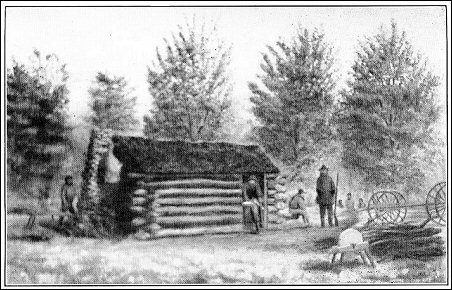 This picture is reproduced from a painting made by Henry Worrall in 1870 from specifications furnished by F. W. Giles, one of the founders of the town. "It is a true representation of the original cabin and its surroundings, as they existed during the winter of 1854-5, to the most minute detail." The painting hangs in the museum of the Kansas State Historical Society. |
|
C. Dickey and George Davis. They arrived and made land claims on November 29, 1854. Several members of the Sixth Party who arrived in Lawrence early in December joined them in founding the town of Topeka.74 Two other members of the Fifth Party, Dr. James F. Merriam, and James A. Hickey, settled in Topeka before the middle of December, 1854. (Departed from Boston, November 21,1854; Charles H. Branscomb, conductor.)
Compiled from manuscript roster in a record book in the Emigrant Aid Collection, MSS. division, Kansas State Historical Society, and other sources. Mrs. Gilbert's name does not appear on the roster. but the date of her arrival has been verified from another source. †Listed in the first census of Kansas territory taken in January and February, 1855. On November 27, 1854, Thomas H. Webb wrote Agent Charles Robinson
B. Slater, agent at St. Louis, wrote on November 25 that the Sixth Party numbering some 30 persons had arrived on that day, and immediately proceeded up the Missouri river on the steamboat Genoa. He also mentioned that William H. Weymouth of the party, suffering from smallpox, had remained inst. Louis. [76] Excerpts from Leonard G. Brown's letter give some details of the journey: Missouri, Nov. 26, 1854.
|
On the roster of the Sixth Party are the names of two men who were in the First Emigrant Aid Party-George W. Hutchinson and Ira M. Jones. Aside from these two, and Mrs. Anson Mallory and daughter, all of whom had interests in Lawrence, the remainder of the Sixth Party who stayed in Kansas, joined with four men of the Fifth Party and founded the town of Topeka. According to historical accounts, Loring G. Cleveland, George F. Crowe, Fry W. Giles, Jonas E. Greenwood, Daniel H. Horne, S. A. Clark, William C. Liniker, Timothy McIntire and Thomas G. Thornton, all of the Sixth Party, reached Lawrence on December 2, 1854, after walking from Kansas City. There they met Charles Robinson, Aid Company agent, Cyrus K. Holliday, from Pennsylvania, and Milton C. Dickey of the Fifth Party. They discussed the new town site (not yet named Topeka) some twenty-five miles up the Kansas river and decided to send a committee to investigate it. The committee found the location ideal. On December 5, they held a meeting and organized a town company. C. K. Holliday was made president. Those who signed the agreement were C. K. Holliday, F. W. Giles, Daniel H. Horne, George Davis, Enoch Chase, J. B. Chase, M. C. Dickey, L. G. Cleveland. Charles Robinson was made an honorary member of the town company. The rest of the Sixth Party remaining in Lawrence soon arrived and work was begun on living quarters for the Winter. Late in December,samuel F. Tappan, member of the First Party and a Lawrence settler, paid "Topeka" a visit and described it in a letter dated December 22, 1854:
|
|
|
1. Other articles on the Emigrant Aid Company published by the Historical
Society are: Carruth, W. H., "The New England Emigrant Aid Company as an
Investment society," in Kansas Historical Collections, v. VI, pp. 90-96;
and four articles in The Kansas Historical Quarterly-Johnson, Samuel A.,
"The Emigrant Aid Company in Kansas," v. I, pp. 429-441; Hickman, Russell K.,
"Speculative Activities of the Emigrant Aid Company," v. IV. pp. 235-267;
Johnson, Samuel A., "The Emigrant Aid Company in the Kansas Conflict," v. VI, pp.
21-33 ; Langsdorf, Edgar, "S. C. Pomeroy and the New England Emigrant Aid
Company. 1854-1858," v. VII, pp. 227-245, 379-398. |


