|
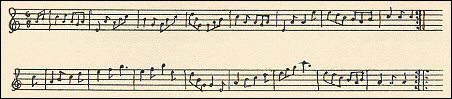
Reproduced below is a fragment of martial music of the American Revolution. The manuscript was received by the Kansas State Historical Society from Ellen G. Parkhurst, of Topeka, to whom it was given in 1910 by Samuel J. Reader. Across the top Reader wrote "The tune my grandfather (Wm. James, of the New Jersey Minute men) played when fifer of his company during the Revolutionary war, 1776." Samuel Reader came to Kansas in 1855 and settled at the now extinct town of Indianola near present North Topeka. Extracts from his diaries, preserved by the Historical Society, have been published in previous issues of the Quarterly. An entry for November 29, 1910, records the copying of the tune for Miss Parkhurst. Reader was then seventy-four years old. ![]() Included in the series of Kansas Historical Marker inscriptions published in the last issue of the Quarterly was one on "Waconda, or Great Spirit Spring." This item, from the Cawker City Free Press of sixty years ago (June 30, 1881), lists some of the "tokens," intended as gifts for the Great Spirit, which were found in the pool. The work of cleaning out the Spring is progressing finely. As the pressure, by removal of the mud, is relieved the water accumulates faster, and to get rid of it Mr. Michener has devised a new sort of pump that throws a three-inch stream of water and is very easily managed. Many relics of "original proprietors" are being taken out of the Spring, among which we noticed the much dreaded scalping knife, a tomahawk, bows, arrows, javelins, rings, chains, brass or copper kettles, some old time flint lock guns and pistols, many parts of which are in a good state of preservation. . . . |
|
From the Kansas City (Mo.) Enterprise, August 22, 1857 (reprinted from the Hericon Argus). We are sorry to see the girls of the present day have such a tendency to utter worthlessness. . . . Years ago, . . . it was fun to go a dozen miles afoot, with mud knee deep to see them, nature instead of art. But now it is different. The dentist supplies the teeth, . . . an artist furnishes the paint, a yankee the hoops, some "French milliner" gets up artificial maternal founts, and the very devil robs himself to give them a disposition to lie, tattle, gossip, make mischief and kick up all sorts of hobberys among people generally. |
|
From the Cawker City Sentinel, copied in the Netawaka Chief, July 30, 1872. Mrs. Mary C. Hawes, of Crooked creek, four miles north of Bulls City, has this season, with a yoke of oxen driven by herself, broken 25 acres of prairie; drove the oxen to break 25 acres more; has shot two buffalo with her rifle, which she calls "Betsey." Her plowing is very well done and with the rifle she is an expert. She has the best crops of corn, etc., that there are in her neighborhood. Our "devil" is very anxious to know if Mrs. Hawes is a widow. Says he wouldn't mind settling on that farm! News, December By the way, Jake, we observe in your last issue that there has been a revival in your town [Emporia], lately, and that about thirty sinners have been reclaimed from the embraces of the Old Boy; and we also notice in the same issue that you publish several selections of a serious and religious character. Are we to infer from them-the "hard times," the revival and your pious selections-that you are one of the redeemed? If so, good boy! Nothing like adversity to bring a youth to his milk: [Burlington] Neosho Valley Register. No, [S. S.] Prouty; we are sorry to inform you that we are not among the number of our citizens who were made happy by being convinced of the "error of their ways," at the late religious awakening here. Our readers, unlike yours, are an enlightened and Christian set of people; and this may account for our publication of articles of a religious and moral character. Of course, we publish something for them as well as for the politicians and others. We are glad to see that you have read those articles-for if you had not told us, we would never have known that you had any taste for anything of that character. It would take something more than an ordinary run of adversity to bring you to your milk, you dried up (morally, not fleshy) old sinner, you. . . TEXAS Cows: The best time to plant them is the last of July, and from the number running around town, destroying gardens and breaking fences, there will be a large number planted. To do it properly, prepare a hole about four feet wide, three feet deep, and six feet long, cover them deep. Any place outside of town on the prairie, where a friendly bullet will fetch them, will do. That is what I know about farming.-A CITIZEN. Miss Tosa Jones, of Argonia, aged 18 years, daughter of J. W. Jones, has this spring broken forty-five acres of land and planted it in corn and intends to cultivate it herself. She can husk and crib sixty bushels of corn per day. She also attends to the feeding of a large number of cattle every winter. Miss Jones should succeed Mrs. Salter as mayor of Argonia. From the Wilson County Citizen, Fredonia, May 29, 1874. The accomplished burglar and thief, Mr. Chase Noble, Esq., who knows how to pick five locks and break jail twice all in one-half hour, has concluded, by unanimous request of twelve of his countrymen, to accompany the sheriff of this county to Leavenworth soon for the purpose of inspecting the public improvements of that place. He contemplates remaining about ten years. From the Oberlin Herald, April 10, 1884. Mr. George Pratt and Eli Craig, of Museum, had a little circus over a claim a few days ago, and during the performance Mr. Pratt felt of Mr. Craig's head with a revolver; after which Sheriff Batchelor organized a pleasure excursion, composed of Mr. Pratt, Mr. Craig and a few other invited guests, and made a trip to Sheridan, taking in the county attorney as they passed through Kenneth; arrived at Sheridan they visited J. Leatherman, Esq., where they held a short entertainment. The programme consisted of short dialogues, off-hand speeches and a clincher by the host. All parties enjoyed themselves, and Mr. Pratt in his generosity paid the expenses of the excursion besides making a small donation to the school fund. From The Commonwealth, Topeka, June 6, 1875. And now comes Mary A. Spring as editress and publisheress of the Index, at Cherokee, Crawford county. The first Kansas editor who gets off anything about "lingering in the lap of Spring" is to be killed and fed to the grasshoppers. |

|
From the Eureka Herald, June 1, 1876. A Canadian gentleman, traveling for his health, passed through town Monday evening. He had the most comfortable traveling wagon we ever saw. It was large enough to contain stove, cooking utensils, bed, etc. He was accompanied by his wife, and had along an extra horse and nine dogs. He evidently enjoys himself as he goes along. From the Garnett Weekly Journal, November 25, 1876. The latest style of young ladies' hats is called the "Kiss-me-if-you-dare." When worn by a cross-eyed woman with a wart on her nose, the defiance is terrible and unanswerable, but when it is backed up by a pretty face, every youth with a spark of manhood in his bosom answers the challenge the first good chance, if it does take all the wax out of his mustache. Hawkeye. From the Eureka Herald, May 10, 1877. The Emporia News calls for the building of a first class hotel in that city. One cf the most varying, indefinite and uncertain terms we have met in Kansas is that of "first class hotel." As we approached Topeka on our introduction to the state in 1870, we saw the Tefft House loudly advertised as a "first class hotel in every respect." We registered at this establishment and were introduced into as shabbily furnished apartment and to as poorly prepared food as we were ever accustomed to see at hotels not aspiring to be rated in any particular class. We heard of the fame of the Robinson House of Emporia on our approach to that city. It also said to the world it was par excellence "first class." We tried it on several occasions. On one occasion we were kept awake all night by native occupants, commonly called bed bugs, disputing our right Of possession by practicing tricks that only bed bugs know how to practice. On another occasion we were as effectually entertained by broad gauge rats disporting themselves over us in a most unceremonious manner. Our experience in these and similar instances in Kansas, causes us to feel a smiling sensation whenever we hear the term "first class" used with reference to hotels. If the "first class" hotels we have struck in Kansas are samples Of all hotels of said class in the state, we hope our neighbors will think better of it and not encourage the builder of another. We prefer a good hotel at any time to first class establishments as they have been dished up to us. |
|
From the Dodge City Times, May 4,1878. In this delectable city of the plains the winter of discontent is made glorious by the return of the cattle trade. With the countless herds come the hordes of bipeds. Weeks and months before, through the blasts of winter and the gentle zephyrs of spring, has impecuniosity longed for the opening of the cattle trade, in which Dodge City outshines all envity and rivalry. This "cattle village" and far-famed "wicked city" is decked in gorgeous attire in preparation for the long horn. Like the sweet harbinger of spring, the boot black came, he of white and he of black. Next the barber "with his lather and shave." Too, with all that go to make up the busy throng of life's fitful fever, come the Mary Magdalenes, "selling their souls to whoever'll buy." There is "high, low, jack and the game," all adding to the great expectation so important an event brings about. The merchant and the "hardware" dealer has filled his store and renovated his "palace." There are goods in profusion in warehouse and On shelves; the best markets were sought, and goods are in store and to arrive. Necessarily, there is great ado, for soon the vast plains will be covered with the long horn and the "wicked city" is the source from which the great army Of herder and driver is fed. The season promises to be a remarkable one. The drive is reported to be larger, and the first herd will probably reach this point within a couple of weeks. There has been no undue preparation, and the earlier season has stimulated activity to the greatest measure Of expectation. From the Lakin Eagle, May 20, 1879. DOES IT BLOW IN KANSAS?-As a truth and no fabrication, Kansas is not a windy country. We have here during twelve months of the year an imperceptible circulation of air from the south, west, north and east (varied to suit one's taste and inconvenience), that in other states as in Colorado, Illinois and Nebraska, might be called high wind, but here it is considered nothing but a gentle zephyr. In some states they have high winds but never in Kansas. A two-gallon funnel turned flaring end windward and gimblet end downward will collect enough of Kansas Zephyrs in seven hours to drill a hole in solid sand rock one hundred and eight feet deep. We never dig wells in Kansas. Condensed air does the work most successfully. The men here are all pigeon-toed and bow-legged. This is caused from an unceasing effort to stick the toes into the earth and trying to keep a strong foothold On terra firma. The gentlemen carry a pound of shot in each breaches leg to keep them (the gentlemen) right side out. Why they are afraid of turning wrong side out we never knew, but the wind has nothing to do with it. We are often compelled to stay down town late of nights, and when we arrive home it generally strikes up a lively breeze, espe- |
|
cially if our breath smells a little of cloves or coffee, yet strictly speaking Kansas is not a breezy country. The fish are very tough in this country because when they walk out to eat grass the wind blows all of their scales off and makes the meat hard and sunburnt. From the Junction City Union, May 10, 1873. The Colorado papers think Kansas zephyrs are no-where because they can't budge a locomotive. Colorado winds can lift such light obstacles without the least effort. |
|
From the Larned Optic, July 30, 1880. The lightning struck a Great Bend girl last week. She was not injured in the least, but her corset ribs were sadly demoralized, as was also the arm of a young man who was trying to keep them in place. When asked by his friends why he keeps his arm in a sling he explains that he "didn't know she was loaded." From the Dodge City Times, March 24, 1877. On Wednesday a gust of wind removed seven dollars out of the stocking of Alice Chambers as she was walking up Front street. After a six-hour search, participated in by all the tramps in town, one dollar was recovered. We had supposed that the Kansas wind was of a higher order, and did not stoop to such larceny. The thing is now settled, that under some circumstances even the wind can be found feeling around in by and forbidden paths. The "wicked city of Dodge" can at last boast of a Christian organizationa Presbyterian church. It was organized last Sunday week. We would have mentioned the matter last week but we thought it best to break the news gently to the outside world. The tender bud of Christianity is only just beginning to sprout, but as "tall oaks from little acorns grow, so this infant, under the guide and care of Brother Wright, may grow and spread its foliage like the manly oak of the forest. Years ago John the Baptist preached in the wilderness of Judea, and his meat was locusts and wild honey, but he baptized many converts in the river of Jordan. Who can tell but that years hence another Luke may write a book about our minister preaching in the wilderness of Dodge City and baptizing in the river Arkansaw? From the Inland Tribune, Great Bend, August 9, 1879. The Colorado exodus has set in; those who went there in the spring are on their return to their wifes' people to spend the winter. On Saturday a wagon passing through had large letters inscribed on the corner: "Prodigal sons going home for a square meal." From the Daily Kansas State Record, Topeka, April 22, 1870. They sell a little whisky occasionally in Leavenworth. The Conservative says that the liquor licenses in the city clerk's office make a strip nine feet long, one name to the line. From the Logan Enterprise, September 23, 1880. An Atchison county man Who had been bitten by a copperhead snake, carried the snake with him to the drug store in order to procure the necessary whisky. From The Independent, Kirwin, January 26, 1881. Since the saloons at Beloit closed, the residents of that burg are drinking water from the Spirit Springs at Cawker City. From the Cawker City Free Press, August 18, 1881. Strangers visiting the Great Spirit Springs will do Well to bear in mind that its waters are laxative as well as healing and soothing to the nervous system, according to the amount imbibed. Like intoxicating drinks, imbibed in moderate quantities and with judgment, it is beneficial, but if guzzled in immoderately large doses it won't stay with a fellow. At least this is the judgment of Put Smith, of Beloit, who visited the great phenomenal wonder the other evening and came home in another man's clothes-they were too large for him. He looked as if he had taken passage for Bulu Land. During the depression following the panic of 1893 Jacob Coxey, of Ohio, proposed that the unemployed be put to work by the issuance of legal-tender currency to be spent for good roads and other public improvements. To arouse public and congressional interest he organized a march of a "living petition" of the unemployed to Washington. The movement, favored with considerable publicity, inspired the dissatisfied elsewhere and several "industrial armies" sprang up to join Coxey. |
|
One brigade numbering half a thousand was recruited in eastern Colorado by "Gen." S. Sanders. The men appropriated a switch engine and cars and set out for Washington. Several attempts by the railroad company to halt them ended in failure. Not until the army reached Scott City, where it was met by a United States marshal and posse, was it overcome. The men were hauled to Leavenworth for trial. After a delay of more than a month, perhaps because the judges felt that "Populist Kansas was no place to convict industrial armies of train-stealing," those who had not escaped were brought before the court and convicted. They were distributed in county jails with sentences of varying lengths to prevent them from reassembling when released. [See Donald L. McMurry, Coxey's Army (Boston, 1929), pp. 206-213.] An account of Sanders' march across eastern Colorado and the capture of the army at Scott City was printed in the Scott City Republican, May 17, 1894:
|
|
|
a mixed crowd. A few were well dressed, but the great majority are miners and mechanics in their labor soiled clothes, there were comparatively few Americans among them. Their discipline and order was surprisingly good, they are governed by written laws adopted before they left Cripple Creek. We were told that they blacklisted all disorderly and tough characters and expelled them, and that 100 such had been weeded out. Mr. Sanders is a tall fine looking, intelligent and quiet appearing young man, with a graceful easy bearing. His word is law. After a consultation with his captains permission was asked of Mayor L. L. Bingaman to make a camp, which was granted, and the different detachments marched to camp between the roads. The surrender had been unconditionally made, and Marshal Neeley made a short speech to each company, explaining that they were under arrest and would be made as comfortable as possible in the coaches, his words were received with cheers by the men. They were told to be ready to start by midnight. Camp-fires were quickly lighted, and the men proceeded to butcher, dress and cook a beef which the citizens gave them: Many begged their suppers from one house to another, while some few offered to pay for what they received, about half of those who got cheese, crackers and tobacco at the stores voluntarily paid for them, we have not so far heard of any ungentlemanly conduct of these men in town. So closed the most exciting day Scott ever witnessed. Our whole city population witnessed the spectacle. Business had been suspended al] day in expectation of no one knew what. The time was divided between looking towards the west for the smoke of the Sanders army engine, and toward the east for the U. S. army engine's smoke. Our officers were not called on to serve their papers. The Santa Fe train was held at Dighton until the morning after the.surrender so as to be out of danger. The road had emptied its water tanks in front of the army and they had to carry water for their engine a quarter of a mile in buckets. We were told that Mr. Sanders is an electrician and a practical miner, and a schoolfellow of "General" Kelley, of the Denver army now in Iowa. It is said that at one time in Cripple Creek, his check was good for $70,000, and that he now carries a check given him by the people of Cripple Creek, for $7,000. The most rational theory of the situation was given us by one who had the best opportunities for observation. He says they are mostly ignorant foreigners, they are single men who have no home or local ties, and were out of work and money, and excited by agitators, like the Indians, believe that if they can only get to Washington, and just get to see the Great Father that he will take pity on them. Of course the leaders know better, and have more definite ideas, and expect to petition Congress: 1st. For free and unlimited coinage of silver; 2d. Adequate aid in irrigation; 3rd. Restriction of foreign immigration. Our opinion is that the rank and file is thoroughly ignorant, thoroughly earnest and thoroughly misled. At midnight the army was put on the Special and taken to Topeka, and from there to Leavenworth for their preliminary hearing. Four of the men were asleep when the train pulled out, and so got left, but were taken on by Mr. Tester, who left Monday morning to attend the trial. |