CHAPTER IX
IN WHICH WE RETURN TO "THE LAND OF THE
FREE"
WE found when we were leaving England another of those curious
contrasts between the nations of the earth that one meets in a
long journey. Coming into Bordeaux we were convoyed for three
hours by a ratty little French destroyer and a big dirigible
French balloon. Leaving Liverpool, we lay two nights and a day
sealed in the harbour, and then sailed out with the
Arabic, the Mongolian, the Victorian,
and two freighters, amid a whole flock of cruisers and
destroyers. The protecting fleet stayed with us two nights and
three days. On the French boat the barber practically had no news
of sudden deaths and hairbreadth escapes which had happened while
we slept. We sailed into the Gironde River peacefully, almost
joyously. But we left the Mersey with a story that a big fleet of
destroyers hovered at the river's mouth; that the Belgic
had been beached out there on a shoal by a
333
334--Martial Adventures of Henry and Me
"sub," and that we would be lucky if our throats were not cut in
the water as we tried to swim ashore after we had been blown out
of our boats.
The French certainly are more casual than the English. But then,
the Germans have sunk virtually no French liners, while the
British liner is the favourite food of von Tirpetz! They even
showed us his teeth marks on our American liner, the New
York. On an earlier trip during the summer of 1917 the boat
had been torpedoed when Admiral Sims was a passenger, going to
England. The Admiral was sitting at dinner when the explosion
occurred and the force of it threw him to the high ceiling of the
dining saloon! At least that's what they told us. Caution and
conflicting doubts, "fears within and foes without," were not so
unreasonable as one might fancy, coming out of any British port.
But to Henry and me the greatest contrast came, not in the
conduct of the ship's officers, as compared with the French
seamen, but in the ship's company, going to war and coming away
from it. We went with youth; the Espagne was crowded
with young men going to war, with young women going out to serve
those who were salvaging the waste of war. The boat carried a
score of lovers--some married, some impromptu,
"The Land of the Free"--335
some incidental and fleeting, but all vastly interesting. For
when the new wine blooms the old ferments, and stumbling over the
dark decks at night on the Espagne, we were forever
running into youth paired off and gazing at the mystery of the
ocean and the stars. So the corks were always popping in our old
hearts; and we enjoyed it. But we paced the black night decks of
the New York as "one who treads alone a banquet hall
deserted." We were among the younger people on the ship. There
was no youth to play with under thirty! No one touched the piano.
No one lifted his voice in song. The most devilish thing going as
we sailed was a game of chess! There was a night game of whist or
cribbage or some other sedentary game, which closed at ten, and
after that in the library the talk sagged and died like a
decomposed chord in a Tschaikovsky symphony! It was sad! One had
to go to the smoking room where there was wassail on lemon
squash and insipid English beer until after midnight. But there
the talk was good. Of course it sometimes bore a strong smell of
man about it, but it was virile and wise. A rug dealer from
Odessa, a dealer in mining machinery from Moscow, a Chicago
college professor returning from Petrograd, a cigarette maker
from Egypt, a brace
336--Martial Adventures of Henry and Me
of British naval officers going over to return with Canadian
transports, an American aerial engineer, back from an inspection
trip to France, a great English actor, who once played Romeo
with Mary Anderson--to give one an approximate of his age--a Red
Cross commission from Italy, and an Australian premier. The whole
ship's company was but thirty-four first class and of these but
six were women. It was no place for dashing young blades in their
late forties like Henry and me.
As the hour for leaving the ship approached, the press of the
splendid months behind us drew Henry and me together more and
more. We were hanging over the deck rail looking at a faint
attempt at a cloudy sunset at the end of our last day out. We
fell to talking of the love affairs on the Espagna, and
perhaps from me came some words about the Eager Soul, the Gilded
Youth and the Young Doctor. Henry looked up dazed and anxious.
Clearly he did not know what it was all about.
"Who was this Gilded Youth?" asked Henry.
"He was the dream we dreamed when we were boys, Henry. When fate
set you out as a book agent on the highway and me to kicking a
Peerless job press in a dingy printing office. The
"The Land of the Free"--337
Gilded Youth was all we would fain have been!"
"And the Eager Soul?" quoth he.
"She, dearly beloved, was the ideal of our boyish hearts. Did you
ever have a red-headed sweetheart in those olden golden days,
Henry?" He shook a sad head in retrospection. "Nor did one ever
come to me. But most boys want one sometime, so I took her off
the Red Cross Posters and breathed the breath of life into her.
And isn't she a peach; and doesn't she kind of warm your heart
and make up for the hardship of your youth?" He smiled assent and
asked: "But the young Doctor, Bill, surely he--"
"He is the American spirit in France, Henry--badly scared, very
shy at heart, full of hope and dying to serve!"
"And it never happened--any of it? " asked Henry.
"Yes, oh, yes, Henry. There was the tall boy who played Saint
Saens on the Espagne, and did the funny stunt at the
auction; there was the night we sat on the food box near the
front at Douaumont and heard the ambulance boy whistling the bit
from "Thais," far up the hill in the misty moonlight; there was
the French soldier by the splintered tree in the Forest of Hess;
there was the head nurse killed by the abri between
338--Martial Adventures of Henry and Me
Souilly and Verdun, who waited while her girls went in; there was
the poor dying boy in the hospital for whom you bought the
flowers
and there was the handsome New York woman coming over to start
her hospital. There was the young doctor whom the German officer
prisoner tried to kill. And there was the picture of the
red-headed Red Cross nurse, and there were our dreams.
"And the ending--will you have a happy ending?" demanded Henry.
"Aren't the visions of the young men, and the dreams of the old
always happy? It is in passing through life from one to the other
that our courage fails and our hearts sadden. And these phantoms
are of such stuff as dreams are made of and they may not falter
or grow weary, or grow old. Youth always has a happy ending--even
in death. It is when youth ends in life that we may question its
happiness."
And so we left our fancies and walked to the big guns far forward
and gazed into the sunset, where home lay, home, and the things
that were real, and dear, and worth while.
THE END
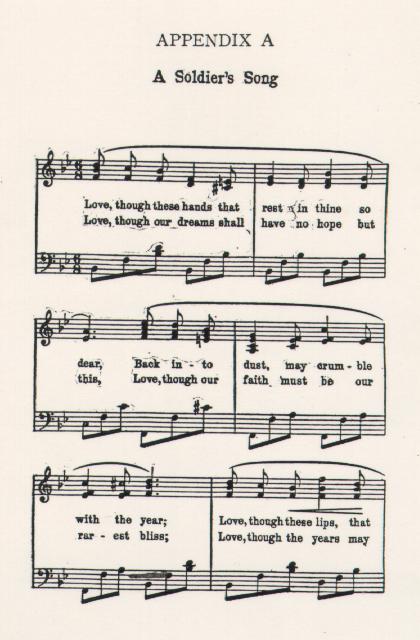
APPENDIX A
|


