CHAPTER IV
SNAKE STORIES, ETC.
Our first acquaintance.--A novel weapon.--A false alarm.--A narrow escape.--A curious sight.--Instinct of pigs.--Our decision, and how we kept it.--Snake hunts.--Another kind of wild cat.--Varieties of snakes.--An easy victim.--Frogs and snakes.--Game.--Figure 4 traps.--Edible and other prairie plants
WHILE wandering about the country one Sunday afternoon during
our first spring, we came across our first snake.
san
My father and I were walking along the dry bed of a stream, when I
saw a tremendous snake coiled up on a pile of drift wood, and I set
up a yell (you must remember that I was only just eleven years old,
and it was my first; I never yelled afterwards at a snake). My father
lifted me up a bank about three feet high that was in front of us,
and sprang up himself, and then asked what was the matter. I motioned
to him to be silent, and then pointed
Page 60
below to where the snake still lay as though asleep.
As we had nothing to attack the thing with we reluctantly passed on
after looking at it some little time. Presently, however, we came to
some young trees, so we cut a long pole with my big knife, and then
went back to settle the business.
We approached very cautiously, so as not to awaken the snake, and then
my father, dropping on one knee at the top of the bank, dealt the
reptile a most tremendous blow. No movement followed, so the dose was
repeated, still with a like result, and upon pulling the snake up on
the bank, we found that it had been dead for some time, as the insects
had began to bore holes in it and eat it. It was a bull snake about six
feet long, and not considered poisonous.
We did not always find them dead though. Shortly after this five of us
were returning from a bath, and came across a rattlesnake all alive and
kicking, or rather jumping. After a short consultation, having nothing
with us more formidable than towels, my father took off one of his long
Wellington boots for a
Page 61
weapon, and hopping on one foot, very cleverly killed the wretched
thing. On the same journey, when a little nearer home, and while
passing through some very long- grass by the side of a stream, we
were rather scared by a very loud and strange noise close to us in
the tangle. Thinking it might be some dangerous wild animal, one of
us rushed to the house for a couple of guns, while the others kept
watch. Upon the arrival of the firearms, the contents of two barrels
were poured into the spot from whence the noise came, and what do you
think was the result? We had simply killed an old heron, who was
sitting on her nest over her young ones!
Our next experience with snakes was when Jack and I were walking
to Parkersville one day. There was a little bit of a track worn by
this time over the grass, and I saw two rattlesnakes lying in the
beaten-down grass, and jumped over them just in time to avoid
treading on them. Again we were unfortunate in having no weapon
with us, and had to pass on, carefully remarking on the place, so
that we might be prepared on our return should they still be there.


Page 63
When we came back one of our neighbours was with us carrying an
axe, and upon reaching the spot we found the snakes not far away,
and he soon cut them in pieces.
One morning my father was just going to pull on his long boots in
the house, and finding that one of them felt rather heavy he shook
it, and out rolled a rattlesnake. I guess that was rather a narrow
squeak. On one occasion Humphrey went out to feed the hogs, and upon
looking into the sty occupied by the old sow and her family of ten,
he found a rattlesnake lying with the busy little ones, taking some
refreshment. They all seemed very happy together, with the exception
of one poor little fellow, who was of course crowded out.
Humphrey called us all out to see this curious sight, and then the
snake was dragged out and killed with a pitchfork. Some people
might doubt the accuracy of this statement, and I almost think that I
should had I not seen it myself. I had heard before of cows being
milked by snakes, but not pigs,. as the two are mortal enemies; but
in this case the old sow was asleep, or she would not have allowed
it.
Page 64
A pig, if attacked by a snake, if it is a venomous one, will lay down
and present its face, and let the snake bite it in the cheek several
times, where it seems to take no effect. When the venom is exhausted in
this way for the time being, the pig will get up and calmly take hold
of the snake and rend it to pieces. In the case of a
non-venomous snake the pig will not take so much trouble, but will at
once attack it and eat it. So much for the instinct of pigs.
All these little incidents made us rather nervous at first, and we
boys declared that we would never go about without thick boots and
leather leggings on, but "Familiarity breeds contempt ;" and before
the summer was over we had got used to such things, and were running
about without boots or stockings on, as is the custom there among
boys in hot weather. By this practice the soles of our feet became
like leather, and I have often stood upon a cactus and felt nothing
of the prickles.
Sometimes Jack and I, and three or four Quinns would get up a snake
hunt. Taking one or two dogs with us, and a large pole for
Page 65
a lever, we would go and pry up big rocks, and look under them for
snakes, and then haul them out and kill them. We often settled a good
many in this way with sticks and stones.
It was rather dangerous work perhaps, but no one was ever hurt. We
were all pretty nimble, and could get out of the snake's way when he
jumped, and the chances were that his back would be broken before
he coiled for another spring.
One day, when out on this business down a creek, our dogs chased a
cat that had left civilisation and taken to the woods. They ran her
pretty close until she sprang up a big hickory tree, from which,
though, we soon dislodged her.
The tree was about sixty feet high, and she went almost to the top,
but I followed, and soon shook her down. She then took to earth,
disappearing down a hole under a big rock.
We set to work digging and poking about for a while, until presently,
instead of the cat, out rolled-a six-foot bull snake. Of course, as
we were out hunting for snakes and not for cats, this served our
purpose as well,
Page 66
and after settling his hash we left the cat in peace.
Now and then we came across the "blueracer " snake, but never
managed to kill one, for, as its name implies, it is a quick traveller;
in fact, it is no sooner seen than gone, like a flash of greased
lightning with the brake off.
Another mystery to us was the glass snake, so called from its
brittleness; for with a slight blow it would break in two. Moreover, it
is supposed to possess the marvellous property of being able to join
itself together again after an accident, but I am inclined to think
this a popular delusion. I have never proved it by experience, although
after having apparently killed one-broken it into several pieces and
leaving it-it had singularly disappeared, as though the head had
come back to gather up the remainder (for the head and front part
generally managed to escape). This matter I must leave for settlement
to others better versed in this branch of zoology than myself.
Another kind of snake, and one that we were not at all fond of, was
the mocassin, a poisonous snake very similar in size and colour to
the rattlesnake, but generally to be found
Page 67
in the water. For this reason it behoved us to be careful in going in
to swim, or we might find our bath occupied.
There was another kind of water snake, a little harmless thing, that
we paid no attention to, often being in the water at the same time.
All kinds are now beginning to get quite scarce, as nobody passes one
if he can possibly kill it. Sometimes we had hard tussels, and
sometimes they were found in such positions as to fall an easy prey
to our tender mercies.
One day Humphrey found a big bull snake down a hole which had
been dug for a fence post. All he had to do then was to ram away at
the "critter " with the post. It was like using a big pestle and
mortar.
Occasionally we would be guided to a snake by the cries of a frog,
and would find the poor thing halfway down the snake's throat, with
his legs crushed out of all shape. The snake then became our victim
by way of a change.
Once we found a big snake that had just swallowed a smaller one; it
was lying almost helpless, with the other's tail protruding from its
mouth. We then killed two with one stone.
Page 68
Small game was very plentiful, such as d prairie chickens, quails,
snipes, wild ducks, i rabbits, and jack-rabbits. The latter were large
creatures, closely resembling the English hare, but more of a fawn
colour. Like the hare, they do not burrow in the earth, but lie close
in the grass; sometimes so still would they sit, in the hope of
not being seen, that we a have been able to throw ourselves on them
and catch them.
Occasionally, if on the high flat prairie, we 0 used to run them down
on horseback; but it was a hard run, as they were very swift, and i
went in long bounds like a kangaroo.
The snipes used to amuse us a good deal by the trouble they took to
lead us from their nests when disturbed. If we rode close by a snipe
on her nest in the grass, she would spring out and flutter away, as
though her wing was broken, at the same time piping; most
mournfully, as though in great pain. If we followed she continued the
game until we got about fifty yards from the nest, when she would fly
away safe and sound, uttering a noise which one could almost fancy
was a laugh at our being duped.
Page 69
Of course to any one in the secret it was vain work on her part, as,
directly a bird flew up in such a commotion, one knew that the nest
was close by.

With the commencement of autumn there were hundreds of wild geese,
cranes, brant, swans, etc., flying south to their winter quarters among
the lagoons of the Mississippi and other regions, only stopping at
night to feed, so that we seldom got a shot at them, as they flew so
high.
Page 70
In the spring they flew north again, on their way to the great lakes.
They looked very pretty in their great V-shaped flocks, and made a
great noise as they flew.
In the winter we used to catch a great many prairie fowls in traps.
We would put a big box on top of a figure 4 piece, and throw some
Indian corn under for bait, and would sometimes catch as many as
three or four of these large birds at one time.
One year we had a small patch of land sown with buckwheat, but as it
was not very good, it was never carried, and the prairie fowls used to
come there in swarms when the snow was on the ground. As we had
four traps, we nearly lived on prairie fowls that winter.
They seemed very simple in that respect, although wary enough as
regards shooting them, for when feeding thus in a field there was
usually a sentinel perched upon the fence.
Quails are very easily caught in traps also, and as they always keep
close together in a covey, we sometimes caught nine or ten at once. I
remember Humphrey killing eighteen at one shot with a gun when in
the woods.
Page 71
A figure 4 trap is made in this way. A stout stick, sharpened like a
chisel at the top end, is placed upright on the ground with a notched
stick resting upon it in a sloping position. This second stick is also
sharpened chisel-wise at one end, and it catches in a notch in a third
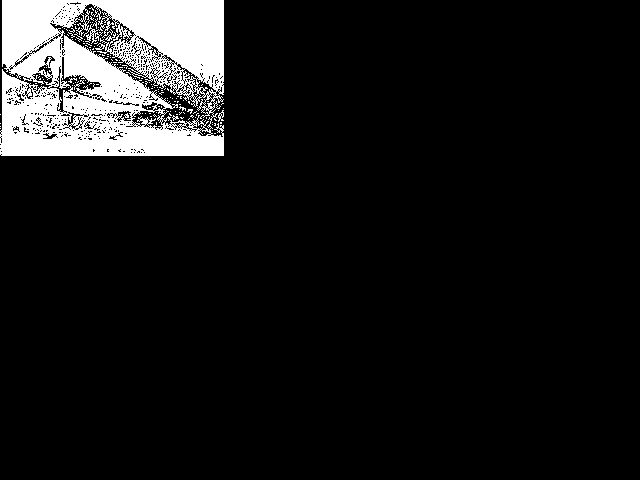
and longer stick. This one has another notch cut in its side, which
catches on the first stick. The trap-box or tub, or whatever it may
be-rests on the top of No. 2 stick, and binds all together. The bait is
placed on or near the end of the long stick,
Page 72
and a very slight touch is suffficient to drop the trap. This
arrangement is said to have been invented by Daniel Boone, the old
Kentucky settler, when his ammunition was all used up. He used to
apply the principle to tremendous heavy logs to fall on and kill bears
and deer.
There are several kinds of wild plants growing on the prairie which
are edible, or at least useful medicinally. Wild onions, or shallots,
were very plentiful. They grew encased in woody, fibrous coverings,
which, when stripped off, disclosed a little kind of spring onion
which was very nice.
Artichokes, too, were abundant, and another plant tasting exactly like
celery. Then there was the wild tea-plant, a small bushy shrub with
white flowers and crisp, bright green leaves, which, when picked and
dried in the sun, made very good tea. Tea can also be made of the
leaves of the raspberry canes, quite as good to my taste as the
ordinary Chinese beverage.
Then there was also a herb which we used as medicine for any little
disorder inside. Besides these there was a peculiar plant known as
rosin weed, from which exuded a
Page 73
gum which the girls and boys used to gather for chewing. Chewing
gum is much sold in the towns, but it is of a different material to
this.
Another plant was known as "snakeweed." One was popularly
supposed to find a snake under it, but this rule did not always hold
good, though we certainly found snakes near the weeds sometimes.
It was rather a peculiar weed, something like a broad bean, with
flowers of the lupin kind. Sensitive plants also abounded on the
rocky upland, the leaves of which all closed up upon being touched.
They had beautiful pink flowers with a most lovely scent.
|


