THE TOPEKA LEGISLATURE.
March 4, 1856, the Legislature chosen under the provisions of the Free-state
constitution, convened at Topeka, and the provisional forms of a State
Government were fully established.
The session was short. It organized; received the inaugural address of the
Governor; accepted the report of the Territorial Executive Committee, whose
functions ceased with the establishment of the State government; prepared
a memorial to Congress, asking admission under the adopted constitution;
chose two United States Senators (contingent on the admission of Kansas as
a State), elected a committee of three to prepare a code of laws and
adjourned March 8, to meet on the 4th of July next.
The officers, National and State, and members of the State Legislature were as
follows:
Governor - Charles Robinson, Lawrence.
Lieutenant Governor - William Y Roberts, Big Springs.
Secretary of State - Philip C. Schuyler, Council City.
State Treasurer - John W. Wakefield, then living six miles west of Lawrence,
on the California road - on the N. W. 1/4 of Sec. 31, T. 12 R. 19.
Auditor of State - Dr. George A Cutler, Doniphan County.
Attorney General - H. Miles Moore, Leavenworth.
Judges of Supreme Court - S. N Latta, Leavenworth; Morris Hunt, Lawrence;
Martin F. Conway, Pawnee.
Reporter of Supreme Court - E. M. Thurston.
Clerk of Supreme Court - Spencer H. Floyd, Neosho Valley.
State Printer - John Speer, Lawrence.
Representative to Congress (elected, contingent on the recognition or the
State Government) Mark W. Delahay, Leavenworth.
United States Senators (elected by the Legislature) - James H. Lane and
Andrew H. Reeder.
Members of the State Senate - Henry J. Adams, J. M. Cole, John Curtis, J.
Dailey, W. Dunn, L. Fish, Perry Fuller, J. C. Green, Ben Harding, George
S. Hillger, H. M. Hook, J. M. Irvin, D. E. Jones, S. B. McKenzie, B. W.
Miller, Josiah H. Pillsbury, J. R. Rhaum, T. G. Thornton, W. W .Updegraff.
Officers of Senate - President, M. T. Roberts; Chief Clerk, Asaph Allen;
Assistant Clerk, W. L. Bridgdon; Sergeant-at-Arms - J. M Fuller; Assistant
Sergeant-at-Arms, Harris Stratton; Transcribing Clerks, James F. Cummings and
J. G. Dunn; Chaplain, Paul Shepherd; President, pro tem, John Curtis.
State Representatives - James B. Abbott, S. N. Hartwell, John Hutchinson,
H. F. Saunders, James Blood, C. Hornsbury, E. B. Purdum, J. McGee, Milton
C Dickey, W. R. Frost, W A Simmerwell, S. Mewhinney, Samuel T. Shore, S. B.
Baldwin, David Rees, D. W. Cannon, Isaac Landers, James M. Arthur, Henry H.
Williams, H. W. Tabor, A. B. Marshall, J. B Adams, T. W. Platt, Rees Furby,
B. H. Brock, John Landis, E. R. Zimmerman, W. D. Barnett, L. P. Patty, T.
A. Minard, Isaac Cody, Thomas Bowman, John Brown, Jr., Henry Todd, J.
Hornby, Abraham Barry, Richard Murphy, William Hicks, B. H. Martin, William
Bayless, J. W. Stevens, J. K. Edsaul, T. J. Campbell, George Goslin, H. B.
Standieford, Isaac B. Higgins, Thomas J. Addis, D. Toothman, William
McClure, J. B Watson, William B. Wade, A. Jameson, A. D. Jones, William
Crosby, S. Sparks, Rees P. Brown, Adam Fisher - 57.
Officers of the House of Representatives - J. M. Lane, Chairman of the
Territorial Committee, called the House to order - Speaker, T A Minard;
Clerk, Joel K. Goodin; Assistant Clerk, Samuel F. Tappan; Transcribing
Clerks, J. Snodgrass, G. T. Gordon; Sergeant-at-Arms, J. Mitchell;
Assistant Sergeant-at-Arms, J. Swain; Chaplain, C. H. Lovejoy.
DEATH OF THE EXECUTIVE COMMITTEE.
The Territorial Executive Committee which, up to the organization of the
Legislature, had been the moving and directing force in controlling and
directing the Free-state movement, having completed its work, made its
final report, through its Chairman, James H. Lane, and, its authority
having passed to the executive of the new government, ceased to exist.
Its wonderful efficiency and tireless activity has been before adverted to.
Through its labors, the objects for which it has been appointed had been,
regardless of every obstacle, fully attained. As stated in the final
report, and as shown by the records of the committee, the cost of
establishing the State government was $15,265.90, for which some scrip had
been issued from time to time as required, and sold in quantities and
denominations to suit purchasers, or paid out for expenses incurred. Much
of it found a market at par value, among friends of the movement in Eastern
States. The form of the obligation was as follows:
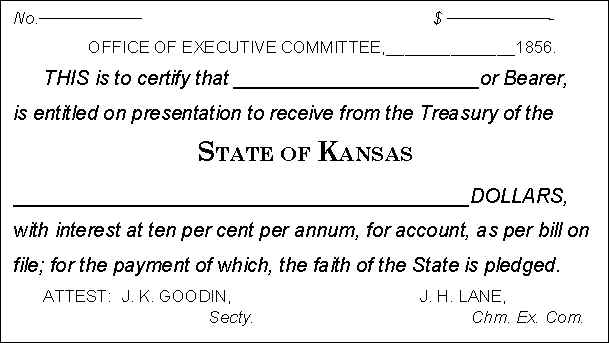
The payment of this scrip was assumed by the State Government which owed
its life to its issue. The issue of like bonds was continued by the
Free-state government, and was its only source of income. It was current at
above par, among its friends, so long as the Topeka Constitution stood a
chance of being accepted as the organic law of the new State, and brought
to all commissaries and agents sent to the East, ready money at its face.
When new acts were passed by Congress, providing for a new Free-state
Constitution, and the Topeka Constitution, with its provisional government,
lost its vitality, the scrip went down with the Government. It was never
redeemed. There was no Government having the authority to levy taxes and
the power to collect them, ever established under the Topeka Constitution; so
the scrip passed out into the realm of financial insolvency. It is held now in
hundreds of families in New England, as a relic of old times, and a testimonial
of money paid for the establishment of freedom in Kansas. It is as worthless as
the Continental money of the old Revolution, or the Confederate money of later
times. Its value to-day lies in the object for which it was issued, and the
motive which brought it into the hands of its present possessors.
The Legislature adjourned with a thorough provisional State organization
established having passed no laws, nor any act contravening the authority
of the General Government or the organic Territorial act. Nevertheless, the
fact of its convening and perfecting in a systematic manner a provisional
State organization, in spite of all threats and intimidation from the
General Government, the Territorial officials, and the Blue Lodges of
Missouri, ratified and confirmed the fact of 'open rebellion against the
laws of the Territory,' and gave the Missourians ample pretext for open and
immediate war. They were prepared, and lacked only the authority of the
Governor to commence an active campaign.
GOV. SHANNON AGAIN.
Gov. Shannon had never been at ease since the treaty he made with Robinson
and Lane. By it he had lost caste with all the Pro-slavery patriots of
Kansas and Missouri, and brought himself under a cloud of distrust at
Washington. As his appointment as Governor of Kansas Territory had not yet
been confirmed by the Senate, on January 5 he started for Washington, where
he arrived five days after, and endeavored to set himself right with the
Pro-slavery junta, President Pierce and his Cabinet. During the time he was
in Washington he interpreted into the Pro-slavery language, and perverted to
Pro-slavery ends every protest, letter and appeal sent by the suffering
Free-state settlers of Kansas to the General Government at Washington. He
returned March 5 having been confirmed in his appointment by the Senate,
and invested with all the power of the United States Army to enforce the
laws of the Territory.
While Shannon remained in Washington, and under his advice, the President
issued his proclamation, already given, declaring the Topeka Government
treasonable. The announcement of his return March 8, by the Kansas
Weekly Herald, Leavenworth, was made as follows:
Gov. Shannon has returned to the Territory. He his all the troops at Fort
Leavenworth and Fort Riley, about 1,200, subject to his call. The laws of
the Territory will he sustained at all hazards, and good order maintained
despite the efforts of fanatics to agitate and keep upstrife. Col. Sumner
has received his instructions to keep his troops in readiness, subject to
the call of Gov. Shannon.
In another column will be found the proclamation of the President, also the
instructions of the Governor.
The instructions with which the Governor returned were as follows:
DEPARTMENT OF STATE, WASHINGTON, February 15, 1856.
SIR - I herewith inclose (sic) to you a proclamation by the
President, dated the 11th inst., duly authenticated, and also a copy of
orders issued from the Department of War to Col. Sumner and Brevet Col.
Cook, of the United States Army.
The President is unwilling to believe that in executing your duties as
Governor of the Territory there will be any occasion to call in the aid of
the United States troops for that purpose, and it is enjoined upon you to
do all that can possibly be done before resorting to that measure, yet, if
it becomes indispensably necessary to do so in order to execute the laws
and preserve the peace, you are hereby authorized by the President to make
requisition upon the officer commanding the United States military forces
at Forts Leavenworth and Riley for such assistance as you may need for the
above specified purpose.
While confiding in the respect of our citizens for the laws, and the
efficiency of ordinary means provided for protecting their rights and
property, he deems it, however, not improper, considering the peculiar
situation of affairs in the Territory of Kansas, that you should be
authorized to have the power herein conferred, with a view to meet any
extraordinary emergency that may arise, trusting that it will be used until
you find a resort to it unavoidable, in order to insure the due execution
of the laws, and to preserve the public peace.
Before actual interposition of the military force on any occasion, you will
cause the Proclamation of the President, which you are herewith furnished,
to be publicly read.
I am your very respectful and obedient servant.
W. L. MARCY.
TO HON. WILSON SHANNON, Governor of Kansas Territory.
The objects which induced the Governor to visit Washington, as well as the
spirit which he cherished toward the Free-state settlers, are more fully
evinced in the following letter, written to his intimate friend and
adviser, George W. Clerk, who was one of the two who killed Barber, and
who, it will be remembered, boasted of it after the deed was done. The
letter was written on the eve of his departure, and reads as follows:
EXECUTIVE OFFICE, SHAWNEE MISSION, K. T., January 4, 1856.
MY DEAR SIR:
Your two last favors are received, and I regret exceedingly to hear of your
unpleasant situation. I hope things will prove better. The evidence you
speak of must satisfy every one that you did not kill Barber. This
difficulty out of the way, I hope you will have nothing to fear I think
that all organizations to take the law into the hands of self-constituted
judges or conservators of the peace will only lead to bad consequences. The
other party will do the same by way of retaliation, and no one will know
when he is safe. I am glad to hear that you discourage all such movements.
I will leave in the morning for Washington City, stopping some days at home
on my way. I shall urge on the President the policy of stationing a
company of U. S. troops in Lecompton, or such other place in that region as
you all may think best. I shall also urge on him the policy of quietly
stationing a company at Topeka about the middle of February next. The
Free-state Government, you know, is to be inaugurated on the 4th of March,
and the Legislature at that time will commence its session. The President
has the power to station troops at any place he sees proper, and there will
be no necessity of his saying for what purpose he stations a company at
Topeka. It will be looked upon by the Free-state men as a significant sign,
and may induce them to pause in their mad career of folly and treason.
I would be glad if you would write to your friends in Congress, and get
them to back me up on what I may seek to accomplish for the Territory.
Moreover, I desire to see and talk with the leading men of the South in
relation to matters in the Territory. I wish to post them upon the real
state of things out here, and what the South must do the coming year or
lose all dominion in a few years in the affairs of the Republic.
Write to me frequently at Washington, to the care of Gen. Whitfield. Post
me at least once or twice a week as to all that is going on out here. I shall
feel great solicitude as to the state of things in Kansas while I am gone.
Yours, with great respect,
WILSON SHANNON.
GEO. W. CLARK, ESQ.
A letter from Gen. Whitfield to Clark, written at about the time of Gov.
Shannon's return, in connection with the one above given, will suffice to show
the general character of the influences at work to direct the administration of
Kansas affairs in Washington, during the winter. The letter reads as follows:
WASHINGTON, 1st March, 1856.
MY DEAR CLARK:
I assure you I have not forgotten our mutual friend Dr. Rodrigue. I have
sent him seeds, documents, etc. One thing you are perhaps not aware of,
that two-thirds of the seeds are stolen, and, having to pass through that
Hell Hole (Lawrence), it is reasonable to suppose that nearly all
are stolen. Say to the Doctor that his name is on my special list.
Clark, you have no idea of the work I have to do in addition to my labors
as Delegate. I must confess, that Reeder and his army of Abs. give me some
trouble. I have thrown him twice, and think I will give him another top. I
feel certain they have despaired of his getting a seat, and only hope to
send the election back. The last move is to send for persons and papers;
one object is to pay his army of Abolitionists that he has here. I think,
though, he will be defeated, and a Commissioner will be sent out. If so, I
will get S. F. Woodson and others to take depositions.
I have labored every day since I left Kansas to induce Southern men to go
to Kansas, and I have strong hopes that we shall have a larger emigration.
Our friends should meet and appoint committees in every town to attend to
them on their arrival.
Shannon is with you, I hope, before this, with full and ample power to put
down the Abolitionists in the Territory. We think here that Mr. Pierce comes
up to the scratch nobly. Your humble servant is charged with figuring in
getting up the message. One thing certain, Clark, if they attempt to fight
Uncle Sam's boys, the ball is open, and civil war is inevitable. If so, you
will see me in Kansas. You can command me here at any and all times.
Yours truly,
J. W. WHITFIELD.
For several weeks after Shannon's return, there was no disturbance which
warranted him in calling on the United States troops, or otherwise putting
forth the extraordinary powers with which he had been invested.
On April 18, the Congressional Investigation Committee arrived in Lawrence
and commenced its work. Simultaneously, Sheriff Jones made his appearance,
with the object of arresting the rescuers of Branson and other Free-state
men. It was the beginning of a thoroughly matured plan of operations
intended to b e unrelentingly carried out for the intimidation of witnesses
before the Committee, for the overthrow of the Free-state government, for
the destruction of Lawrence, for the utter crushing out of all anti-slavery
sentiment in the Territory, and for the establishment of the Territorial
enactments as the supreme and unquestioned law of the Territory.
It will he remembered that on the commencement of the Wakarusa troubles, S.
N. Wood and others engaged in the Branson rescue had absented themselves,
in order that Lawrence should not become implicated by harboring them. Wood
had visited the Eastern States, where, by his telling speeches, he had done
much to increase the interest in Kansas affairs and stimulate a furor of
emigration to the scene of conflict, of ardent men, who, informed of the
danger, were coming prepared to take the chances. He had thus, during his
absence, rendered himself more obnoxious than ever to Jones and his gang.
Soon after his return, April 19, Jones arrested him in the streets of
Lawrence on the charge of rescuing Branson. The crowd gathered around and
managed, without doing any personal violence, so hustle Jones away from his
prisoner, or Wood away from his captor - at any rate they became separated,
and Jones departed without his prisoner, amidst the jeers of the
good-natured mob. He spent the night at Lecompton, and re-appeared in
Lawrence the following (Sunday) morning just as the citizens were
assembling for worship in the various churches. He had four additional
warrants for persons who had indirectly aided him in losing his prisoner on
the previous evening. Wood was nowhere to be found. Jones summoned some of
the church-goers to his assistance. None of them responded. Their faces and
their steps were set toward the sanctuary and they would not turn aside. A
crowd less piously inclined gathered in the street and bandied epithets
with the irate and frustrated Sheriff. In it Jones discovered Samuel F.
Tappan, another of the Branson rescuers, who had already been once arrested
for the offense, and had vainly sought a trial. The Sheriff promptly, and
with perhaps undue earnestness, seized him by the collar, whereupon Tappan,
with like promptness and undue earnestness, struck him a smart blow in the
face. This was sufficient - violence had been used - and Jones again left,
declaring that he would return with troops sufficient to make the arrests.
He claimed that he had at that time forty names on his paper, against whom
warrants should be served. He returned to Lecompton, and immediately
informed the Governor that he had been resisted by the citizens of Lawrence
in the performance of his official duties, his prisoners rescued from him,
and himself assaulted, and called on him for sufficient military force to
enable him to serve his warrants.
Gov. Shannon promptly answered the call, by requesting Col. Sumner to
furnish an officer and six soldiers as a posse for the Sheriff.
Accordingly, Lieut. McIntosh, with ten men, was detailed and sent to the
assistance of the Sheriff, and a courteous letter sent to the Mayor of
Lawrence, by Col. Sumner, notifying him of the sending of the detachment,
disowning any knowledge of the merits of the case, or personal interest in
them, and counseling obedience to the laws.
Jones appeared, with his posse of United Slates troops, in Lawrence, April
23, and arrested without resistance, John Hutchinson, E. D. Lyman, G. F.
Warren, J. G. Fuller, F. Hunt. A. F. Smith, and others, all respectable
citizens of the town, on the specious charge, made by him to obtain
warrants for their arrest, of 'contempt of court,' inasmuch as they had
not, on the previous Sabbath, answered his demand to aid him in the service
of his writs. His prisoners were not, as they should have been, brought
immediately before a Justice of the Peace or other local magistrate for
examination, but held as prisoners in a tent, under the charge of the
soldiers constituting the Sheriff's posse, until he might decide what
disposition should be made of them. Nevertheless, no attempt was made to
rescue them. The bait thus set by Jones to lure the citizens of Lawrence
to destruction was too apparent, and nobody in that orderly town walked
into the trap.
Jones decided to remain in the camp of Lieut. McIntosh for the night. He
had a new warrant for the arrest of S. N. Wood, for larceny; and as Wood
was not to be found, he tarried.
Late in the evening, Jones was fired at, from the darkness without, three
times. The third shot took effect between his shoulders, in a place to
bring him down. He was immediately carried to the Free State Hotel, and
carefully attended by the citizens, and Dr. Stringfellow, his particular
friend, who, with Whitfield, was attending the sessions of the
investigating committee.
The shooting of Jones was unfortunate for the citizens of Lawrence. Nobody
knew then. nor has it ever been proven to this day, who fired the shot.*
-------
* Charley Lenhart, a young printer, is believed to have been the man who
fired the shot. He subsequently led a wild life as a Free-state guerrilla,
and died during the war in Arkansas, being at the time a member of an
Indian regiment and holding the rank of Lieutenant. He died in hospital, of
consumption. Jones himself, conscience-stricken, thought his would-be
assassin was a man who, in jealousy, sought his death on account of his
(Jones) interference with his marital rights.
-------
The citizens did all possible to alleviate the suffering of Jones and to
preserve his life. They also promptly assembled and publicly condemned the
outrage, of which they were entirely innocent. The meeting was addressed by
A. H. Reeder, Charles Robinson, and other leading Free-state men, all
denouncing without stint the dastardly act. The resolutions passed
condemned the act, disavowed any sympathy with the assassin, and pledged
the citizens to do what lay in their power to apprehend and punish him.
George W. Deitzler, as Secretary of the Committee of Safety of Lawrence,
offered a reward of $500 for the apprehension of the assassin, and undue
sympathy was showered upon the wounded Sheriff by the citizens.
Notwithstanding the prompt and well-known disavowal of the act by the
citizens of Lawrence, the unscrupulous Pro-slavery press seized upon the
circumstance to still further inflame the Pro-slavery mob of western
Missouri. The Squatter Sovereign, the Leavenworth Herald, and
all the smaller papers over the border, announced the murder of Jones, and
called on his friends to immediately come over and avenge his death. Not
one of them ever published the proceedings of the indignation meeting held
in Lawrence, nor the fact that he was alive, not dangerously hurt, was
tenderly cared for by the citizens of Lawrence, and able to be removed to
Franklin on the next day after the assault.
Col. Sumner, in response to information from Lieut. McIntosh, had, with his
command, reached Lecompton. He was there informed that his further presence
was unnecessary, as the persons against whom writs were issued had all fled
from Lawrence. He accordingly returned to Fort Leavenworth with the main
body of his troops, leaving a small detachment at Lecompton, subject to the
order of the Governor. Just previous to his return, the following
correspondence passed between him and Gov. Robinson:
HEADQUARTERS FIRST CAVALRY, CAMP NEAR LAWRENCE,
April 27, 1856.
SIR-As there are no municipal officers in the town of Lawrence, I think
proper to address you before returning to my post. The recent attempt made
upon the life of Sheriff Jones will produce great excitement throughout the
Territory and on the Missouri frontier, and I consider it of the utmost
importance that every effort should he made by your people to ferret out
and bring to justice the cowardly assassin. It is not too much to say that
the peace of the country may depend on it for if he is not arrested, the
act will be charged by the opposite party upon your whole community. This
affair has been reported to Washington, and whatever orders may be
received will be instantly carried into effect. The proclamation, which
requires obedience to the laws of the Territory as they now stand
until legally abrogated will certainly be maintained, and it is very unsafe
to give heed to people at a distance who counsel resistance. If they were
here to participate in the danger, they would probably take a different
view of this matter.
I am, sir, very respectfully, your obedient servant,
E. V. SUMNER, Colonel First Cavalry Commanding.
TO MR. CHARLES ROBINSON.
REPLY.
LAWRENCE, K. T., April 27, 1856.
SIR - Your note of this morning is received, and in answer permit me to say
that the cowardly attack upon Mr. Jones receives no countenance whatever
from the citizens of Lawrence, but, on the contrary, meets with universal
condemnation, and if the guilty party can he found, he will most certainly
be given over to justice. It is and has been the policy of the people of
Lawrence to yield prompt obedience to the laws and officers of the Federal
Government, and as Mr. Jones was acting with the authority of that
Government on the day of the assault, the guilty party was an enemy to the
citizens of Lawrence, no less than a violator of the laws. The people of
Lawrence are without any organized municipal government, and consequently
no person or persons can speak or act officially for them, but, from what
I know of their feelings and disposition, I have no hesitation in saying
that they will ever be found loyal citizens of the Government and ready to
do all in their power to maintain the laws of their country.
As an evidence of the public sentiment of this community, I inclose
(sic) a copy of the proceedings of a public meeting held on the
morning after the unfortunate affair occurred.
Very respectfully your obedient servant,
CHARLES ROBINSON.
COL. E. V. SUMNER.
The Law and Order men took immediate advantage of the event, to not only
precipitate a conflict, but to break up if possible the work of the
investigating committee then in Session at Lawrence. Whitfield affected to
be panic stricken, averred that no man's life was safe in Lawrence, and
that it was impossible to induce the attendance of witnesses there. He
urged the committee to adjourn, and went so far as to state his belief
"that the commission was at an end; they might as well return to
Washington." He betook himself to Franklin for safety, then to Lecompton,
and, finally, as the committee continued its work without interruption,
again returned to Lawrence to attend its sessions.
On the disabling of Jones, his warrants were turned over to one Samuel
Salters, who, as Deputy Sheriff, scoured the country in search of persons
whom he desired to arrest, with a posse of United States Dragoons at his
heels, who, it is truth to state, had no heart in the work they were
ordered to perform, nor respect for the officer they were ordered to
assist. His efforts resulted only in terrifying the families of the
Free-state settlers, and in forcing the men he sought to leave the county
or otherwise avoid him. He made few arrests.
Along the border, there was only such lynch law for the Free-state men as
the 'Law and Order' party chose to dispense. Pardee Butler was again seized
in the streets of Atchison,* threatened, buffeted, and otherwise shamefully
abused, then stripped, served with a coat of tar and cotton, and sent out
of town. No Abolitionist was allowed to peaceably walk the streets of that
town.
-------
* See History of Atchison County.
-------
On April 28, J. N Mace gave his testimony before the committee, concerning
the outrage at the March election of 1855, at Bloomington, near where he
lived. On that night he was attacked at his own house, wounded, and left by
his assailants. No writs were issued for the apprehension of the
perpetrators of these, nor the numberless other like crimes committed on
the Free-state people, nor did Gov. Shannon or any other official see fit
to telegraph, or write concerning them, to Washington. United States troops
were not brought into requisition to quell the disorders rife all over the
Territory, except where they might be used to humiliate the citizens of
Lawrence, or to exasperate them to disloyal acts, which, from the
beginning, they had studiously avoided.
Up to May 1, all efforts to break up the investigation or to bring the
Free-State men into collision with the United States forces had signally
failed, and new tactics were at that time adopted.
|
![[TOC]](../images/bttoc.gif)
![[part 31]](../images/btnext.gif)
![[part 29]](../images/btprev.gif)
![[Cutler's History]](../images/hok.gif)